

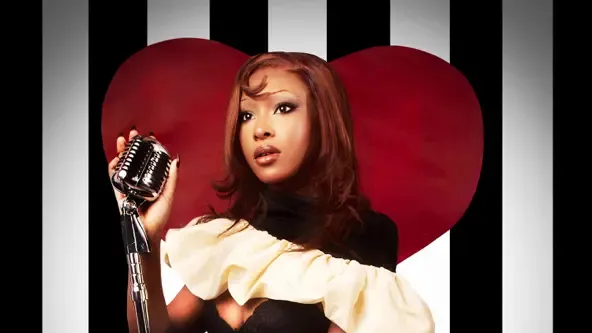
The New Era of Pop and RnB is here – and it’s British
Defining an artist is easy. ‘A person talented in the art of music,’ the Oxford English Dictionary tells me. Yet there is an irony in that definition. The tacit implication of an immutable confinement to convention, telling you exactly what you are and how to be it—a strain on musical culture that I’ve only seen worsen this decade, in a landscape dominated by nostalgia and temporal stasis. Personally, I believe the only way to combat this is to call on the return of the artist in modern music, only this time defined on their own terms. Where am I placing my bets, you ask? On our own rising star from the UK—Natanya.
Released in 2025, Natanya’s EP ‘Feline’s Return’ reflects a plethora of historical visual inspiration. Taking inspiration from Old Hollywood, the Georgian era, and the gothic surrealism of Tim Burton’s cinematic oeuvre, ‘embracing boldness’ appears to be Natanya’s key tenet. Maximalist visuals in the spirit of 2016 have quickly dominated the trends this year—see the success of PinkPantheress’s ‘Stateside’ and Zara Larsson as examples—but what makes Natanya distinct is her engagement with her inspiration. She doesn’t simply market herself with cultural buzzwords that risk fading into irrelevance within a lunar cycle; instead, she places an emphasis on herself and her own individual motion. Describing the direction of ‘Feline’s Return’, Natanya is adamant on encapsulating that sentiment of cat-like self-sufficiency to insist upon herself while remaining ‘an outlier’. Indeed, another artist engaging in ‘hair theory’, the signature swirl on her forehead combined with a sleek elongated eye look defines her ‘feline’ era, granting her a distinct appearance amongst an industry that has codified visual homogeneity via the Y2K aesthetic.
Part of what makes Natanya so successful is indeed her investment into her own visual style—an art that has been in decline over the past decade. Looking back to the ‘80s, it was Janet Jackson who solidified the music video as more than just an emerging form of promotion with her album Rhythm Nation 1814. Reflecting the political overtones of her conceptual album, music videos like ‘Rhythm Nation’ and ‘Alright’ both served to express Janet Jackson’s impressive choreography and exist as a visual expression of narrative. The music video remained an integral part of creation in pop music, paving the way for the ‘Single Ladies’ and the ‘…Baby One More Time’s of the early to mid-2000s. Yet, due to the socioeconomic disruption of the pandemic, as well as a shift within the music industry to prioritise social media engagement, it’s hard not to notice music videos becoming more of a side-dish rather than the main feature of modern albums. Natanya marks a shift in this respect, with the majority of her 11-track EP receiving an official video or visualiser, each with their own voice. The video for ‘Meeting You Once (The End)’ evokes the simplicity of Michael Jackson’s ‘Rock With You’, while ‘Daydream’ brings a genre-bending blend of R&B and early 2000s indie rock, both becoming an unalienable component of her music. However distant from the commodified micro-aesthetics of the 2020s so far, there is a level of consistency in that relationship between visual and aural that allows it to define itself as truly ‘Natanya’.
Beyond her visual style though Natanya shows intention and substance behind her aesthetic. Taking comparisons to her sonic inspirations—from Amy Winehouse to Tyler, The Creator—in her stride, ‘Feline’s Return’ manages to capture an array of sounds that struggles to be defined by the conventional standards of the industry. An inseparable part of Natanya’s genius is her deep involvement in her craft. Trained in both classical and jazz piano, she writes, sings, and produces her own music in a landscape where female music producers see little exposure. Of course, there’s no shame in not being a producer or instrumentalist. Michael Jackson, the literal King of Pop, was never fluent in an instrument. Yet, what made him different was his deep involvement in the creative method of music creation. Being a perfectionist is arguably what the industry needs if we want more artists that feel unique. Creative control means individuality and rebellion against a cultural landscape that has propagated a ‘fast fashion’ approach to success. In the long term, it creates artists prepared to last, shaping the space they’re in rather than rushing to conform to it. Rest is resistance.
The demand for something different is here, and it is repeatedly Black British artists that pioneer ingenuity in both the musical and cultural space. However, whether the UK industry itself is willing to take a chance on these artists is another question. Take for instance growing artist Odeal, who imbues soulful RnB with afrobeat influence. While receiving 2 MOBO awards for ‘Best R&B/Soul Act’ and ‘Best Newcomer’ in 2025, the artist was snubbed for a nomination at this year’s BRIT Awards, a topic of controversy amongst many fans. Signing with American record label LVRN, time and time again, it is the US that is bringing Black British artists the momentum they need to succeed. It underscores a valid concern in the nationwide music scene—is their success predicated on expatriation?
That the UK has a shortage of successful R&B acts is a myth—the industry simply remains ignorant of their talent. It was only in 2024 that the ‘Best Pop/R&B Act’ category for the BRIT Awards was split into ‘British Pop Act’ and ‘British R&B Act’, a silent recognition of the fact that R&B artists, which are undeniably overrepresented by Black Britons, faced unfair competition in nominations. But, therein lies the double-edged sword: the reality of being boxed into the R&B category on account of race. I can only hope to see more progress in that space, already being led by 2026 BRIT nominee Jim Legxacy who, with his album fittingly titled ‘Black British Music’, takes it upon himself to redefine what a Black Artist can make—from Emo rap to Indie Pop. The hope is there. All it needs is exposure.
Only time will tell if Natanya’s ambition will lead to decade-defining success, but, until then, she’ll stand as an example of resistance in a world of cultural stagnation, and one that I think the UK should prize dearly.
Words by Mya Sidhu
You may also like
Shadow Ticket by Thomas Pynchon: A Review
Thomas Pynchon’s history is flat. If anything, historians tend to think the periods of history the

The Allure of Black-and-White Cinema: A Recent Resurgence
Can embracing technological limitations bring us closer to our objectives in making art? Is engaging
Contribute to The ISIS!
The ISIS Magazine is calling for submissions for next term’s issue! Send your pitches to isise