

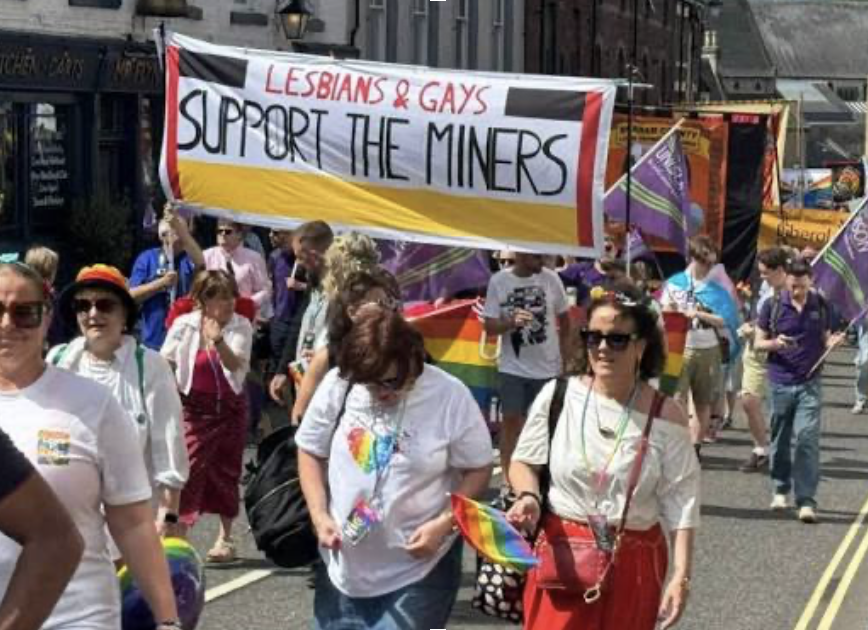
re: power in pride
The increasingly rapid march of Reform UK across the country’s councils has been impossible to ignore. From the David Brent-like monologues of George Finch to the more sinister figures who have emerged from the woodwork over the past few years through the party, Reform has produced a motley crew of characters as they sweep into power across the country. They are epitomised in Rupert Lowe and Zia Yusuf who take great delight in appearing as the nodding dogs behind their leader, promising some impossibly vile attack on a minority group, some warmed up Thatcherism, or faux-populist posturing. Notwithstanding their national prospects and the new challenge of Restore UK, they are the UK’s premier right-wing political group, defining and stretching the boundaries of what constitutes acceptable debate.
In Durham, where Reform swept to power last year by winning 57 out of the 98 available seats, one of the first acts of the new county council administration was to forbid the flying of the Pride flag. Darren Grimes, former right-wing talking head-turned Deputy Leader of Reform’s new county council administration, promised that Durham Pride would not receive “one penny” of taxpayer funding. This hostility to the flying of the Pride banner over county council buildings is a curiously un-British phenomenon, given that the traditional grounds for complaint of British and European populists were immigration, Europe, and vague senses of modernity. Hostility to homosexuality and to the broader LGBTQ+ community was an element of the Christian right in Britain in the 1980s and 1990s but has since gone out of style. Section 28, which forbade “intentionally promoting homosexuality” as an acceptable lifestyle in schools, was enacted in 1988 by the Thatcher government, whose backbenchers often chomped for a return to woolily-defined ‘family values’ of Christianity, the nuclear family, a mythologised parish community, and class collaboration.
These backbenchers existed in a world detached from the society of the 1980s and 1990s, as do Reform’s modern day Thatcherites. As the mines were speedily closed, industries shuttered by high interest rates and foreign competition and workers left to sit on the dole as society grew increasingly atomised, all those values they claimed to be working towards, as embodied in the relatively stable environments produced through trade union leadership, were being undone. Yet the workers, much like the LGBTQ+ community, did not go quietly into that good night. As has since been memorialised in books, film and TV, coal miners striking in south Wales and the north of England entered into tempestuous yet effective collaboration with gay rights campaigners, uniting those of different material and political interest in their campaigns against the common enemy of a New Right government. The neoliberal economic programme promised nothing but poverty and indignity to those workers whose jobs were on the line, and whose neoconservatism proffered little more than annihilation or exclusion for the workers of the country.
That tradition of cross-sectional collaboration was restored when Durham County Council, under the leadership of Reform UK, attempted to cancel Durham’s Pride parade this year by pulling all council funding. The chair of the Durham Miners’ Association, Stephen Guy, intervened when he discovered that the council had withdrawn its £2,500 of funding, attempting to, “encourage the trade union movement to step up […] and stand shoulder to shoulder with the LGBT+ community,” for their solidarity and support when striking against government policy. The attention Reform UK’s move drew ended up producing ten times the funding withdrawn by the council, with Equity, ASLEF, Unite, the CWU, the NUM, and NASUWT all contributing to the fund which has since reached over £25,000 and whose parade drew the attendance of the local Labour MP, Mary Kelly Foy, helping to lead opposition to the council’s actions. In return, the local LGBTQ+ community will attend the 140th Annual Durham Miner’s gala.
But the case of Durham, whilst ultimately successful in preventing the reactionaries in control of the council from trampling on fifty years of hard-earned progress, is only one case. With how weakened trade unions are now compared to their heyday in the 1960s and 1970s, the TUC and its constituent unions can only do so much to prevent Reform UK’s tide of Americana-type Christian conservatism from doing away with the legacies of so many campaigners, who gave so much for the basic right to be seen and included as individuals and as a community. The threat of Reform UK and all it represents is so great as to require a modern day united front of the working and middle classes, the trade unions, campaign and activist groups, and the political left. Theirs is not the bland, mundane cronyism and unambitious defensive politics of the Conservatives; it is a fundamental attempt to hack away at this country’s decently minded, compassionate spirit, to transplant it with some rotten, crypto-bro backed interpretation of British history that cares nothing for the people that live on these islands beyond the pursuit of power. Prevarication and individual disagreements cannot be allowed to condemn the LGBTQ+ community back to the shadows as the working classes are mercilessly exploited. Together, the threat of Reform UK can be thrown back; without collaboration, there can only be defeat.
Words by Arun Lewis
You may also like
Berlin, open city
In military terms, an open city is a city that has abandoned all fortifying efforts. Once a c

Television Loving Care
“In every generation there is a chosen one. She alone will stand against the vampires, the demon

Orla Wyatt’s A+E is incredible
You’ve not really been to uni until you’ve sat overnight, squirming and overheated, on the J