

Under Review: Scenes with Girls
‘“All that time, all that time, I thought I was missing Jude.” And the loss pressed down on her chest and came up into her throat. “We was girls together,” she said as though explaining something.’
— Sula, Toni Morrison (1973)
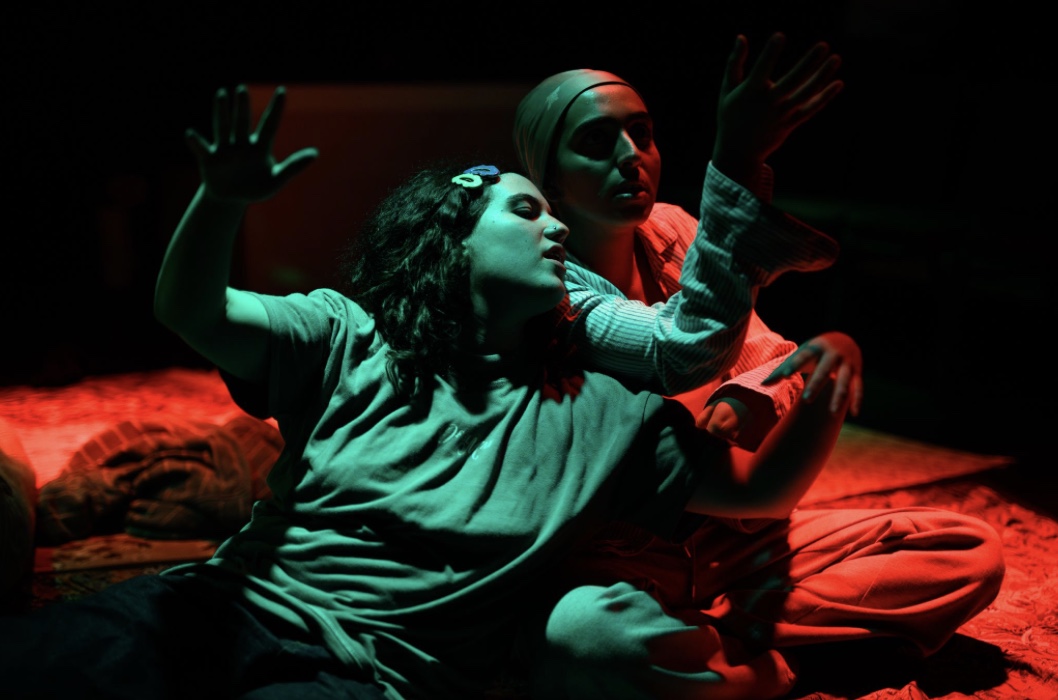
Co-produced by Labyrinth Productions and Full Moon Theatre, Miriam Battye’s Scenes with Girls comes to life at the Burton Taylor (BT). The entire theatre has been converted into a 20-something’s flat—boy-band posters on the walls, an incoherent cluster of carpets on the floor, a clothing rack chock-full of oversized shirts. One corner has even been transformed into a true-to-size bathroom, lined with teal tiles and more hair products than could ever be necessary. As the audience continue to file in, find their seats, and chat to each other, Lou (Sanaa Pasha) and Tosh (Juliet Taub) sprawl on beanbags centre-stage, scrolling on their phones and playing footsie. Soon afterwards, they get up and perform the Just Dance choreography to One Direction’s ‘What Makes You Beautiful’. Throughout the pre-show sequence, it’s difficult to gauge whether the girls are already in character or simply enjoying one another’s presence as real-life friends. But then again, the same question can be asked of us: are we there as spectators, aware of the distance between ourselves and the narrative of the play, or have we become pseudo-roommates by stepping foot in the BT?
The sequence of 22 scenes that make up the play interrogate these ideas of closeness and intimacy, and the value we place on certain relationships over others. The show opens in medias res with Lou talking about the various men with whom she has recently had sex. She refers to them only as numbers, not talking about them so much as through them, expressing the insights that the experience of sleeping with them provided for her. The girls riff on each other’s words endlessly, a Bluetooth connection allowing them to anticipate a thought before the other has verbalised it. The first couple of scenes follow the same model, with the lights going off and a few seconds of generic bass playing in between to allow the actors to rearrange themselves. An emerging power dynamic soon becomes clear—it feels as though Tosh’s presence is only meaningful to Lou insofar as it affirms that she is actually beyond the patriarchal “narrative” that so many other girls have fallen victim to. She is allowed to have bad sex with bad men as long as Tosh knows that she only thinks of them as another tally mark. Yet, it’s the only thing she can talk about. Tosh gets progressively more fed up with being used as a sounding board, occasionally bursting Lou’s bubble by asking if they can talk about “anything other than cock”. Her reign over their dynamic is short-lived, as she soon starts compulsively apologising and allows Lou to fall back into the same pattern.
The crack in their relationship is only deepened by the entrance of Fran (Georgina Cooper).
She is everything Lou and Tosh have sworn themselves not to be. It is implied that Fran used to live with Lou until she moved in with her boyfriend, who is continually referred to by all the characters as either ‘boy’ or ‘thingy’. Despite the fact that they see her frequently, the two girls treat Fran like she could not be farther away from them. They love her, but… she is “addicted to the narrative”, she will never do anything interesting with her life, she is boring, boring, boring. None of this is reflected in what they say to her face. They’re perfectly happy to placate her as she shyly admits that she and ‘thingy’ do fight sometimes and that she is anxious about not being enough for him—or him not being enough for her. At the end of her first scene, Fran finally admits to the girls that she and ‘thingy’ are engaged, to which they respond with a resounding series of empty congratulations: “How wonderful! How exciting! How great!”
After Fran leaves, Lou throws a tantrum, reasserting Fran’s nothing-ness and her disbelief that she’s the one getting married. Lou could fuck him—this boy whose name she doesn’t care to learn—in an infinitely more interesting way than Fran ever could. The audience joins Tosh in her shock and dawning realisation that Lou is perhaps at the point of no return. Later, in an argument that culminates in Tosh moving out, she asks Lou, “why do you always need a witness?” Even after she leaves (a detail which struck me was that Fran refers to Tosh as “thingy” once she’s exited the stage, and consequently Lou’s life), that question lingers. We are still watching, and for the duration of the play, Lou can’t walk away. She depends on us as witnesses as much as we depend on her to take us to the end of the story.
All three members of the cast are masters at balancing the subtle and the outrageous, and this script allows them to showcase every dimension of their capabilities. Pasha’s performance was particularly impressive—when Taub and Cooper are on stage, she manages to contain the range of emotions she’s experiencing in just her eyes, finally breaking down into tears and curling up on the floor once left alone. Rosie Morgan-Males’ direction is simple yet immensely effective. The tight space of the BT is made even smaller by the fact that the audience wraps around three sides of the stage. Due to our proximity, we’re interpolated into the setting and the story as a result, like pieces of furniture and trinkets strewn around their flat. Tosh and Lou are on stage for almost the entirety of the play, and to leave Tosh is forced to walk out of the room entirely. As onlookers, we feel as though we are physically participating in the complicated relationship between the three women, and we experience the loss of Tosh just as viscerally as Lou does.
The fact that Tosh leaves her for a boy forces Lou to confront the importance she has placed on men for the duration of their friendship. At the end of the play, all three girls find themselves liberated from the “narrative”: Tosh moves back in, having realised she was only “playing the role of ‘girlfriend’” very convincingly, and Fran breaks off her engagement with… Tristan, who can now be named given he is of no importance anymore. The pre-show ease between Tosh and Lou returns, and the show comes to a close with the girls tangled together on their beanbags. This time, though, they don’t speak. They share a cheese sandwich and Tosh gives Lou the crust of her bread, their Bluetooth-sync reemerging. But has anything really changed, except the boys that have come and gone? All we know of Tosh and Lou’s relationship is the breaking point, and it’s difficult to see beyond it. Ultimately, Scenes with Girls forces usto question the narratives that govern our relationships—but perhaps more importantly, it made me reflect on how I talk to my girlfriends, or rather, how I listen to them.
Words by Rüya Oral. Image by Freddie Houlahan
You may also like
PRESSURE POINT: Beware the new theocrats
Theocracy has a new frontman in Ahmed al-Sharaa. The overthrow of longstanding dictator Bashar al-As

Futile Reflections
“If I write what I feel, it’s to reduce the fever of feeling. What I confess is unimportant, bec
The Resistable Rise of Arturo Ui: a study in unnecessary subversion
Being funny is harder than most people think. Being funny on stage is even harder. And being funny i