

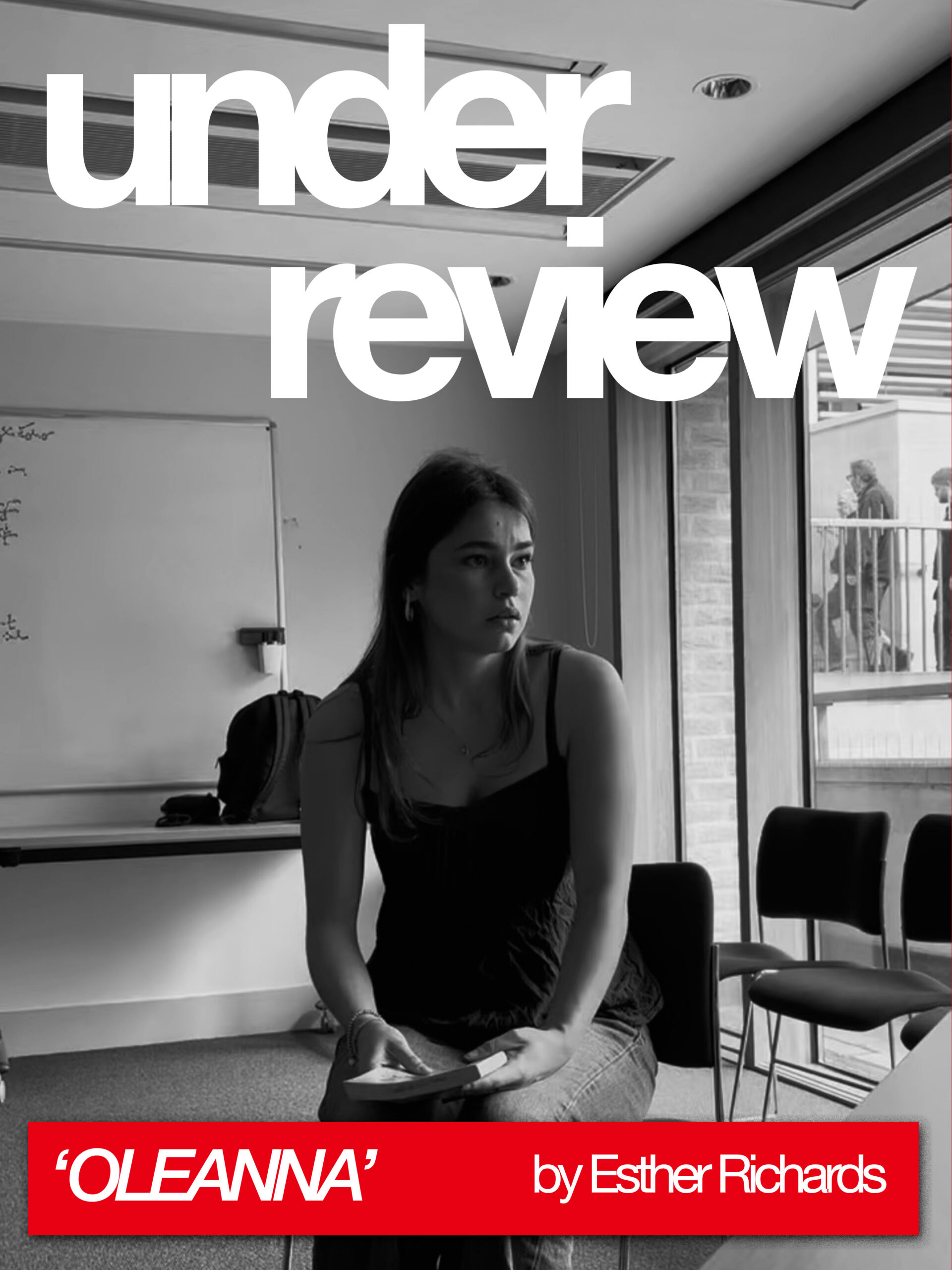
Under Review: Oleanna
While linguist Robin Lackoff claims that men in academia are a group which has “taken itself out of the search for power and money”, the intersection between education, elitism, status, and masculinity is writ large in Boulevard Productions’ excellent new adaptation of David Mamet’s Oleanna, directed by Charlie Lewis and starring Laura Boyd as Carol and Alec Greene as John. Charlie describes Oleanna as an “explanation of what power and privilege mean in an educational setting”. The play depicts the battle of wits between John, a middle-aged professor at an unnamed American university, and his student, Carol, all taking place within the confines of John’s office. Although John’s motivations behind his private meetings with Carol at first seem well-intentioned, their relationship soon takes on a predatory and exploitative tone, culminating in a shocking outburst of violence at the end of the third act.
Oleanna’s exploration of gendered power dynamics, consent, and political correctness has clear relevance today, especially in Oxford. The play is being staged in The Long Room in New College, a uniquely resonant setting given the recent allegations of sexual misconduct against a former fellow of the college, Professor Miles Hewstone, and the information which has come to light about how these allegations were handled by the college’s administration. In light of this, it would have been a logical directorial choice to set Oleanna not in America, but in Oxford or a similar British university. However, Lewis resists this urge and retains the original setting of the play—in my opinion, very wisely so. He explains this decision as being partially due to the fact that Mamet’s signature choppy and naturalistic dialogue loses some of its rhythm when spoken with a British accent, but the fundamentally American essence of the play runs beyond just the syntax of the text.
There are certainly parallels between the classist, hyper-masculine hierarchy that is present in John’s office and the dynamics that can sometimes come to the forefront in an Oxford tutorial. Boyd says that one of the things which drew her to the role of Carol was the character’s frustration at her inability to access the pretentious, academic verbiage used by John as she comes from a lower socio-economic background than most other students, a feeling that many Oxford students can surely relate to. Yet, aspects of the sheer status held by men in academia, which is explored through John and Carol’s relationship, perhaps does not translate so smoothly to an English setting. While an Oxford education still carries great social and class currency, this is complicated by the English tendency to view established systems of authority—including prestigious universities and the people who uphold them—with mockery and disdain. This, in some ways, contradicts the completely earnest individualism at the heart of American higher education, which is riddled with nepotism, bribery, and desire for illimited personal achievement at all costs. The concept of John’s imminent and lucrative “tenure”, honouring his academic achievement and permanently securing not only his position in the university, but the future of his family, seems fairly alien to an audience in the UK where the salaries of academics are decreasing by the minute.
While Oleanna’s American setting perhaps does not need any adaptation, many modern critics think that the play’s attitude towards allegations of sexual harassment and the women who bring them forth must be rethought for the modern day. When Oleanna was first performed in 1992, the audience’s reaction towards Carol was incredibly vitriolic, as she was viewed as a deceitful and vindictive woman who chose to ruin an innocent man’s life out of sheer spite. When asked about whether a reinterpretation of the script is necessary for a post-#MeToo world, the cast and director said that, although they sought to “shift the balance” by giving more credence to Carol’s perspective, it is not the play’s text that needs to be altered. Mamet’s stage directions are extremely sparse, leaving the severity of John’s physical transgressions and eventual violence up to the director’s interpretation. Right up until the play’s violent conclusion, much of John’s behaviour towards Carol sits within a grey area; it seems highly inappropriate and predatory and is interpreted as such by Carol, but it doesn’t necessarily fit into the legal understanding of sexual abuse. It would have been easy to artificially exaggerate the extent of the harassment in the play to force increased audience sympathy towards Carol, but here a much subtler approach is taken. This production is not afraid to explore the uncomfortable ambiguity of John’s motivations in the “difference between intention and reception” in a way that is nuanced and sensitive, yet does not seek to undermine the severity of his breach of appropriate professional conduct or excuse his exploitative behaviour.
This is achieved through Boyd and Greene’s impressive performances, and Charlie’s stripped-back yet extremely thoughtful staging. While Greene noted that the generational divide between Carol and John may not fully come across given that the two actors are the same age, the imbalance in power between the two characters is portrayed with extraordinary force. Even though I only saw a full run-through without any of the props or setting pieces (apart from a few chairs) and without the most appalling scene of violence, the hierarchy at play came across perfectly in the difference in the two actors’ body language and use of their voices, with Greene’s masculine bravado contrasting Boyd’s charged nervousness. The subtlety with which Greene shows how John exerts his sexual power and physicality over Carol—the way he ‘manspreads’, as instructed by the director, puts his arm around the back of the sofa when he is sitting next to Carol without touching her, leans in to her when talking, or the way he pulls out a chair and ushers her to sit down while he tells a sexual anecdote—shows the extent of the director and cast’s thoughtfulness in every gesture and inflection. Boyd’s portrayal of Carol is equally excellent. She states her intention not to shy away from Carol’s flaws as a character, but try to “find the reason in these unreasonable actions”. She also says that it “wouldn’t occur to me” to play Carol as an entirely unsympathetic character, and her moving performance is certain to evoke empathy in the audience.
Charlie rightly describes Mamet’s Oleanna as ”theatre of provocation”. It is by no means an easy or relaxing watch, but it is an extremely gripping one which will stick with you after the performance has ended. The play will run in the New College Long Room until Saturday of 1st Week, and I would highly recommend for everyone to go and see it.
Words by Esther Richards. Graphic by Ben Adams
You may also like

“Stop right now, if you can”: Interview with Clive James
Clive James is an Australian critic, poet, novelist and memoirist, best known for his television rev


PRESSURE POINT – JD Vance: America’s unlikely heartthrob?
Last week I came across a Substack article entitled “Women Across America Just fell in Love