

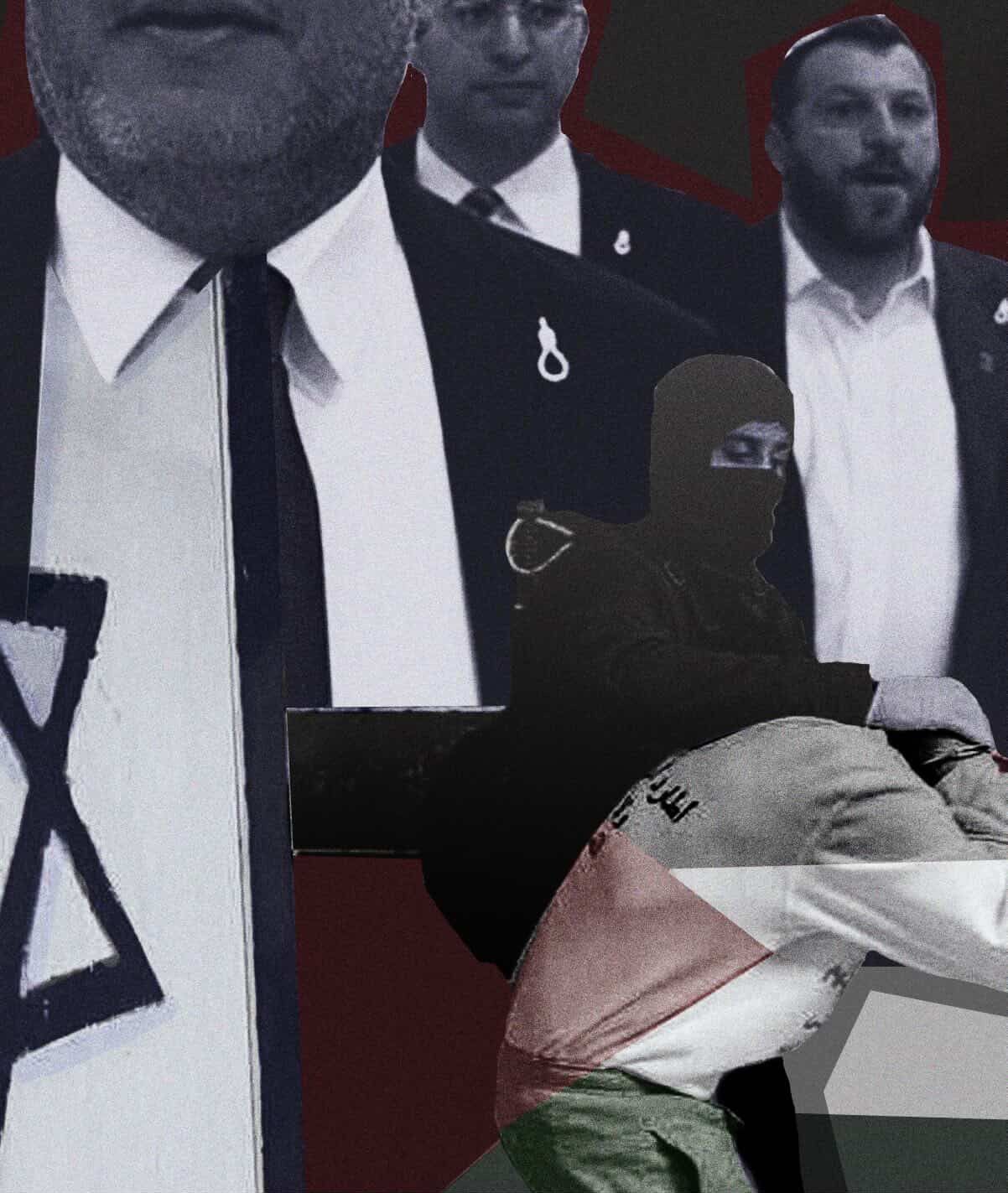
re: The death penalty in Israel
On March 30, the Israeli Knesset passed a law that expanded the use of capital punishment in its justice system.
The bones of the system look like this:
- In the civil court system, the death penalty can now be applied to any individual who acts with the intent of ‘negating the existence of the State of Israel’.
- For those tried in the military courts (Palestinians, never Israelis*), however, the death penalty can now be applied to anyone convicted of acts of terrorism without ‘prosecutorial request’—the courts can impose the death penalty automatically.
- There is no appeals process for those sentenced to death, and executions must be carried out within 90 days of conviction.
- Those convicted have restricted access to legal counsel and visits from family members
I do not intend for this article to be a source of legal information. The bill is available for all to read and I urge you to listen to the voices of the Palestinians who have lived, and will continue to, live under this system. The news cycle is fleeting, the coverage on this topic even more so, but this reform to capital punishment warrants scrutiny in a state where only two executions have taken place.
The concept of capital punishment remains controversial—its ethics and practice are consistently debated globally, and it has time and again proven to be a faulty and misdirected response to crime. What about, then, a system of capital punishment where case-by-case analysis is removed, the convicted person is dead within three months of sentencing, and legal analysis is isolated to the prosecutor at the original sentencing?
The Knesset has legislated to turn killing into an automated process.
I say that definitively. While coverage of the bill from news outlets, the Israeli courts and international bodies leave space to equivocate on what may come of this, this bill has been passed into a system shaped by one-sided persecution—in this context, the trajectory is clear.
The context of the legal system:
- It is inherently two-tiered. In the occupied West Bank, only Palestinians are governed in the military courts, while their Israeli counterparts are tried only in civilian courts.
- The military court system has jurisdiction over 1) ‘security offenses’ and 2) any act judged to be a threat to public order. Vague boundaries, meaning civilians can be convicted, under the premise of being a threat to national security, for as little as traffic violations (which make up 40% of all indictments in the military courts).
- In the military court system, all roles are carried out by the Israeli Defense Forces. The police, the panel of judges, the prosecutor. I leave it to you, reader, to decide whether a system in which this much conflict of interest could ever be an impartial and neutral arbitrator of justice.
- Disproportionate surveillance and police brutality have meant that, as of April 2026, some reports estimate there are close to 10,000 Palestinians in Israeli custody, a statistic which has doubled in the last three years1, showing a clear widespread wave of aggression across any and all land inhabited by Palestinians since the war in Gaza began.
- In the military court system, conviction rates currently lie at 96%2 (estimated to go up to 99% in some years). Not the symptom of a thorough judicial system, but the result of plea deals elicited in prisons that have been described as a ‘network of torture camps’. 84 Palestinians have been killed in Israeli prisons since October 2023 3.
Does any of the above information seem like that of a system that uses the courts to rehabilitate? Or even to discipline? Increased police aggression and arrests in the West Bank since October 7th show what we already know—the state of Israel operates under a clear apartheid of Palestinian and Israeli, reserving cruelty solely, and indiscriminately, for the Palestinian population. Perhaps now, we can understand why the death penalty is, as Mariam Barghouti says ‘the institutionalisation of a practice well under way’.
النَّكْبَة or Nakba is the term used by Palestinians to describe the events of 1948, following the UN-mandated partition of Palestine. What ensued was brutal—forced displacement, a cultural and physical erasure of Palestinians from their land. It was the first of many widespread campaigns of violence, but what has persisted in Palestine remains a bureaucratic evil, one in which the erasure of Palestinians is legislated into action, and occurs through militarised policing and arbitrary punishment. This continuing permeation of violence into every aspect of the lives of Palestinian men, women, children is a violent dispossession—visible ‘in the endless grind of colonisation, in mundane everyday routines, and in the ghosts that haunt our domestic lives’ as Tareq Baconi writes in his analysis of the Nakba.
The state of Israel is often accused of apartheid. And yet, a state of apartheid is different to a state of ethnic cleansing. In Gaza, health authorities estimate a death toll of 72,5494 from the direct bombardments of the I.D.F alone. A U.N. report in October 2025 counted 1001 deaths in the Occupied Palestinian Territories5. There is no scope for equal governance under Israel’s two-tiered system. I suppose mine is one of many voices trying to express a shock, shame, and disgust at the passing of this bill, where international law has become, at best, a witness and, in reality, a perpetrator of this genocide.
A state of apartheid has become a state of catastrophe, you must know that the Nakba never ended.
Naima Aden
Artwork by Ediz Atilla Ozer
References:
- https://www.aljazeera.com/news/2026/1/20/israeli-prisons-are-akin-to-torture-camps-israeli-rights-group-finds
- https://www.btselem.org/press_releases/20260330_israel_turning_execution_of_palestinians_into_official_state_policy
- https://addameer.ps/statistics
- https://app.powerbi.com/view?r=eyJrIjoiODAxNTYzMDYtMjQ3YS00OTMzLTkxMWQtOTU1NWEwMzE5NTMwIiwidCI6ImY2MTBjMGI3LWJkMjQtNGIzOS04MTBiLTNkYzI4MGFmYjU5MCIsImMiOjh9
- https://www.un.org/unispal/wp-content/uploads/2025/10/WB_Public-Statement-202510171135-compressed.pdf
You may also like


British Bombs: The Rise of Declan McKenna
Sitting in silence on a Zoom call with a group of strangers and waiting for Declan McKenna to

Think of the Children
“The mechanisms of moral panic…lead to the emergence of an imaginary solution – in tougher