

The right to assume
Amongst my friends, and definitely amongst people I do not gel with, I am a notorious party-pooper. I take pride in being annoying, and I have no problem shutting down jokes by chiming in with a grating, ‘am I the only one who doesn’t find that funny?’ whenever I deem it necessary.
In short, I am that one friend who is too woke. In the people-I-do-not-gel-with camp, I am sure many would deem this an inevitable defect of my identity; I feel no need to disagree. It is easier to be loud and proud about your woke-ness when that woke-ness is what your rights, your ability to enjoy certain freedoms, and pretty much your entire existence hinges on. Even those who do not consider themselves marginalised could not be so ignorant as to not recognise that they live in a moment where, if not themselves, their neighbours are under the attack of authorities and being forced to fend for themselves.
Whilst the real world is overwhelmingly vicious, growing up queer in the internet age has had its perks. It is easier now than ever to find community, especially thanks to the emergence of specialised online spaces based around representations of queer people in film, music, and other cultural mediums. People who are hindered from expressing themselves freely in their real lives can easily post a Heated Rivalry edit on Instagram and watch thousands flock to them like moths to a flame. Speaking from experience, watching successful, beautiful women kiss other successful, beautiful women on YouTube was more bang than a 12-year-old me ever thought she would get for her buck—even today I find that seeing celebrities be celebrated when they come out rather than blacklisted is valuable. But recently, I’ve noticed a trend of pseudo-intellectual think-pieces being posted on social media, often in response to members of these predominantly queer online communities, claiming that if you dare infer on-screen boy-kisser Hudson Williams might like kissing boys in his free time, you’re the devil incarnate.
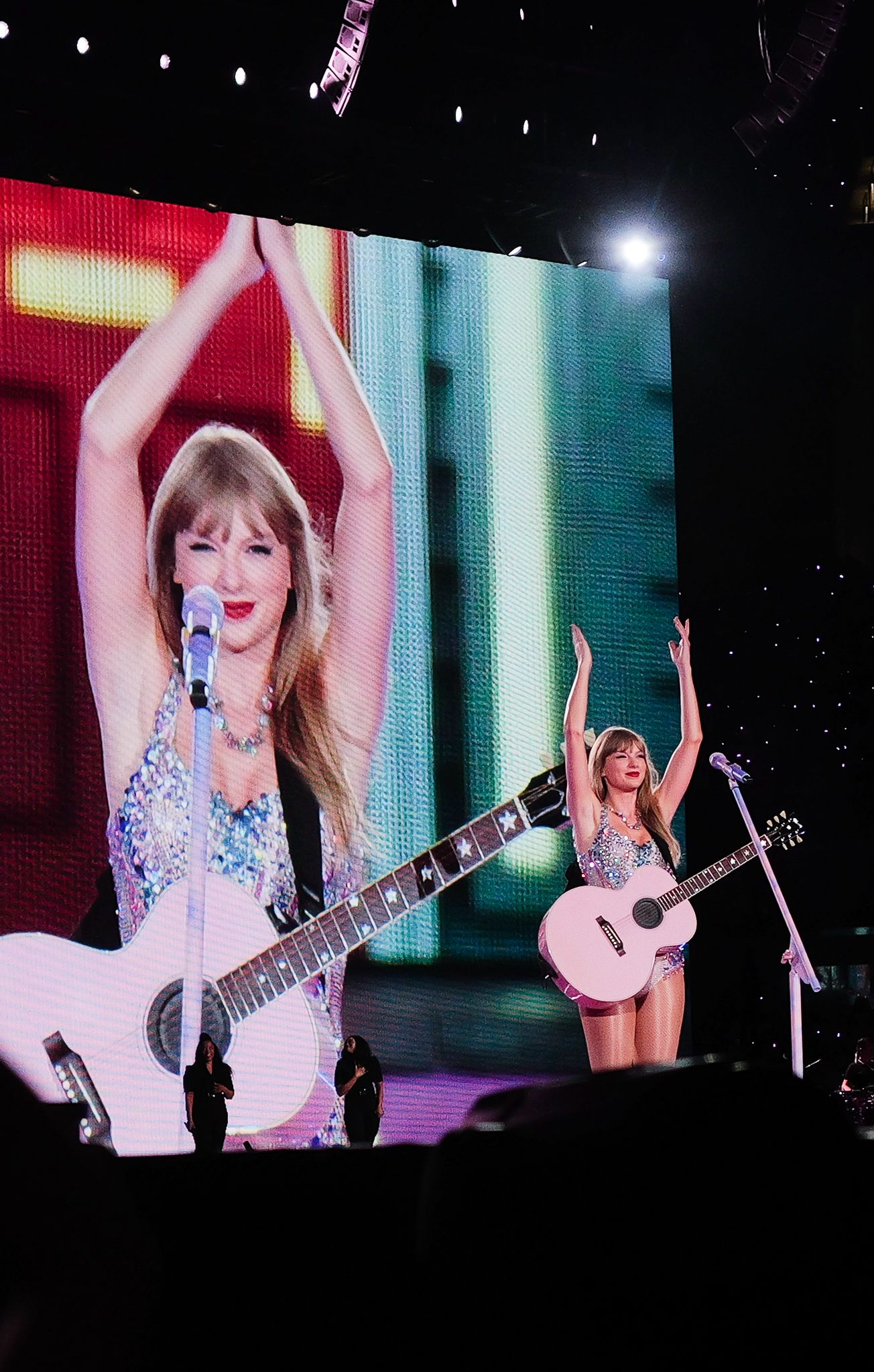
So, this is my friend-who’s-too-woke manifesto: making people feel bad about assuming that a celebrity is gay doesn’t make you a good ally, actually. This discourse arises directly from the inability of audiences to reconcile the attested fact that celebrities are people with what holds equal truth: celebrities are brands. Though she is far from the only celebrity to be questioned about their sexuality, Taylor Swift is a particularly interesting case study because she is someone who has built her entire brand off of being as personable and relatable as possible. In the past, I have had conversations with my parents where they’ve questioned who the Michael Jackson or Madonna of our day is, and it sometimes confuses me as much as it does them to say that, in terms of popularity and worldwide renown, it’s probably girl-next-door Taylor Allison. She owes her vast musical empire almost completely to twenty years of allowing listeners to believe that they are essentially reading her diary when they stream her songs. Her celebrity persona invites fans to enter into a parasocial relationship with her. This is tangible both in the content of her music—the ‘vulnerable’ aspects of herself, her career, and her relationships that she details in her songs—but also in the strategic way she personalises her releases. The whole ‘Taylor’s Version’ project is built on the idea that your good friend Taytay has been cheated out of her life’s work by the big bad company and it is the least you, as her good friend, can do is to listen to watered down editions of decades-old songs with the fervour of a new release. When you tune into a track, ‘From the Vault,’ how could you not feel like you are being let in on a secret, as a trusted member of Taylor’s circle?
As a fan, it is not unnatural to start finding aspects of Taylor’s carefully crafted personal life to compare to your own. The ‘Gaylor conspiracy theory’, as the Wikipedia page dedicated to the phenomenon aptly calls it, emerged not as a smear campaign, but, to my belief, as a result of Swift’s own marketing tactics. On the aforementioned Wikipedia page, there is a paragraph dedicated to Swift’s use of easter eggs, and how she has ‘trained’ her fans to look for hidden meanings in everything she does.’ This is what led fans to conclude that the song ‘Wonderland’ off of her 2014 album 1989 was about Glee actress and Swift’s estranged friend Dianna Agron, for example; Agron had an Alice in Wonderland related tattoo that she had removed following the release of the album. For a young, impressionable Swiftie—a category most of her fanbase fits—thinking that your idol has sent you on a treasure hunt to discretely tell you that she is just like you must be uniquely validating experience. It is not altogether unlike QAnon phenomenology, where followers endlessly follow breadcrumb trails that lead nowhere at the behest of an elevated leader. The process becomes learned and almost intellectualised, though in the case of Swifties, much more sympathetic. It would be on brand for Taylor to have something she can’t tell you in so many words, right?
Personally, I think it unlikely that Swift is queer, but I see little issue with believing that she is. Even considering her recent engagement to football star Travis Kelce, she could easily be bisexual. Hell, she could be a lesbian majorly in denial, swinging in the complete opposite direction to make up for it. If, come tomorrow, she released a video of her saying ‘I’M STRAIGHT, LEAVE ME ALONE!’ and proceeded to delete all of her social media, I would still be inclined to have more sympathy for those scoffing and calling it a PR stunt than for her. The point is, Taylor Swift doesn’t owe anyone queerness, but she does owe them tolerance for thinking she could be. After tormenting us with ‘You Need to Calm Down’ for the past 7 years, it’s the least she could do.
I recognise that there are instances where these kinds of assumptions can have negative outcomes for the celebrity they’re associated with. The most cited example of this is when Heartstopper star Kit Connor was forced to come out as bisexual after persistent harassment from fans of the show. I sympathise with Connor, primarily because he is very young and has nowhere near the fame nor the resulting protection that Swift does. But this is a scenario that often gets misconstrued as a lesson in minding your own business and that nobody owes you anything, rather than one in how toxic celebrity culture can be for all parties involved. It seems ridiculous to me that Connor, whose breakout role was a bisexual teenager in a story centred around queer relationships, was discomfitted by people perceiving him as queer. I also do not believe that coming out was to the detriment of his career.
Connor addressed the situation on X (formerly Twitter) in 2022, saying that he was being forced to “out himself” and that those who had pushed him to do it had “missed the point of the show.” He added that he found it strange that people can guess at someone’s sexuality based on their voice or appearance: “I feel like that’s a very interesting, slightly problematic, assumption to make.” But, like… is that what happened? Was anyone “outed”, if he himself chose to make a public announcement about it? Were the assumptions a result of Connor’s looks, or mainly because he was comfortable engaging in a gay romance on screen? Cut to the present day, Connor has starred in various critically acclaimed blockbusters, and in 2024 made his Broadway debut to much success. I am genuinely happy that he is able to both be, in his own words, “confident and comfortable” in his sexuality and also pursue his passions prosperously. I am sure he knows that not everyone, including a large portion of those curious about his sexuality, gets to be so lucky.
Ultimately, the moralising rhetoric of ‘you don’t owe anybody anything’ (the kind of language which appeared in the replies of Connor’s post) approaches human connection as transactional rather than relational. It presupposes that your identity has some kind of value attached to it that you must store in an offshore bank account until it’s worth enough to broker away. But the truth is, there has never been a time you have owed people things more! Namely: kindness, compassion, the benefit of the doubt. If you’re a celebrity, additionally: your money, your voice, your platform.
And if you are someone who actively profits off of queer culture, you damn well owe people the right to assume.
Words by Rüya Oral.
Photo by Paolo V. Free to use under the Creative Commons Attribution 2.0 Generic License.
You may also like

Oxford: a place for lovers?
What makes a city feel romantic? Oxford, certainly, looks the part: honey-coloured stone, lamplit an
Who cares about the Oscars, anyway?
Yesterday’s Oscars brought a shiny, glamorous conclusion to awards season. In the current politica

Invisible Illnesses
Beginning life at the University of Oxford as an international postgraduate is a momentous event and