

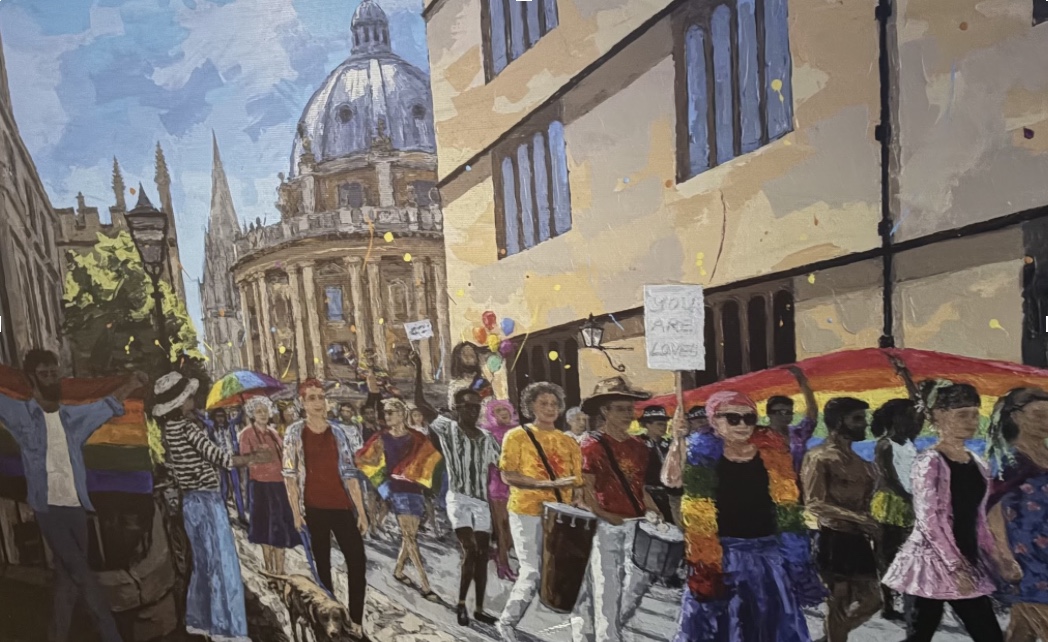
Coming In
‘Did you know he’s gay now?’
Now…? Ah, yes. Obviously in reference to that fateful day when he woke up, necessarily on the wrong side of the bed, walked into his dressing room and came out adorned in rainbow clobber head to toe. A changed man.
The ignorance of such a question is plain. Our friend here didn’t wake up one day and ‘decide’ to be gay; nor did he suddenly realise on a whim.
Some of the assumptions inherent in this invasive piece of gossip are also latent in what we’ve coined as ‘coming out’, or at least how we think about it. To come out suggests something linear, sudden, fixed. You’ve stepped from one place into another, better still stepped out of that dark closet, one foot after the other, and landed on firm ground in broad daylight. It is often assumed that to come out is to assert comfortability in your queerness, as though it were the final stage of security—much like marriage: a public declaration in the name of espousing who you love.
But this coming out is not so much an assertion of knowing your queerness as it is a continual trying it out (or trying it on, since you’ve spent so much time in the closet), for it is not clear what is being ‘stepped into.’ We’re familiar with the classic baby gay phase—recently ‘out’ and newly navigating a queer identity. But this has become a popular slang term for a reason. Coming out enables the freedom of visibility where we can openly try out and to figure out; to not know. How are you to act now the mask is lifted and you’re before an audience? Becoming visible allows us to try out different performances that suit us best; to emulate various queer stereotypes in the name of authentically imitating them, or not.
What’s more, coming out is continual. It works less through a singular, sudden moment than through renewal. There’s the first big episodes: telling your parents, your friends, your relatives that you see once a year. But then there’s work, and university, and new friends, and a different job. Coming out is inherently about externalising to another that which is within. But the point at which we might consider ourselves ‘fully out’, in spite of these renewed ‘tellings’, is the point at which that exterior—the knowledge that the world has of us—is transferred back as a comfortability within, where we do not need the world’s validation to be out to the world. At the point we are fully out, then, we are also most in; back to the same point of departure, albeit with a different posture.
But coming out is not just continual in the telling, it is continual in what we tell. Once disclosed, labels are taken as an immutable branding stamped onto our identity; they are received as if we are making a binding promise to the confidant. But labels are momentary, they are not contractual; they are for us, not others. If coming out is only the beginning of finding out your queerness, why should labels not be open to change in light of new experiences? With this in mind, coming out is necessarily non-linear for we retreat back into ourselves to better express ourselves. We come (back) out to the same people as before in a circular fashion. If labels appear to pose challenges when proving themselves unfixed, it seems that being ‘unlabelled’ is taken to task for the same reason. Coming out is associated with assertion, and yet to be unlabelled is to assert a lack of assertion: it occupies a position of queerness without being labelled as queer. It is both not to be in a label or subset, and yet still, in a sense, to have come out.
This shuttling between ‘in’ and ‘out’ is in fact what much of coming out is about. The desire to step into your community, to be part of that ‘in-group’. You are now openly part of a community, and you participate with that community in that you speak up and speak out. But you do not participate in that community, for the reluctance to be out of that heteronormative circle pulls at you. To maintain the performance that you fit the norm convinces you, at least partially, that you are in this circle. It is a false sense of security but a security nonetheless. And at the same time, that normative circle has pushed you out—there’s no room for the weird gay girl that stares at us while we change. So you find yourself on the periphery of what you were part of and want you want to be part of, neither totally out of nor totally in either of them, even though you have now come out.
So you might come out, but coming out does not mean that you are in. Coming out is not a decisive finality, it is a beginning.
Words by Maddy Wilson.
You may also like
Oxford’s Identity Politics and JCR BAME Officers: Effective in raising awareness, or an exploitation of ‘emotional labour’?
PART I: The Difficulties of Anti-Racism within the Framework of Oxford Bureaucracy The Junior Common

ISIS LAUNCH NIGHT: Thursday 7th week
Acoustic Launch night at Jericho Tavern

Un-innocence: Wuthering Heights (2026) reviewed
Contains spoilers for Wuthering Heights (2026) Emerald Fennell’s Wuthering Heights (2026) i