
25:00
25:00
We are told what we see is real. We are told not to question who arranged the seeing.
Here is an ordinary week. I wake to an alarm, optimise the hours, hit the deadlines, the achievements, and begin again. Short are our 8 week terms; fast is the pace. We are promised that this is what life is, and the promise is its own reward. Somewhere along the way you take it to be your own volition. The machine runs on, and it asks one thing of you—that you do not stop to ask what any of it is for.
The philosophers have a word for the world as we perceive it—phenomena. It is synthesised, assembled, delivered ready for us to consume. Those philosophers would also say that the world as it is—noumena—eludes us. The bad news, as Kant saw it, is that the gap between the two is unbridgeable. The worse news is that we have stopped caring. We have stopped minding. The lights are bright enough now that we no longer ask what they are hiding. The idea that our reality is synthesised, is woven for us to perceive, seems an abstract conception. Though it is not.
The synthesis is comforting, and comfort is the point. A perception need not to be true to feel true, and a feeling that runs true is enough to keep most from looking past it. A lullaby, it dulls the edges, rewards the incurious, and makes the unexamined life not merely bearable but pleasant. If we take the distinction to be true, it is clear that we are living through falsehoods. Trapped in perception. All is but phenomena—weaved in the instant, gone by the next. Reality becomes the synthesis of joy. It needs not be true, but to feel as though would be enough. So here is my proposal, and its name, the twenty-fifth hour. There is no such hour on the clock; that is the whole point of it. The clock runs to twenty-four and resets, and we mistake the reset for progress—each day new, each year an advance. The twenty-fifth hour is the vantage one step off the dial, from which the supposed forward-march reveals itself to be just a loop. Today is only yesterday seen again; tomorrow, only today. The eleventh hour is the frantic minute before midnight when we are most inside the clock and most afraid of it. The twenty-fifth hour stands outside the clock altogether. From there, you can finally see the shape of the thing, of life as it was taken to be.
Kant uses noumena for what we can never construct—the thing in itself, sealed off from us forever. Yet, precisely because the in-itself is foreclosed, the only reality we will ever have is the one we make and agree to share. We cannot ever truly reach the noumenon; we can only build one and call it true. The question I propose asks who has been doing the building, for what, and whether you have ever asked.
Reality is assembled. By people, out of their subjectivities, for their ends. By experiences, which breed ideas of self. What we call the real world is the synthesis of countless subjective ones that happened to win. Aristotle had a word for shared, reputable belief—endoxa, the things held to be true by most, or by the wise. Yet, once you strip the reverence from our common reality, what is left? Merely endoxa that has hardened. We have other names for as it sets. When it sets a little, we call it ideology. When it sets completely, we call it religion.
Religion is the clearest specimen because it is the most successful. A contingent claim, made by particular people at a particular moment, repeated until repetition becomes authority, until authority becomes fact, until the fact becomes the floor beneath everyone’s feet—including the feet of those who reject the doctrine but are still forced to inherit the world that it built. The thicker it grows, the more it resembles something discovered rather than made, and the harder it becomes to pull apart. By this mechanism, synthesised reality survives. History read within the clock is a linear line; read from the twenty-fifth hour, history becomes a circle: the same human desires and fears, the same need for authority, for a rationalised reality to share, dressed in the costumes of the age. The doctrines change their names, ideologies progress, philosophers each assert their own ground. To say ‘history does not exist’ is provocation; the sober version is that there is no objective story, only the recurring contest over who gets to define the present, of which ideas dominate the clock.
To reach a noumena was never the point. Kant is right. No one can. The most powerful ability that all have is understanding. Only when we stop pretending that the reality we were handed is the only one on offer, only when we open our eyes and build, deliberately and with intention, our own reality, can we escape that which we are otherwise made to inherit in the dark. I have no delusion that this is the first such attempt, or that it will be the last. It is one more human attempt at self-definition, and it will perish like the others. I would only like it to leave a mark as it goes a spark in the fog, enough light to gather a few people willing to ask the same question. What is time, really? Look up from the clock. It’s 25:00.
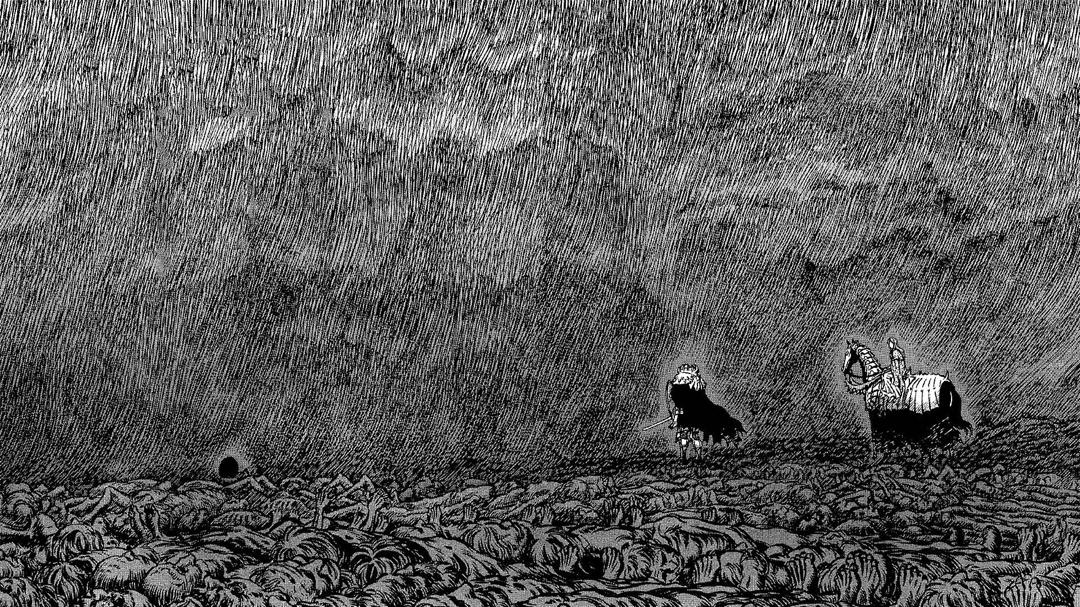
Words by Kevin Cui. Image from Berserk by Kentaro Miura
You may also like

Secularism isn’t ready for He Jiankui
In November 2018, He Jiankui broke the mould. Two days before he was scheduled to speak at th
Recentring Death
“It is hard to have patience with people who say, ‘There is no death’ or ‘Death doesn’t ma
Icon of the Week: The Phoenix Picturehouse
During my first month at Oxford, I was in a relative, consistent state of terror as I tried to carve