

Under Review: Ulster American
Ulster American is like smoke.
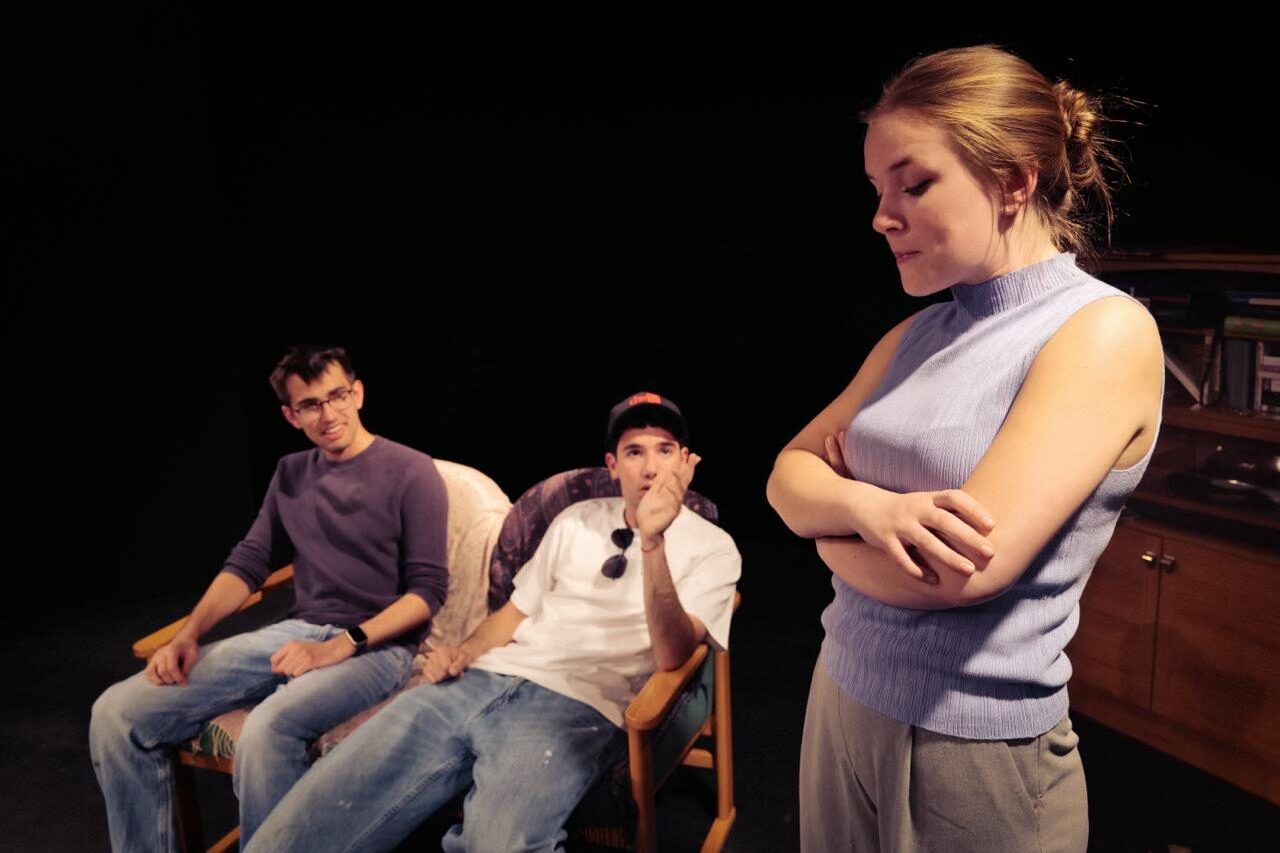
A British director and an American actor walk into a room. What do they talk about? Well who they would rape if held at gunpoint of course! The provocation of Ulster American wastes no time and it felt as though I had sat down and became an unwilling participant in a thought experiment that I had not consented to. What’s more, this is just the beginning. Grá Production’s Robyn Hayward and Kate Burke started their theatre company with a bang with this production following Leigh Carver (Rohan Joshi), Jay Conway (Aaron Gelkoff), and Ruth Davenport (Caeli Colgan).
The play follows a British director, American actor, and Irish playwright who are hoping to work together, and put on a play about an Irish protestant named Tommy who is released from prison and hopes to ‘kill all the Fenians’. Colgan as Ruth Davenport is also an incredibly intriguing character, she enters the room bustling and energetic in a way that makes the audience certain that this is surely the character we are supposed to root for. However, it becomes apparent very quickly that Ruth is as morally compromised as the rest—her central conflict not only being her insistence that she is British and not Irish, but also the fact that her play’s lead character, Tommy, is frankly a murderous lunatic who Ruth is deeply sympathetic towards. Despite no longer rooting for Ruth, I was also frustrated by the men, once divided, united against her in their misogyny and attempts to prevent her from tweeting that they’d Jay and Leigh had admitted to choosing to rape Princess Diana and Margaret Thatcher respectively.
Rohan Joshi particularly stood out in his successful depiction of corruption and cowardice. His inability to admit his part in the rape scandal mentioned prior, coupled with his desperate attempts to prove he is an ally of women (even insistingthat he wishes he was trans) functions as a metaphor for a cowardice of white privilege Gelkoff was incredibly strong as Jay, encapsulating the unawareness of a self-absorbed Oscar winner who uses his social status as a shield from any critique or discomfort. In moments when he wishes for more information than he is receiving, Gelkoff captures this desire—to know more than what you do, without letting on that that is what you truly want—amazingly. His delivery was on point and often resulted in raucous laughter amongst the audience.
Ulster American is about Irishness in a way that subverts both the expectations of the characters and audience. You might enter expecting two citizens of imperialist nations to invalidate the identity of an Irishwoman. Instead, Jay and Leigh are excited by her identity and intend to utilise it; enticing audiences with conversation about colonisation and oppression from the comfortable distance of a country both oppressed and absorbed into whiteness. Colgan’s character instead adamantly insists that she is British, a fact both male characters seem resistant to, perhaps because oppression does not look how they wish it did. Joshi captures this perfectly in his hilarious, but infantilising, dismissal of what, to Davenport, is objective fact. If there is one thing Ulster American does spectacularly, it is capturing the nuances of Irish oppression, and forcing the audience to confront the discomfort of sympathising with someone like Davenport, someone both a victim and moral accomplice in colonisation.
What makes Ulster American particularly exhausting is the fact that it quickly becomes apparent that it was never about oppression for any of them. Instead oppression functions as social currency, something to weaponise, or strategically invoke when convenient. Jay constantly frames himself as radically progressive and deeply committed to women despite the fact that almost every interaction reveals the extent to which feminism operates as branding for him. His insistence that ‘no one has done more for women in theatre than I have’ becomes increasingly absurd precisely because the play strips away the illusion that allyship necessarily reflects morality. Leigh operates similarly, though in a quieter and arguably more recognisable manner. Rohan Joshi’s performance is incredibly convincing in its depiction of cowardice disguised as sensitivity. His desperation to appear progressive reaches its peak in the line where he insists he wishes he was trans, a statement which feels less like solidarity and more like the logical extreme of performative allyship. Even Ruth, despite occupying the most vulnerable position within the room as the only woman present, selectively weaponises her own oppression throughout the play. Eventually all three characters reveal the extent to which their politics collapse the moment status, reputation, or success are threatened. The Oscar itself becomes almost comically symbolic of this. Morality in Ulster American exists like something standing on the edge of a cliff. It remains intact only whilst conditions are comfortable enough for it to do so. The slightest pressure immediately sends it collapsing into the abyss.
Questions of Britishness, Irishness, and whiteness similarly sit at the centre of the play’s tension, particularly through Ruth’s insistence that she does not ‘need British people’s permission to be British’. The line initially feels absurd enough to provoke laughter throughout the audience, though the discomfort of that laughter becomes increasingly interesting once the play’s broader concern with colonial identity emerges more clearly. Ruth’s insistence that her blood is British introduces an especially unsettling dimension to this conversation because it exposes how identity within the play repeatedly collapses into questions of inheritance and legitimacy. The discussion surrounding accents furthers this tension even more. The suggestion that wealthy people would not even notice whether an accent was authentic reveals the extent to which class and whiteness ultimately override authenticity itself. Within the context of Oxford and OUDS specifically, the play begins to take on an unintentionally meta quality.There is something deeply uncomfortable about watching a predominantly privileged audience laugh so comfortably at conversations surrounding colonialism, rape, race, and identity whilst existing within institutions that often reproduce those same hierarchies.
The play takes on an even more interesting dimension when you take note of the function of blackness in this play. This is not a play about black people, and yet they felt like a character in this play simply because of the social function references to blackness, chattel slavery and the n-word played in the text. The play actually opens with a question of whether the two men had ever used the n-word, and contexts in which it might be ok, and whose it is to reclaim. The function is to be shocking—and that it is—but it also is a viscerally uncomfortable reality of black audience members, that blackness specifically often functions as something to pedal a story as opposed to being engaged with. Once the provocative tone is established, blackness disappears, its role fulfilled. Whilst this play does not need to centre blackness, its mobilising of black suffering without sustained engagement leaves a bitter taste in the mouth. Within the context of Oxford specifically, Ulster American occasionally began to feel less like a disruption and more like a form of recognition. The play repeatedly condemns performative progressivism, moral posturing, and the weaponisation of oppression within elite liberal spaces.
This is not a critique of the actors, or even the dialogue but the place in which the story sits. Some of the loudest laughter throughout the performance emerged during discussions surrounding race, rape, colonialism, and identity in ways that occasionally dulled the force of the play’s more uncomfortable observations.The production at times felt like it was holding up a mirror to people already surrounded by mirrors. This is not necessarily a failure of the performances themselves because all three actors are genuinely compelling to watch. Aaron Gelkoff in particular was consistently hilarious whilst still managing to remain deeply unsettling, and the pacing of the dialogue ensured the production rarely lost momentum even during its most repetitive stretches. Yet there remains a frustration in the fact that this particular genre of critique, namely wealthy white liberals using the language of oppression to advance their own status, has already been explored so extensively across contemporary theatre and literature that the play occasionally feels as though the script is directing itself. One begins to wonder what distinctive mark this particular production leaves behind once the shock subsides. What new narrative is actually being challenged here? Perhaps this is why Ulster American ultimately felt like smoke. For a brief moment the room fills with confusion, tension, laughter, and hyper-awareness before the smoke gradually clears and everything remains positioned exactly as it was before.
Ultimately Ulster American succeeds far more convincingly as a performance than as a political intervention. Its acting is excellent, its pacing sharp, and its dark comedy genuinely effective in maintaining tension even during the play’s most grotesque exchanges. At its best it offers an incisive critique of progressive hypocrisy, exposing how quickly morality collapses once status, reputation, and power are threatened. Yet the play simultaneously remains trapped within the same familiar frameworks of liberal self-awareness that it attempts to critique. Its observations are often intelligent and occasionally brutal, though rarely surprising. Like smoke, the play fills the room completely for a moment before disappearing, leaving the structures it condemned standing exactly where they were before.
Words by Damola Sijuwade. Photograph by Ediz Atilla
You may also like
Victoria Viatorum
I first met Maria on Friday. She stood in the street and talked at me in hurried Greek, and then whe
Icon of the Week: The Jericho Tavern
Dan Spencer is the general manager of the Jericho Tavern, the pub and music venue that spawne

Icon of the Week: Rebecca Harper
Going through the transcript of my conversation with Rebecca felt like deciphering a lost language.