
Bourdain, revisited
Anthony Bourdain. The epitome of the New York chef. Perhaps the most woke man born in the 50s. The performative male’s performative male. He’s had a profound impact on how I eat, how I travel, and most importantly, how I view the world.
Despite his somewhat insufferable Gen-Z fanbase (of which I am shamelessly a part), I think Bourdain is more relevant now than he has ever been. For those unfamiliar with his work, Anthony Bourdain was a chef, writer, and documentarian. When not working in his New York kitchen, he spent his days recording and exploring the cultures and cuisines of the world. Much of his work deals with the condition of humanity, or more specifically, how the concepts of ‘culture’ and ‘cuisine’ constantly interact with the political state of the world. Moreover, I believe he offers a lesson for all of us—to learn what it means to truly be a ‘global citizen’. He had an outlook on life that was complex and full of internal conflict, but that was precisely what made his character so compelling. What Bourdain showed us was a world filled with unvarnished, yet layered, perspectives. Some are agreeable and easily digestible; others, if you will excuse a second pun, are harder to swallow.
If there is one tendency he consistently pushed against, it was the vilification of ‘foreigners’. As someone with American heritage, it may simply be the consequence of having grown up with an inevitably yankee-centric worldview, but time and time again I have found that every new place I visit has been victim to unfair and inaccurate depictions and stereotypes. Bourdain understood that the world we’ve been taught to believe in is skewed by the forces of media and propaganda, imposed upon us for generations. He spent his time in the spotlight trying to change our views of those our predecessors spent centuries humiliating and belittling.
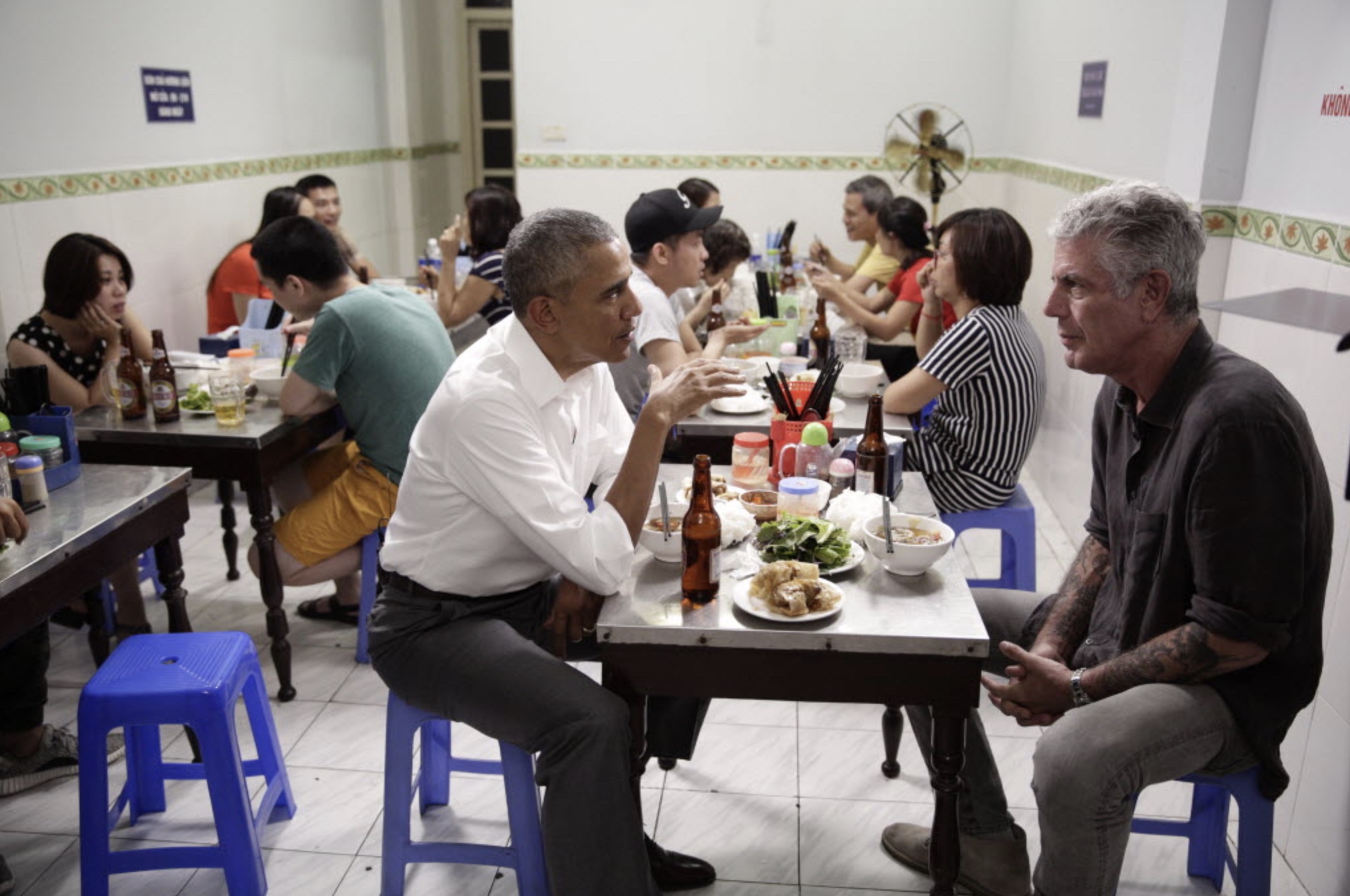
Perhaps his most famous manifestation of this goal was the surreal meal of bún chả Hà Nội in Vietnam that he shared with then-US President Barack Obama. Inviting the most powerful man in the world to momentarily experience the life of an average Vietnamese citizen, still living in the aftermath of imperialist exploitation, was an act of symbolism in itself. A setting we rarely see sitting US presidents in, I think it finds its success in the ironic conflict the imagery creates. Many current world leaders wouldn’t be caught dead sharing a meal and drink with a recovering addict in such a casual way. In doing so, Obama seemed to be taking responsibility for the atrocities perpetrated by his predecessors. Unthinkable in today’s America, rife with stubborn foreign policy and contrarian politics, it was a sign of the times.
Obama’s visits to Vietnam, Cuba, and China (among other nations) were a major step in attempts to normalise diplomatic relations between the US and these nations it had formerly acted in hostility towards. I also believe that his willingness to appear on TV with Bourdain, in a light few presidents have been seen in, points to the political climate of the time. Obama’s foreign policy positions were by no means perfect, with some being actively damaging. However, I do feel that there is something to be said for the extent to which his administration made efforts to deescalate conflict in many parts of the world. It is news to no one that global politics have regressed since; Bourdain represented an era where curiosity was an important aspect of diplomacy.
Bourdain’s episodes in Southeast Asia are some of his most soul-stirring works. Portraying his appreciation for places torn apart by American imperialism as an American was a politically charged act. Even considering the two nations’ sordid history, humanity shines through in his conversation with his friend Hà on a floating fishing village in Ha Long Bay, Vietnam. She speaks of the veterans she has met who harboured no ill-will against their former enemies. The truth of the matter is that her experience is not unique: people everywhere are far more generous than the narratives pushed give them credit for. Most striking, however, is not the forgiveness itself, but the power of real human interaction to counteract the hate and damage caused by propaganda. If you have the will to go out and search for your own answers, you will come out the other side with a far more positive opinion of the world than what the media shows.
Bourdain’s career was not always so focused on this innately political aspect of travel. His visit to Beirut, Lebanon, was somewhat of a turning point in the nature of his work. In his 2006 episode of No Reservations, filmed in Beirut, he and his crew were caught in what later came to be known as the 2006 Lebanon War. He described the experience as an ‘embittering and angering experience’. Watching the indiscriminate bombing of the capital, including his only route home, the commercial airport, shifted the focus of his work. Food became a springboard to have difficult conversations and tell uncomfortable stories about real people across the globe.
Though this was the first moment in his career when his platform became more politically charged than the typical culinary travel show, it was certainly not the last. What Bourdain demonstrates is that you cannot travel the world as a neutral observer. In an increasingly interconnected world, conflict affects all of us, directly or indirectly. Consider why South Asian restaurants are so ubiquitous in the UK. They did not appear out of thin air, rather a wave of migration caused by the violent, British-led partition of India left many new communities in Britain homesick for their traditional food. Eating at an Indian restaurant in London is not purely an act of feeding oneself; it is to engage with Britain’s colonial history and its profound impact on the stability of its victims’ homelands, cuisines, and cultures.
Bourdain was not afraid of making his audience uncomfortable. Without a doubt, Season 2, Episode 1 of his show Parts Unknown (2013) highlights this attitude most effectively. Visiting Jerusalem, Gaza, and the West Bank all in one sequence, the episode is one of the most politically and emotionally heavy he ever produced. His descriptions of the conflict in plain language remain as relevant today as it was 13 years ago. He platforms Palestinians’ voices in a way that remains resonant and thought-provoking. He depicts the diversity of views, food, and life that persist in spite of the unjust laws that propagated brutal violence, bombing, and an apartheid legal system. The power of diversity and cooperation shines through, in spite of the forces that try to divide and destroy innocent people. Put most plainly by Leila el-Haddad during their conversation in Gaza:
‘It is important to be able to provide Palestinians with an image of themselves that they recognise, a very humane image, because all they’re seeing in the media… is these very caricatured images of gunmen, wailing women and this grim cinder-block landscape.’
She captured the very essence of Bourdain’s mission, to humanise people who have been dehumanised for so long. Humanity and hospitality are not distinct to the West. In my own experiences visiting other countries, my view that there are far more shared values between cultures than initially meets the eye has been constantly reaffirmed. Bourdain shows us—and even Obama suggests during their meal—that everyone takes pride in their food, pride in their families, and pride in their land. But most importantly, the majority do not truly wish harm upon anyone, despite the overwhelmingly loud and incessant voices of the minority that do.
What Bourdain has taught me is that travel and food are always political. The privilege the UK passport grants us to travel freely should serve to open our minds to the lives and struggles of people all over the world. What use is travelling if you stay in your hotel drinking cocktails? Going out there to experience difference and diversity is what offers us the chance to live life through the perspective of others. Sharing a meal with someone of an entirely different background to yourself, as Bourdain spent his life doing, helps us to escape the prejudices we may hold.
He proved to me that travel cannot be taken for granted. Travelling and eating with the intent to bring ourselves closer to others is one of the most enlightening things we can do. Food acts as a lens through which we can view society; it has the ability to reveal how politics change even the most habitual moments of our lives. Predictably, I will leave you with a quote of his: one that sums up a viewpoint which I hope will change the world, or at the very least your life:
‘If I’m an advocate for anything, it’s to move. As far as you can, as much as you can. Across the ocean, or simply across the river. The extent to which you can walk in someone else’s shoes or at least eat their food, it’s a plus for everybody.’ — Anthony Bourdain in Medium Raw, 2010.
Words by Milton McGrory. Image via Wikimedia Commons
You may also like
The Isis interviews Tan Pin Pin, award-winning Singaporean filmmaker
Interviewing a consummate documentary maker is a dangerous game. Only ten minutes into our interview

Pearl Necklaces, ‘Dada’ Bracelets and Crucifixes: Jewellery and Image-making
In the intricate realm of crafting one’s image, be it in the political or personal spheres, th
“Stop right now, if you can”: Interview with Clive James
Clive James is an Australian critic, poet, novelist and memoirist, best known for his television rev