

The Isis On: Kpop (Has K-Pop killed the pop star?)
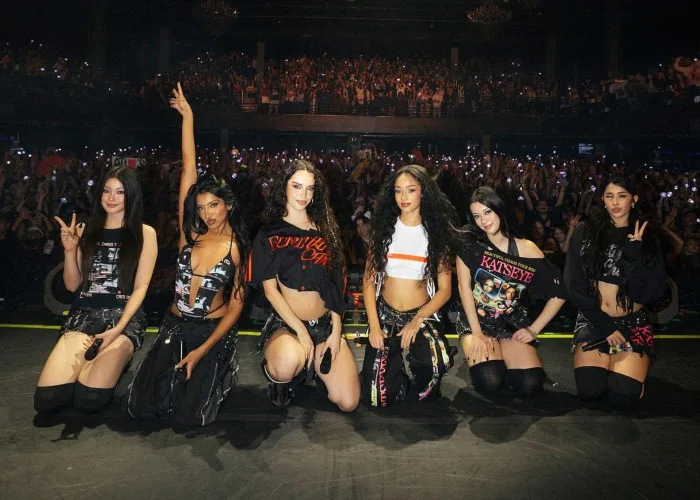
The label ‘K-Pop’ is simultaneously unproductive and irreplaceable—multivalent creative output is funnelled through a misnomer implying singularity, yet its formula for success lies in a unique ecosystem which successfully sends troops of artists into the battle for chart dominance each week. With ‘global girl group’ KATSEYE under scrutiny surrounding Manon’s departure and accusations of devalued artistic output, the crumbling foundations of a group in limbo—formed through the K-Pop formula yet concerning Anglophone artists and audiences—are slowly revealing themselves. The wider pop industry has realised the ultra-profitability of the K-Pop model, yet the value in replicating this formula outside the culture which produced it remains unclear. Ultimately, The Isis’ features team has one question: Is K-Pop a corrupting or constructive influence on the pop industry?
RÜYA
Is Manon leaving KATSEYE? Should Adela or Emily from Dream Academy replace her? Are Lara and Megan secretly OT5? Is ‘PINKY UP’ the worst thing since ‘GNARLY’? If none of these words mean anything to you, you’re one of the lucky ones. As someone who spent six years fighting tooth and nail in the K-Pop trenches, I feel qualified to declare that since BTS won their first Billboard award, K-Pop has been systematically and ideologically poisoning both pop culture and the pop industry. It’s clear that K-Pop considers itself a corporate enterprise or a competition sport rather than a musical genre. Unfortunately, this model is very profitable, and the rest of the music industry is starting to catch on.
Whilst the K-Pop industry certainly didn’t pioneer the idea that ‘video killed the radio star’, it is a more visual medium than any of the genres it shoplifts from. Each release revolves around an aesthetic referred to as its ‘concept’, and throughout the group’s promotional period they must not stray from the Pinterest board carefully curated by their marketing team. The old and tired of last week is replaced with the new and flashy. Hair is dyed; costumes are changed; merchandise is updated.
Simply listening to a K-Pop song is a lacking experience; as a consumer, you are trained by companies in possession of these groups to prove your devotion by investing in the physical. Fans are commanded to purchase albums—either choosing one of the four different versions that each come with unique photobooks, posters, and assorted miscellanea, or instead dropping a light £300 on the whole set and preparing to hunt down the particular photocard of Jungkook you missed out on in the depths of Vinted. With the core purpose of maximising capital, music is anything but the driving force when the K-Pop industry has so much else to offer. They sell what’s cute and fashionable by telling you that it’s cute and fashionable. If the pretty porcelain face living in the piece of paper you won in the lowballing war to display in your phone case says it is, then it must be! By the time the vapidness begins to dawn on you, they’re ready to sell you the next shiny thing rolling down the conveyor belt.
K-Pop groups are the biggest musical acts since Britney Spears to have a massive dance component involved in their releases. Each song is mechanically constructed to come equipped with fully-fledged choreography that can be neatly divided into 30-second clippable sections to maximise potential for TikTok virality. Groups with bigger fanbases who tour internationally perform 2 hour-long sets with near non-stop dance routines, sometimes up to 3-4 times a week. As a result, how athletic, fit, and most concerningly, how thin any given member of a K-Pop group is becomes a qualitative measure of their talent.
Disordered eating habits are flaunted by the celebrities themselves, and fans are quick to voice exclusionary and fatphobic attitudes against those who do not fit into these suffocating standards. Jimin from BTS was recently at the centre of the discourse cycle after he posted a photo of a scale on his Instagram story displaying, at best, a concerning figure. Videos of Sunoo from ENHYPEN being made fun of by other members of the group for having chubby cheeks enable Korean netizens’ reaction to Jeongyeon from TWICE putting on weight. Biases created by companies uphold the interests of the public—fans do not care about their idols’ vocal warm-ups, but their workout routines.
In this sense, K-Pop is theatrical—its essence dwells not in sound, but in the body. K-Pop ‘idols’ (the only word ever used to characterise these stars) adopt personas specifically manufactured for their audiences, preventing them from realising they are worshipping a false god. However, the particularities of the K-Pop industry are also borne directly from the fact that the breach of the genre into the Western mainstream has coincided with internet culture. As our attention spans grow shorter and our vocabulary narrower, the K-Pop machine rolls out songs with three-note chord progressions and nonsensical combinations of English slang words with more vigor. Given that the K-Pop formula is as much about setting trends as following them, let’s use the buzzword du jour instead: K-Pop is performative, rather than theatrical—somehow both in the matcha-drinking, Clairo-listening straight boy sense and the Judith Butler sense.
Butler asserts that ‘gender is a kind of imitation for which there is no original, in fact, it is a kind of imitation that produces the very notion of the original as an effect and consequence of the imitation itself.’ In a similar vein, there is a commercialised lack of authenticity to K-Pop music, and its repeated performance trains audiences to continually consume products. ‘PINKY UP’ imitates ‘GNARLY’, which imitates predecessors in noise music like ITZY and Stray Kids. Though the music is certainly inspired by and often directly samples artists outside of the K-Pop ecosystem, it would be disparaging to say that KATSEYE finds its origins in R&B or hip-hop, given the lack of acknowledgement to said sources, as well as the industry-wide appropriation of Black culture disguised as an organically rising trend. Thus, to say that K-Pop is imitation without originality feels perfectly apt.
K-Pop is far from the only thing that has led to the decline of the pop industry; without much debate, the downfall of all creative industries is undeniably late-stage capitalism. However, the K-Pop model embodies everything that is wrong with society under late-stage capitalism—pitting individuals against each other, isolating them from their communities, and demarcating their value based on superficial and arbitrary metrics. To quote Addison Rae, a victim of the globalised K-Pop model, the core tenet of this operation is simple: ‘Money is Everything.’
REMIE
To be a star is to shine—with spectacle, with influence. Just as ‘video killed the radio star’, it’s easy to see practices popularised by the K-Pop industry bleeding into Anglo-centric popular culture and say ‘K-Pop killed the global pop star.’ While purists claim the prevalence of choreography, videography, and aesthetic concepts in K-Pop indicate neglect of the music itself, these are elements which have long defined pop royalty: ‘King of Pop’ Michael Jackson’s trademark precision choreography. ‘Queen of Pop’ Madonna’s theatrical image reinvention. ‘Princess of Pop’ Britney Spears’ stylised breathy vocalisation. To be a pop star has always meant to be an idol—to manufacture cultural moments as a mythologised embodiment of popular trends. The K-Pop formula has not killed the pop industry, but distilled the essence of pop success to produce their own line of stars.
Behind the ‘K-Pop formula’ is a refurbished Motown ‘Charm School’ program, an assembly-line approach to artist development from which legends like Marvin Gaye, Diana Ross, and The Jackson 5 graduated. Amongst entertainment labels creating ripples that would become the hallyu (韓流) wave, SM Entertainment, though claiming the title ‘Star Museum’ in their representative initials, pays homage to its strategic predecessor with their artist collective branded SMTOWN.
K-Pop has not killed the pop star. K-Pop is the only honest factory in the pop star business—the product is the person. Idol. Bias. Center. External influences behind every pop star are made explicit by camera lenses pressed directly into what should be an artist’s private bubble, from the pressure of beauty standards to the bargaining power of fans, and the strategic manoeuvres to create spectacle without controversy. Every aspiring idol is subjected to vigorous training and evaluation in their climb to stardom. Alongside vocal and dance training, trainees undergo language classes, media and personality training, and even acting classes, groomed to capitalise on their charisma and gracefully sidestep potential scandal. The fumbling charm of a fresh-faced musician with their first release is replaced by a group of all-dancing, all-singing professionals meticulously manufactured for stardom.
Through market evaluation and trend surveillance, the K-Pop industry has optimised the probability of their artists’ success. Each group’s brand identity, termed their ‘concept’, is established from debut, carving out their space in the oversaturated market and staking claim to sectors of audiences through loyalty to this artistic color. Critics conflate continuity with restricted expression, alleging that visual extravagance dilutes the artistic value of K-Pop music. At the same time, recent breakout successes of artists such as Chappell Roan, Sabrina Carpenter, and PinkPanthress may be attributed to established sonic identity, consistent aesthetic branding, and striking personality—elements solidifying status after years of creative output; elements which K-Pop has established as bare minimum. Aesthetic concepts like ‘futuristic’ and ‘supernatural’ indeed lack the necessary cohesion of musical trademarks, yet the simple solution assuring continuity is creative freedom—observe Stray Kids’ wordplay-heavy experimental music, NMIXX’s mid-track genre-bends and intricate harmonies, and i-dle’s provocative assertions of feminine individuality. Evidently, the K-Pop industry enables the optimal balance of artistic freedom within systematic infrastructure rich in creative resources.
Attempted implementation of the K-Pop formula in Western entertainment media only forges unstable relationships poisoned by televised tension, everywhere from the Next Influencer competition, a scramble to capitalise on Hype House fame, to HYBE’s Pop Star Academy, their most transparent attempt to sink their claws into American audiences yet. These recreations fail to recognise how fans-turned-trainees uniquely desire K-Pop stardom, and how integral the Korean entertainment industry’s inter-artist network and promotional infrastructure are to its continual success. The world desires to replicate the profitable K-Pop model, but lacks its centralised efficiency developed over years of industry co-ordination.
While spotlighting individuals, the K-Pop ecosystem is a uniquely symbiotic commune. Korean national television networks collectively form a week-long run of different music shows where K-Pop releases are performed and promoted, rendering the dominating source of Korea’s global soft power concentrated and accessible. Artists, though broadcasted for a literal five minutes of fame, gain valuable exposure to previously inaccessible audiences, as well as opportunity to observe and interact with industry peers across generations, companies, and styles. Inter-group collaborations and covers promise united viewership of the rare showcasing of skills beyond a group’s typical artistic identity; talents obscured by the editing of a sleek K-Pop song and music video are illuminated by accompanied performances such as choreography videos and live-band vocal sessions. K-Pop has not killed the pop industry, but guaranteed regular platforming of its artists and facilitated the development of their symbiotic network—if anything, the K-Pop industry has impressively lively proportions of popularity.
K-Pop idols’ greatest competitors are not industry peers, but the torrents of short-form content monopolising viewer interest. Pop stars are now burdened with digital obligations previously relegated to influencers—instead of being held hostage by a Tonight Show host’s fake laughter, artists now establish personas through social media to remain relevant between projects. K-Pop’s streamlined marketing machinations are transparent: parasocial interest is nurtured through faux-casual Instagram posts of photoshoot quality and, more disturbingly, video calls ‘rewarding’ fans for highest monetary expenditure. These highly regimented promotions are also highly honest—an idol’s public and private personas may be curated, but documented creative processes in ideation meetings, recording booths, rehearsal rooms are irrepressibly genuine. Whether driven by creative curiosity or aesthetic attraction, viewers may access artistic production in process, ensuring the ladle of interest in the K-Pop formula remains continually stirred.
It is refreshing to see professional performers increasingly entering the K-Pop industry—a looks-based economy where beauty is currency, where performance quality is gambled away in favor of reliably profitable visual allure. Cross-industry entrants are emboldened by idol appearances on programmes specialising in particular performance skills: Show Me The Money featuring K-rap and underground hip-hop culture; Street Woman Fighter showcasing female dance crews; The Masked Singer evaluating vocalists without visual bias. With the multitalent-demanding idol industry and specialised performance industries equally displayed under the microscope of televised media, witnesses to the backstage bloodbath may step in with clearer insight than ever, if still desiring the risk—not reward—of stardom.
To be a pop star has always been to be dehumanised at the mercy of an industry-wide plague of executives extracting maximum profit with minimum investment. Medical coercion. Stage-persona-induced dissociation. Sexual harassment as spectacle. The K-Pop industry transparently promotes its idol-products; precisely because of these overly intimate artist-fan interactions, executives face the combined bargaining power of idols easily publicising previously hidden struggles, and audiences demanding better conditions for the labor they spectate.
The industry itself has always killed the pop star. If to be an idol is to be consumed, perhaps to live within the K-Pop industry’s rigid walls is the best mode of survival in the worst environment.
Words by Remie Cheng and Rüya Oral. Photo via Katseye on Instagram.
You may also like

Don’t Worry
A look at a long line of not so accurate doomsday predictions


The Resistable Rise of Arturo Ui: a study in unnecessary subversion
Being funny is harder than most people think. Being funny on stage is even harder. And being funny i