

Under Review: The Future of the Left, at the Union
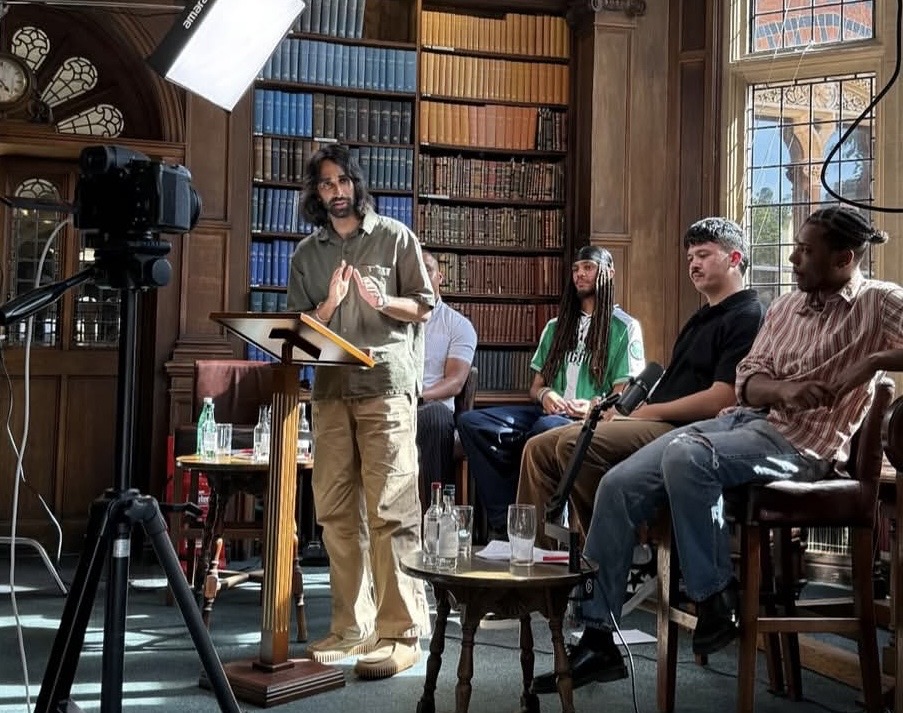
There is a particular kind of irony that only the British left can produce with such reliable efficiency. Last weekend I found myself squarely inside it, as four rising left-wing podcasters—Noah East and Sean Ramiz of Northstar Politics, and Freddie Feltham and Jovan Owusu-Nepaul of What’s Left?—gathered to debate the future of the left in this country.The venue chosen for this exercise in radical imagination? The Oxford Union, of course.
The theme of the debate was clear. The future prospects of a unified left are dubious, at best, in the murky waters of modern British electoral politics, and tracing a path to an electorally viable left wing party is a daunting project in the face of a growing right-wing coalition of politicians in the Conservative and Reform parties.
Freddie and Jovan of What’s Left? argued a clear position: the future of left-wing politics runs through the Labour Party. Jovan’s commitment to this position is, in some way, remarkable. He stood as a Labour candidate against Nigel Farage in Clacton in 2024, in what was shaping up to be a defining moment not just for his career but the entirety of British politics—perhaps a Labour candidate whose graduation was still in recent memory, necessarily progressive, could make a stand against Farage. Until he was instructed by the party to stand down as Labour conceded to Farage in order to grant him a quiet (in their eyes, guaranteed) victory. And yet here he was, arguing with apparent conviction that Labour was the vessel of progressive change, with an appeal to Labour’s record.
Jovan cited the fact that the current Labour government is the most progressive government we have ever had, the highest proportion of state-school educated ministers in recent history, the scrapping of the two-child benefit cap, windfall taxes on energy companies. All real credentials, but ones that have been cherry-picked from a record list that avoids true progression of the ideological sense. Labour’s stance on Gaza, the party’s reversal on tuition fees, and more broadly the calculated retreat from anything that might actually threaten the institutional status quo. Jovan’s insistence on Labour’s accolades felt, to me, imbued with a deeply conservative sentiment. The idea that ‘this system has worked for us, therefore we should and can make these institutions work for us’ seems more fitting in my Theory of Politics notes on conservatism than a debate concerning the future of current British politics. The reality is that those institutions have shifted with the sands of time. The Clause IV that committed Labour to any fixed socialist ideas is gone, and the backsliding has reached even the jewel in the crown, universal healthcare delivered by the NHS. So, to treat the party’s present as a natural extension of its radical past is a rose-tinted historicism the actual record does not support.
Freddie’s contribution was more candid, and also more troubling. His central argument was that Labour, as a party for the worker, remains the only coherent vehicle for the working class, and that the broader left has failed by retreating into identity politics and what he called purity testing: an inability to engage with anyone who doesn’t already share your politics. By virtue of this, what had ensued was a narrowing of the ‘left’ coalition to the point of irrelevance for the white working class. There is something of substance in this critique of identity politics, but the framing he reached for felt uncomfortably familiar, one that I have heard far more often from centre-right politicians dismissing the left than from within it. Of greater concern was Freddie’s scepticism of proposed Green Party policy—redistributive tax proposals, their borrowing for investment—the more structurally ambitious parts of their programme. Again, it seems contrary to a debate between two progressive groups that one side should take such a managerial position.
Disagreements on policy while maintaining a consensus on ideology is standard in political movements, arguably a creative force in coming to democratic compromise. For the British left, however, Labour’s (in)action regarding the genocide in Gaza has forced a question about whether any ideological consensus remains at all. When Sean asked What’s Left directly what their red line was—the point at which Labour’s behaviour would become undefendable—they visibly struggled to reconcile their personal convictions with Labour party policy, because doing so requires you to make peace with a government that has equivocated on genocide. The argument that we must accept Labour as it is—that the ship still sails, we simply need better sailors, or people ‘inside the system’ as Freddie put it—only holds if the ship has a destination. Labour can only become the home of the future left if the party is clear on who, and what, they seek to represent. Something two of its most promising advocates could not name in this debate.
And yet I found myself also unconvinced by Northstar Politics. Their refusal of the comfort blanket that is Labour felt more honest, and Noah and Sean’s insistence on a theoretical overhaul, a politics rooted in justice or some universal morality, provided something more foundational than the pursuit of parliamentary majorities. But, for all their intellectual ambition, Northstar could not quite name the thing, that evasive unifier of the left. They argued that identity was not the problem—that British people needed to focus on finding a new flag to rally around, to organise in a way that reflected the multiplicity of the British identity, and the British electorate did not alienate the large groups of people the left needed. The conversation gestured toward the rainbow as evidence of the existence of a pot of ideological gold without drawing the map to it, falling into the same trap of reliance on critical theories that plagues new-age left wing ideologues. Northstar seemed to represent a group of the left that, at moments, define themselves primarily through their broad opposition to Labour, and broad support for Zack Polanski’s Green Party—and in their rejection of mainstream party politics, fall into its same trap.
What struck me most, standing back from all of it, was that these two coalitions of people did not seem to be united on anything more than an aversion to the modern political right. It did not seem as though What’s Left? were on board with genuinely progressive politics at all, where progression means change, or invention. And Northstar Politics, for all their moral clarity, struggled to name what a politics built on that clarity would actually look like in practice. Rather than leaving refreshed, and with a sense of trajectory, one left wondering whether there was any collective future of the left at all.
The irreconcilability of the two positions became clear when an audience member claimed he did not view What’s Left? as occupying the same ‘left’ as himself, stating that his politics included the death penalty for billionaires and a return to revolution. When members in the audience began to laugh, it felt like the defining moment of the evening as we witnessed the growing chasm in the left—to put it simply, those who believe the system can work and those who believe it cannot. The history of the left has always been the history of shared identity, an issue that occupied most of the afternoon. But if the issue is that there is no more to the left (electorally, at the very least) than ostensibly representing an alternative to the sliding scale of right-wing ideals and politicians in British politics, what shared identity remains to be found?
And so the irony became clear, sitting in that chamber, watching four Oxbridge-educated men attempt to diagnose the British left with a problem. If all we, on the left, have to hold ourselves together is aversion to the far-right populists of Britain, how can it be that we congregate in chambers that platform those voices? What is the future of the left, if its primary saviours are to be found in the same chambers as Tommy Robinson and Laurence Fox? The Oxford Union does not need my help inflating its sense of importance and duty to direct the course of progressive politics. But I think it is worth sitting with what this choice says about the left, and the continued willingness to align ourselves with institutions like these. To debate the future of the left in those chambers is, by virtue of sharing them, to prop up a society willing to count far-right nationalists among its platformed speakers.
Perhaps there is no unified left whose future we can sit around theorising over. Perhaps this is the conclusion such a debate in Oxford, at the Union, was always going to produce.
Words by Naima Aden. Image via NorthStar Politics on Instagram
You may also like

Icon of the Week: Riverman Records
Walking around Oxford can sometimes feel like you’re in a labyrinthian web of cafés, libra

An Interview with Thu Thu Aung
Thu Thu Aung is a Myanmar journalist who began working in local newsrooms in 2007 during the Saffron
The future of happiness
Are you happy? Is the person sitting next to you, if there is any such, happy? I don’t know; perha