

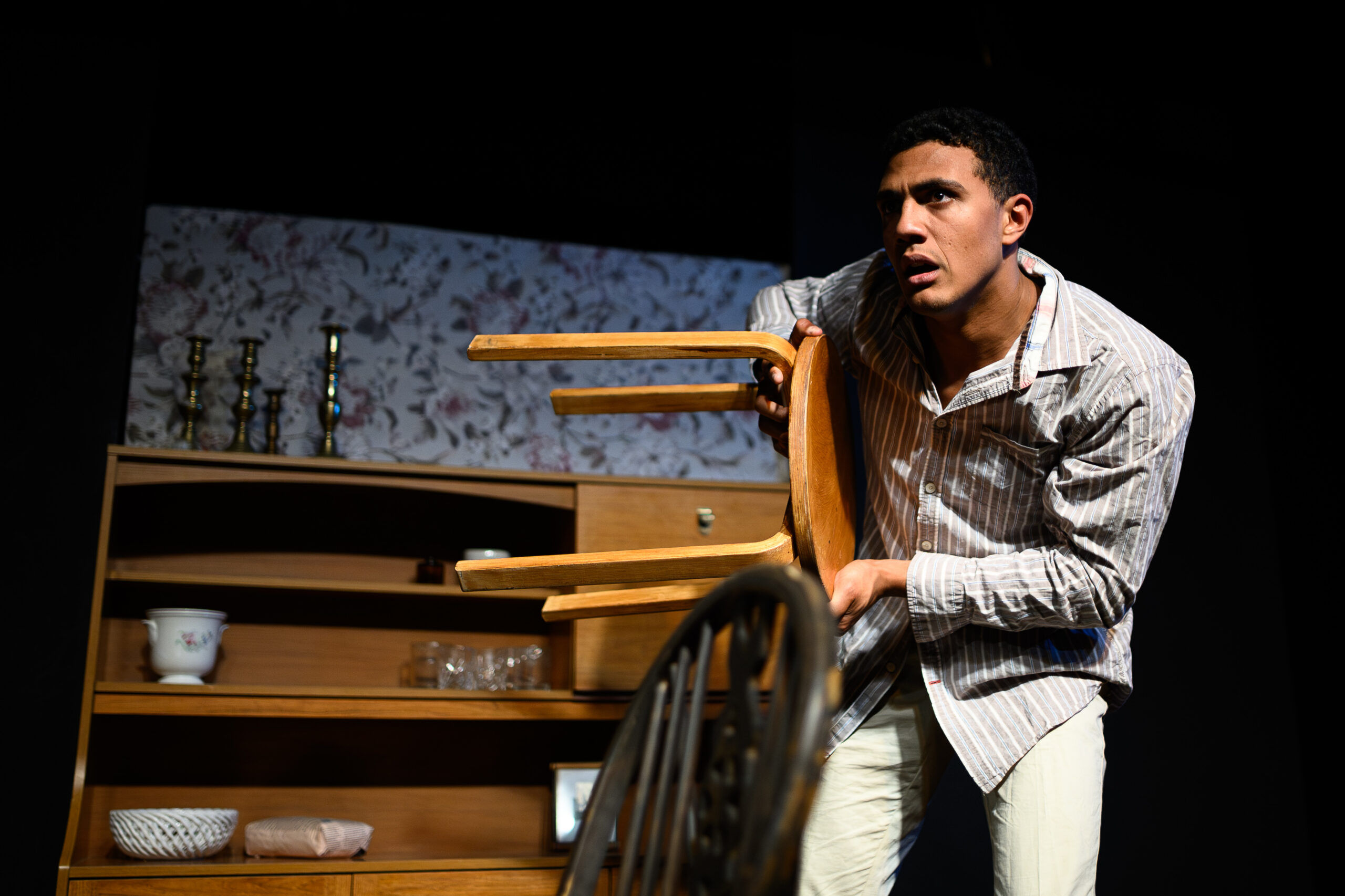
Under Review: The Birthday Party
Stepping into the theatre for Postbox Productions’ adaptation of Harold Pinter’s The Birthday Party, your perception becomes one with the play itself: locked into place, unwavering, unfaltering. Co-directed by Loris Avery and Marnie Frankel, the production is uniquely unsettling, never providing audiences with the satisfaction of a definitive interpretation. Frankel described The Birthday Party as a play about the ‘oppression of creativity by capitalism and institutional forces,’ while Avery expressed their desire to preserve the narrative’s ‘constant uncertainty’. Once inhabited only by Stanley, the monotony of Petey and Meg’s seaside boarding house is intruded on by Goldberg and McCann. Beneath their sophisticated charm and authoritative confidence in being sent by an ‘organisation’, there is an underlying discomfort as audiences sense their obscured motives. Characters never cease to converse, yet never begin to understand each other. Thoughts, intentions, and even identities remain blurred, not only to the audience but to the characters themselves. Though confined to the same boarding house, they do not seem to inhabit a common reality. Instead, each character exists within their own isolated mental world, guided by private desires, anxieties, and illusions. It is precisely this ambiguity, this persistent inability to distinguish performance from sincerity, truth from fabrication, that speaks so strongly to our modern age full of unknowns.
Beneath the suits, the briefcases, and the political masquerade lies something far more sinister: an idea. It is an idea of uniformity, of prescribed ways to think, behave, and feel. Their sterility intrudes upon the house’s regularity, taking advantage of their complacency to rupture their bubble. Through this, the play becomes less about physical violence and more about the gradual destruction of individual deliberation. Goldberg speaks not to converse, but to indoctrinate. His speeches are long, nostalgic, and almost hypnotic. The audience cannot distinguish truth from fabrication, reality from performance—regardless, like the characters onstage, we are compelled to listen.
Each character appears trapped within their own self-created reality. Stanley lives within his past, unable to reconcile with the present. Meg exists for others, her identity dependent on external affirmation. Petey is nothing but white noise behind the chaos, predictable and passive, existing rather than engaging with life. The most unsettling figure, however, is Goldberg. His façade is immaculate—the audience never truly sees him. His praise is calculated, his charm manipulative, his intentions obscured by rhetoric. The mysterious ‘line’ he repeatedly refers to, which Pinter described as ‘the most important line in the play’, forces the audience to wonder whether such a ‘line’ exists beyond the stage as well. Goldberg constantly speaks of values, of proper behaviour, of the ‘right’ way to think and act. However, the unease this creates stems from the fact that his authority infringes upon the audience’s own ability to deliberate independently. We are no longer certain what we ourselves perceive. We are lectured, guided, almost indoctrinated alongside the characters.
Interestingly, the youth of the actors in this production intensifies the play’s ambiguity. The characters themselves feel aged, worn down by routine and ennui, trapped between nostalgic attachment to the past and fear of the future. Seeing these roles performed by younger actors, however, introduces the unsettling possibility that these tendencies are not at all confined to age. Perhaps each character represents something universal within all of us. Like Meg, perhaps we all seek reciprocation and validation from others. Like Stanley, perhaps we all live partly in memory. Like Goldberg, perhaps we all wish, consciously or unconsciously, to impose our own certainties onto others. And perhaps, like McCann, we all fear uncertainty and seek comfort in the ‘absolutes’ provided by stronger personalities.
Ultimately, the central tension of The Birthday Party lies not simply in its strange conversations or its atmosphere of quiet menace, but in its ambiguity. We never learn whether Stanley truly committed the acts implied by Goldberg and McCann. We never discover the true nature of the organisation. We do not even know whether it is genuinely Stanley’s birthday. Yet despite this ambiguity, the audience feels the weight of the play intensely. Pinter suggests that life itself operates within this same uncertainty. Ironically, Stanley and McCann often seem like the only genuinely individual figures in the play. Their personalities may be eccentric, volatile, even uncomfortable, yet they are undoubtedly distinct. That individuality, despite its instability, is what brings vitality to the otherwise monotonous world of the boarding house.
Reality rarely presents itself in clear categories of truth and falsehood. Instead, existence unfolds within a constant grey area where certainty is impossible and meaning remains unstable. To live, the play implies, is to endure ambiguity. To search for truth among contradictions, and when truth and fabrication become inseparable, to accept uncertainty itself as the only certainty we possess.
Words by Kevin Cui. Photograph by Freddie Houlahan
You may also like
Tea-time: in conversation with Jen Monroe
Jen Monroe is a chef and artist whose project, Bad Taste, is committed to exploring new ways of thin
An identity crisis, or identity in crisis?
Niche. Esoteric. Underground. Buzzword, buzzword, buzzword. The perfect signifier—buzzword has its
Old English, Old Oxford
Two months ago, I found myself at an English formal with the rest of the English freshers at my coll