

An identity crisis, or identity in crisis?
Niche. Esoteric. Underground. Buzzword, buzzword, buzzword. The perfect signifier—buzzword has itself become a buzzword of sorts. How apt! The rapidity with which these trends and aesthetics proliferate and the brevity, or lack thereof, with which they last is not just symptomatic of insidious influencer culture, but a deeper mass identity crisis that influencing thrives upon. Trends are themselves aimed at groups, they make you part of a collective, and yet every trend claims to make you different.
This is not an invective on trends, nor those who partake. We all do in some capacity—be it because of an affinity with that which is trending, or with the notion of the modern trend itself. But what trends show is a collective desire for difference: difference to who I was yesterday, and difference to the people I encounter today. It is establishing difference to our past selves, near or far, and difference to others in the name of establishing identity. But does this vacillation between ‘in’ and ‘out’ and ‘back in’ again not hint at an identity crisis, rather than assertion? We step into different boxes, jump through different hoops, thinking that we are on the straight and narrow to ‘finding ourselves’. Yet in doing so, this journey brings us back to a dusty box, tucked away in the attic since the 2000s, and brought back in the wake of the flared jean revival.
We find ourselves constantly troubled by constantly trying to find ourselves.
But is this not exactly the point? There is nothing constant about ourselves except for our inconstancy. Who I am today is not who I was yesterday, and who knows what I’ll be tomorrow. Sure, I might look the same. But my temperament can never quite be the same; I can’t stand that song I was obsessed with for a week; I’m ‘not in the mood’ for the meal I’ve craved for the past three nights; I allow myself to chew the cud of things I consciously don’t want to; and I’ve already done what I resolved not to do yesterday. I’ll start tomorrow.
It is precisely because of this inconstancy that trends work—they, like us, are both steadfast and fugacious. To state that our identity is in crisis is to state the obvious. It is necessarily in crisis because it is always unfixed. In spite of this, there seems a common discomfort at the idea of identity being something other than homogeneity and fixedness. Our reluctance to accept that we are contradictory and errant indicates that identity is, as a concept, in crisis.
Stemming from the Latin root word idem, meaning ‘the same’, the word eventually evolved into Medieval Latin identitatem to describe ‘sameness’ or ‘oneness.’ At the very core of the word is the concept of an immutable character, a character which is in sameness with itself and/ or and with a collective. In its residue, as the word seeps into everyday parlance, we are left with the challenge of trying to know what it means to have an ‘identity’ when a word bound up in sameness is used to describe what really is our individuality, as if our contradictions can be neatly packaged up in one box; a Russian doll big enough to fit our various selves.
For Judith Butler, identity is relational—the self exists through recognition from the other in a social context. They write of ‘our fundamental dependency on the other’, meaning we cannot exist without addressing the other and being addressed by the other, and hence we cannot escape our fundamental sociality. It is to say that ‘who I am’ is communicated through mediums such as actions and speech. Such mediators require the presence of an other (the other being anyone perceived as distinct from oneself) in order to recognise me. ‘I am not, as it were, an interior subject, closed upon myself, solipsistic, posting questions of myself alone. I exist in an important sense for you, and by virtue of you’ Butler writes, summing up Caverero’s argument. The precondition of the self must be the other—we exist for and by them.
Identity, then, is not about sameness or ‘oneness’, but about recognition from the other. Certainly it is true that much of who we are occurs through performance, performance that necessarily occurs in a social context for it presupposes an audience. Shakespeare might have been ahead of the curve with his famous adage—‘All the world’s a stage.’ Yet defining identity as performance falters, too. How can we be totally known to another when the other recognises only that which mediates the self? Actions and speech are precarious: their intentionality becomes blurred in transmission, leaving my performance, thereby my self, open to an interpretation which is not me. Butler, too, is aware of this precarity, recognising that ‘the account of myself that I give in discourse never fully expresses or carries this living self.’ The means by which we transmit our self is the same means by which we remain partially obscured, and so identity remains on the horizon. Nebulous, just out of reach.
But it is not only in a social context that this notion of relational identity falters. In a purely social context, there are introspective troubles—can the self truly be recognised, or simply vectors of the self? Yet when we transfer to the political arena (supposing it can be isolated from the social), the fundamental premise of relational identity is troubled—the necessity of the other. We have seen and continue to see the constant weaponisation of the concept of the other: the genocide of Palestinians; colonisation in any and all its forms; repression under the Iranian regime. These are of course but few examples of an endless and ongoing list. But the point remains that, when trying to establish or affirm a sovereign, political (and perhaps national) identity, it is not the presence of the other that is necessary, but the effacement of that other. To return to Cavarero, she argues that we are beings who are, of necessity, exposed to one another in our singularity, and that our political situation consists in part in learning how best to handle—and to honour—this constant and necessary exposure. While this might apply to socialised individuals, to say that our political situation consists in honouring this exposure is optimistic. If only this were the case. For it is often through erasure by, rather than peaceable exposure to, an oppressive other that many understand their political situation.
Needless to say, looking at politics in such a way is a huge abstraction and simplification. But nonetheless, it is clear that social and political identities have competing demands, and therefore theories which seek to explain identity prove inadequate in light of these different demands. While socially, the absence of the other proves a threat to the existence of the self, politically it is the other’s presence that appears to ‘threaten’ sovereign identity. Attempts that seek to pin down identity repeatedly fail; their assertions falter under pressure. Neither the etymological definition of identity, born through sameness, nor the theoretical definitions of identity, born through alterity, prove adequate—identity remains notionally in crisis.
While I have, necessarily, only scratched the surface of identity theory, I stand firm that any theory, whatever it may be, will prove in some form inadequate. To commit to theory is to commit, in some form, to fixture, or at least to an approach towards understanding. But how can we understand and be understood when we are constantly inconstant; when we are mediated by exterior performance; when we suggest the self only exists by virtue of the other but ‘we’ consciously erase the other? We talk of identity as if it is something we might find. We joke that someone has ‘found themselves in Bali’, which in itself has become a trend. I’m sure in ten years, they’ll ‘find themselves’ again, elsewhere, when there’s a new trend. ‘Discovery’ is only ever a point of departure.
Definitions of identity are, then, appropriately unsuitable; identity can exist only in crisis.
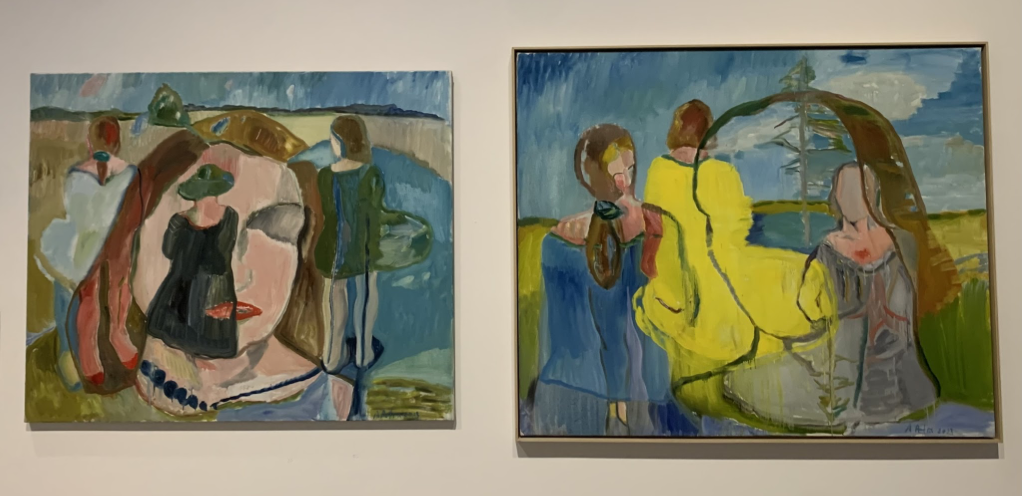
Words by Maddy Wilson. Photograph by Maddy Wilson
References:
The Oxford English Dictionary, part of Oxford University Press.
Butler, Judith, Giving an Account of Oneself (New York, NY, 2005; online edn, Fordham Scholarship Online, 2011).
You may also like

Icon of the Week: The Tescalator
Let me set the scene. You’re spacing out, walking a busy street in Oxford, probably thinkin

Icon of the Week: Yasmin Poole
Very few people, I should imagine, would identify a nameless figure in a logic problem as someone to

Marr on the Monarchy
“I am an unashamedly populist storyteller”, Marr explains, and with figures approaching six mill