
Under review: Exhibition 005
Exhibition 005 was a testament to the vitality of the student art scene in Oxford. The annual, student-led exhibition hosted by Worcester College invites submissions from practising artists across the university, as well as city residents and pupils from local schools. I left feeling pleasantly reminded of the fact that art doesn’t need a reason. Or rather, the creative range of exhibition contributors’ pursuits reminded me that there are endless reasons to produce art. For family members and remembrance; for culture, identity, beauty, and pain; to investigate, to hate, to find solidarity, or to escape. From the 19th-22nd of May, the Sultan Nazrin Shah Centre served as a lively gallery to house all these ideas.
The exhibition seemed to cover every medium; I encountered paintings, sculptures, textiles, ceramics, drawings, photography, video, not to mention multi-media pieces. This range and multiplicity was a testament to the amount of artists who contributed to the show, all flexing their unique skill sets. Most artists had only one work to their name on display, meaning that every step you took led you to a unique creation. Some appeared professionally crafted, others more experimental. Two ceramics works, for example, spoke to me in different ways from different corners of the space. One glossy terracotta set was highly functional and restaurant ready, while another clay piece was inspired by volcanic eruption, abrupt and jagged in its shape, surface and slip. This is a merely microscopic example of the variety of artistic virtuosity on show at 005.
Some pieces were grounded in Oxford, as a place to study but also to live. Two detailed pink and blue biro drawings of Oriel and Hertford invested their staid facades with neon electricity. Another familiar Oxford scene was a painting of two girls in sub-fusc, backs to the viewer, walking either into their university years post-matriculation, or into the real world after finals. A photography piece used a multiple exposure technique to record friends in Pembroke college library. The figures are cloned, in different positions, like ghosts acting out an all too familiar restlessness amongst bookshelves. One smaller textile work stitches together the floor, wall and furniture of the artist’s room in Cowley. The view from the window depicts a zebra; not a regular sighting in south Oxford. Through this meticulously embroidered addition, the artist playfully evokes their nostalgia for their year abroad in Granada. Oxford and elsewhere are blended in this piece, just as they are in the exhibition as a whole.
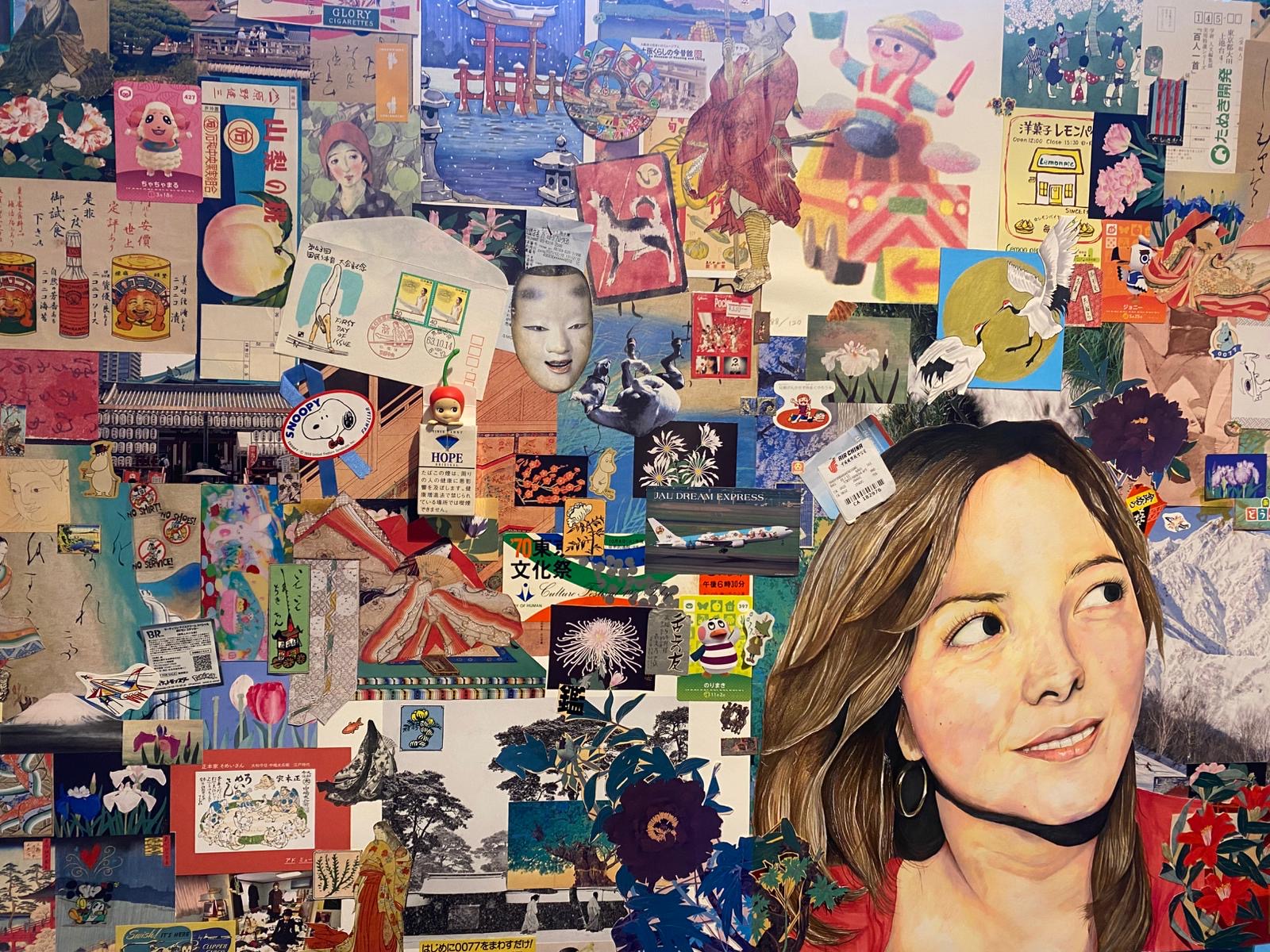
I found other work brilliantly eclectic and unexpected. A small felt cow stood on a pedestal in the centre of the gallery, impossible to pass by once noticed. Next to it sat three inflated sugar packets labelled ‘Daddy’, jauntily placed and boldly coloured. On one of the floor to ceiling windows of the Sultan Nazrin Shah Centre, small microscope slides encased polygons from scans of body parts. I read each label with astonishment and delighted confusion: here a sample from the artist’s ‘Left knee lateral side’, there a piece of their ‘Right pupil’. The layout of the exhibition accentuated the diversity of the art; the large wall space allowed for life-sized paintings, while hanging sculptures were suspended in the open space. The neutral tiles lay as quiet backgrounds to floor pieces. The space was also utilized to question the boundary between gallery and artwork: one mixed media structure demanded that visitors step around it, mixing dolls house furniture with painting to blur fiction and reality.
Other pieces pushed this interaction between artwork and beholder even further. One exhibit consisted of a TV and keyboard, programmed to make the video display become more distorted the more people pressed its buttons. I felt most connected to simpler methods of engagement, however, like when flipping through a small lined notebook full of cartoons and writing. The tactile element to this piece made its themes of bodies, gender, and trauma all the more accessible and potent. Here, I took artistic interaction outside the walls of the gallery, sending photos to my sister and asking her to translate the french speech bubbles. My time spent with other artworks also outlasted the evening of the exhibition’s launch. The next day, I found myself re-reading a Sylvia Plath poem which had inspired one multi-media, abstract drawing in the exhibition. Looking back over photos, I followed a QR code that was attached to one less assuming piece, a box of clothes intended for charity donation. I was amused to find a Vinted account, listing each item of clothing with reasons for giving them away. These explanations ranged from ‘looks quite bad’ to a more hateful ‘i actually never fucking liked this dress.’ The significance of each garment, its memories and stories, made this piece individual and relatable all at once.
The curation of the exhibition also hugely enhanced my experience. Interpretive labels were placed alongside every piece, giving short descriptions of the work along with details of the artist and mediums. Some were incredibly detailed, informing on the artistic process and logistical matters, while others were less wordy. A loud, sparkly ‘Strictly’ sign stuck to one wall was paired with the comically short phrase, ‘I like strictly come dancing.’ A painting of a wonderfully obtuse pigeon was explained as being about the artist’s ‘simple and pure love’ for the birds, ending that ‘Her name is Kelly, named after my friend who looks like it.’ One of my favourite paintings, a watercolour of sharks, had a description which read like a poem – ‘She slides between the waves of the late Cretaceous seas, her shadow blending with so many others’ – and added an eerie atmosphere to the saturated underwater scene. I got a feel for each artist’s voice from these printed plaques, which strengthened the sense of self within each work.
This year saw the introduction of the Provost’s Prize, awarded to four artists in recognition of their outstanding work. Jon Mackay won the prize for Technical Mastery – their print of a station platform uses a restricted palette and a vanishing perspective to create a gentle ambiance. K.B. Clear, winner for Innovation & Experimentation, submitted a painting. Their piece presents three male figures, remarkably dressed, on a black background. Skilful highlights contrast against the void behind the men, and vague ghostly shapes – a suit and head on the left, a dress and hand on the right – suggest other bodies looming in the darkness. The prize for Narrative & Storytelling was awarded to Yasmin Seyfollahi, whose posters explore her Iranian identity and themes of gender equality, womanhood, and freedom. Finally, the prize for Work in 3D went to Kashmira Patel. Her ceramic work, which I have already mentioned, is titled ‘FURY – Violent Eruption’. The tripartite piece displays the natural power of volcanoes and mediates between conflicting themes of destruction and creation. Before announcing these winners, though, it was emphasised that choosing a mere four artists was an ‘impossible task’.
If I had to use one word for the Exhibition 005, it would be ‘expansive’. The work stretched across countries and cultures, ages and occupations. The artists are a diverse culmination of people, each with their own perspectives, which the viewer could attend to and experience at will. The title of Worcester’s annual exhibition is, I hope, telling of future longevity. The student body will be lucky if 005 reaches the triple digits it promises, continuing for hundreds of years to come.
Words and photography by Nancy Dawe
You may also like
The True Cost of Porn: The Monopolisation of the Porn Industry
Open a private browsing tab. Turn on your VPN. Type ‘ethical porn’ into the search bar. Press en
No-one’s Little Girl
“This is a chord. This is another. This is a third. Now form a band.” So reads the infamous illu
In conversation with: Alec Tiffou, Orli Wilkins and Sonya Luchanskaya
Susie: “Alec, would you say you have a niche as a writer?” Orli: “Fucked up shii