
Under Review: On Colneis Road
The path to On Colneis Road is as winding as the one down memory lane. Behind heavily bolted doors lies the New College Warden’s Stables, a space which, much like the sprawling ivy interlaced with eroding stone walls by its entrance, is suspended between past and present, manufactured and natural. The exhibition of sculptures, drawings, and light installations crafted by Ruskin students Kit Callum Rush and Hattie Hone explores collective memory and childhood—inaccessible realities permanently etched in our past yet eternally malleable by permutations in our present. Their art is unabashedly insistent in its nostalgic charm. To quote Hattie, the pieces are ‘interconnected’ in graphic cohesion but ‘elusive’ in location and time. Kit agrees: ‘A return to something familiar but partially mythologised.’
Sunlight diffuses softly through the stable doors, not quite reaching every corner of the cavernous space. Sparsely occupied by familiar objects, the stable encloses a capsule of schoolroom miscellanea. Two lightboxes are situated against opposing walls, their decidedly electronic glow acting as the backdrop to scaled-up recreations of vintage tea cards on each of their faces. ‘[A]ll systems GO’, one declares from its dark corner, voice tucked away despite its bold text. ‘HISTORY OF AVIATION’, the other sagely replies. The naive desire to take flight is suggested throughout the installations: a frayed Japanese airplane seatbelt dangling loosely from a crooked nail, its faded print still legible, though perceptibly bleeding—‘DO NOT Use for Child Seat’. Gold stars stapled across the When I Grow Up bulletin board, the realism of childish scribbles on worksheet templates torn to pieces by one conspicuously sophisticated drawing in their midst. ‘When I Grow Up, I want to be…’ the printout in Comic Sans prompts. The clearly adult lettering responds: ‘TROUT.’
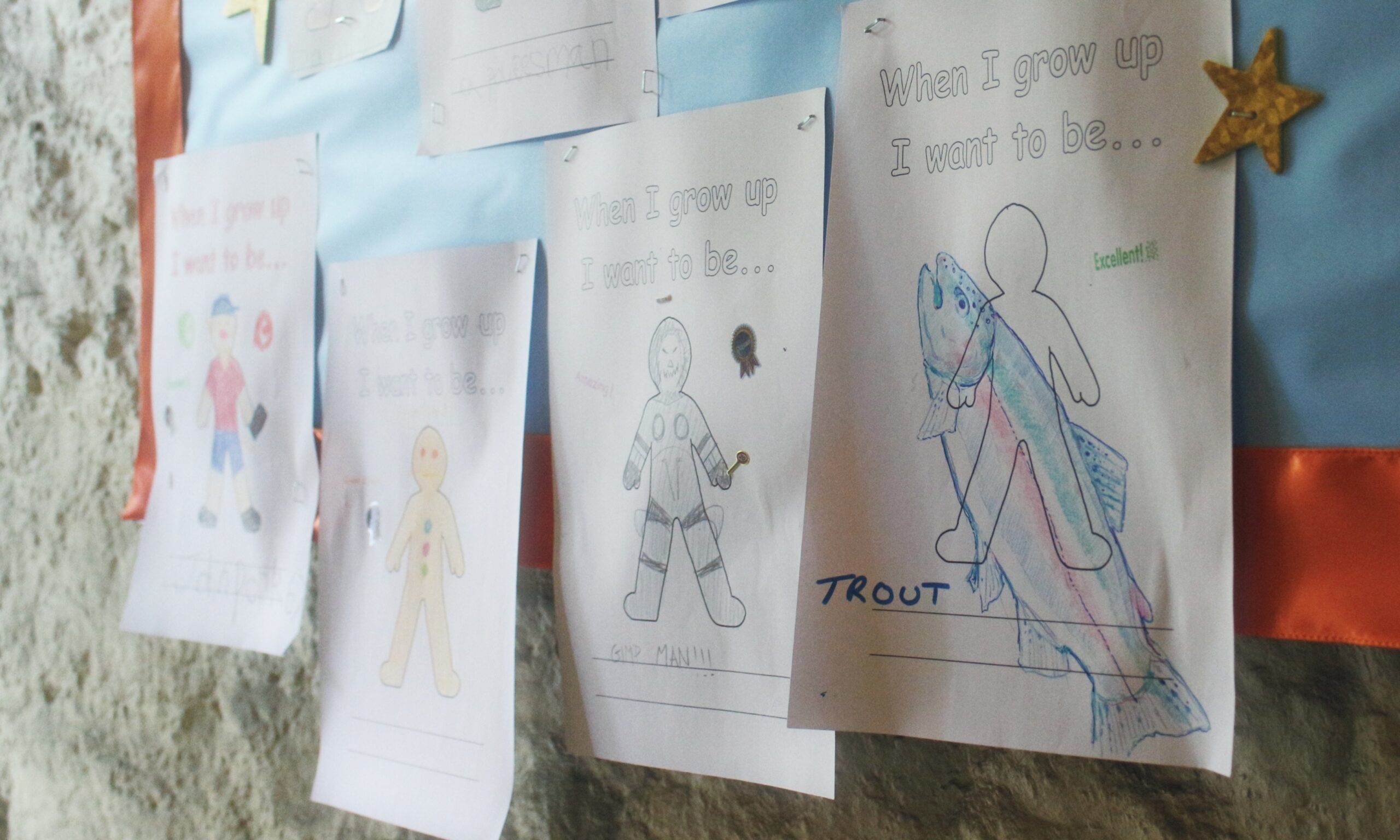
For all the imagined and reimagined fragments which the On Colneis Road exhibition promises to recall, one must wonder how loyal this diorama-esque collection of objects remains to its mission. The When I Grow Up board asks one of the most common questions posed to children, yet displayed are creations by young adults of the present, imitating past aspirations of a future which has yet to manifest. ‘I want to be.’ The tacked up worksheets declare this with a larger than life confidence—a confidence carried by tiny shoulders bearing colorful backpacks the size of their torsos, in bodies that may always be hoisted onto the reliable shoulders of someone larger, somebody older and wiser.
What does it mean to ‘be’?
The clumsy-handed child does not see past a literal ‘be’: to be a name, an occupation, a family member; to be one of the many figures towering above them. The clumsy-handed child, despite being penned by a university student, has not lived enough life to see the unspoken rules waiting to be broken. The adult artist returning to this familiar question sees much more in what they can ‘be’—a different species, an emotional state, an internet meme.
When I grow up, I want to be…
‘Loved,’ replies one anonymous contributor, adult sincerity permeating from behind the masquerade of childish innocence.
Alone in the center of the stable stands a retired pommel horse, splay-footed with her head lowered. Tina the pommel horse was one of the few pieces specifically created with the New College stables in mind—despite her attempted graduation from pommel horse into a rocket, she remains transparently equestrian in form. In some ways, the exhibition reanimates the long-gone equestrian bodies that once inhabited the last of Oxford’s college stables still standing, yet there is something of a perpetual dying in Tina’s stillness. A vintage pommel horse brought into an art exhibition, bearing stencil-painted NASA logos on its flanks and a wooden fin drilled down through its leather skin. Reborn as a rocketship featuring in countless childhood dreams, yet doomed to never fulfil her original purpose again. ‘We wanted to repurpose it because she looked incredibly sad’, Kit says. ‘She still does.’ While the artists breathe life into the space by returning a horse to an unused stable, Tina is consigned to straddling the boundary between her retired and renewed identities as defunct pommel horse and reimagined rocketship, neither more visible than the other.
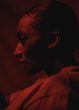
Childhood memories are an incurably permanent fixture of our past, susceptible to reinvention and corruption by every piece of information acquired through our ever-evolving inventory of experiences. The shadowed, almost-forgotten yet whisperingly influential corners of our memories are embodied by a tucked-away room deep into the stable. A far cry from tall ceilings illuminated by LED chandeliers, the wall physically dividing the two spaces obscures the contents within and guards all but a sliver of light from entering. In this darkness, the images, the acoustics, and the mood all become muted—‘Sinister,’ Kit says. ‘A shrine,’ says Hattie. Greyscale headshots are lined up on a bulletin board simply titled ‘Staff Board’, with Kit and Hattie’s peers featured in ununified style and emotion. Kit tells me that behind the camera, Hattie provided them with only one prompt—‘Do you want to be a happy teacher or an angry teacher?’ The photographed individuals are flattened into printed archetypes formed by a one-dimensional worldview, unnamed images known solely by their titles.
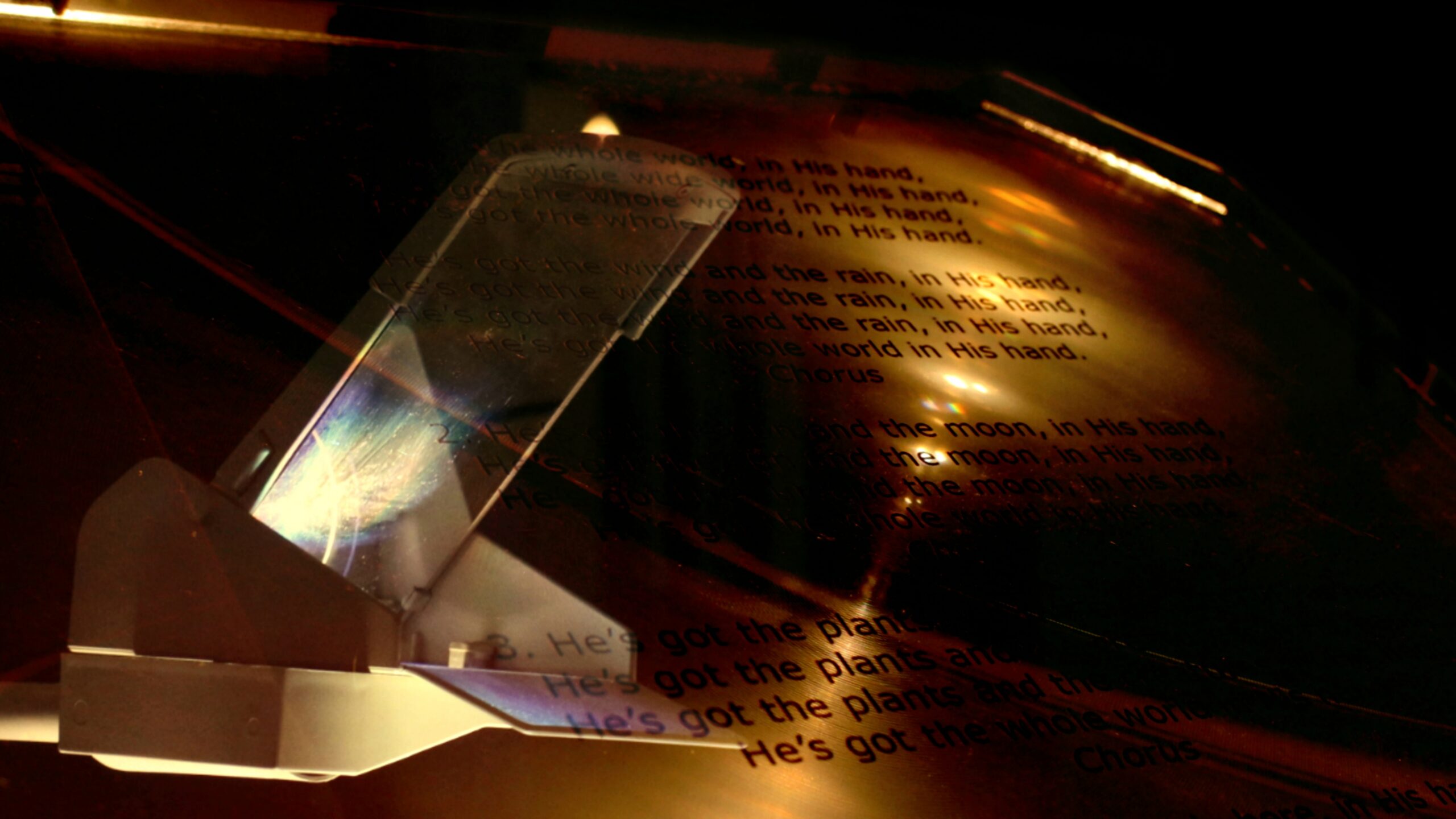
This pendulum between collaborative memory and individual imagination is most strikingly encapsulated by the projector sitting between the two divided spaces. Acquired from an old school in Devon, the machine projects song lyrics printed onto clear acetate sheets, the projected lines conforming to the jagged edges of the stone wall of the stable and dispersing into bursts of color with chromatic aberration. When questioned about selected lyrics and fonts allocated to each print, Kit laughs: ‘We just printed them like that,’ denying intentionality behind the varying moods expressed by each typeface and verse. The songs were ‘fundamental to core values of growing up,’ he adds, remembering being taught to be ‘lovely, open, and accomodative.’ These surplus sheets are hastily tucked beneath the warm body of the projector, a silent dare for viewers to dictate what future audiences will see. The acetate sits cleanly printed above the machine’s warm whir, yet through the lens travels a beam of light dancing with dust, landing unsteadily on the imperfect expanse now painted in color. Words laid down by assumed adult authority wash over the child, reproduced in overlapping echoes.
On Colneis Road makes visible scattered shards of memory that are immediately recognisable, Kit and Hattie’s installations fusing with the viewers’ decided interpretations. The experience of childhood is tentatively collective, but far from shared. Undeniably personal threads weave themselves around the room to embody both Kit and Hattie’s ‘childhood inspiration and forward thinking’, yet they accept that while certain pieces may ‘evoke responses quite strongly, other people won’t associate as much.’ Their pieces are rich with hidden stories nurtured throughout the production process, yet inaccessible to viewers. As we continue down our winding paths, the stable doors may remain unbolted but closed for the time being, light slipping through its hinges to kiss the undusted items within.
Words by Remie Cheng.
Photography by Remie Cheng.
You may also like

Varsity Arts Night: The Isis x The Mays
Friday 2nd February, 7-10 pm Art by Dowon Jung.
Panda Porn and Jurassic Park: why should we conserve species that refuse to have sex?
You know the vac has reached a new low when you start searching up panda porn. Not the
Top G Diffusion Filter
Andrew Tate. Dostoyevsky. Subterranean Homesick Blues. Couperin. Turbo-folk. Durex. Henry Fie