

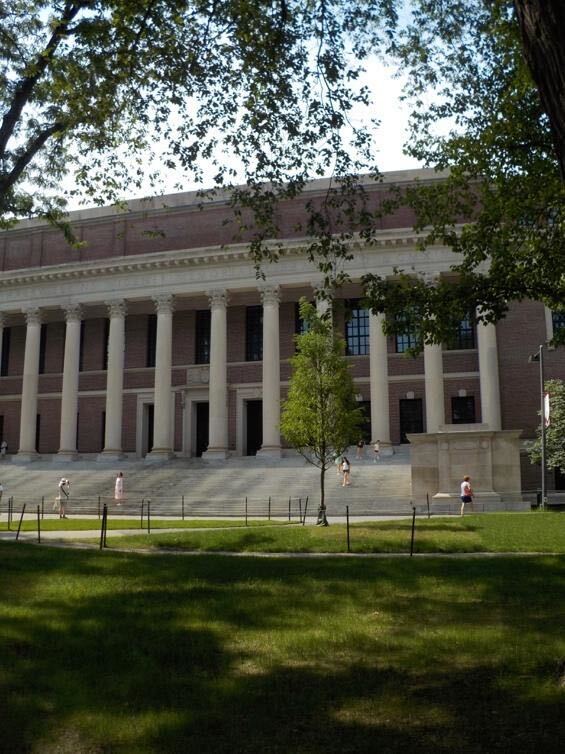
Greetings from Boston
Boston seems to stand alone amid the current political clusterfuck of America. Clusterfuck is not a word one should use lightly— not language befitting a postcard— and yet, it is the only term suitable for a nation taking a hacksaw to its own foundational pillars.
I don’t mean that Boston is entirely exempt from the tyranny of America’s leadership. Although Massachusetts voted overwhelmingly Democrat in the 2024 elections, the city is in a state of tumult. There are mass strikes across public services. The restaurant where I’ve spent 35 hours a week serving gourmet sandwiches lives in uneasy awareness of ICE. My aunt and uncle are scrambling to get a European passport, while their neighbours pray that their Brazilian family can get a visa for their son’s wedding.
The Bostonian bubble has been, for the most part, unwillingly plunged into America’s current state of affairs. Massachusetts’ beloved Senator, Elizabeth Warren, ran in the Democrat presidential primaries of 2020. My grandma’s voracious participation in her phonathon, and the campaign T-shirt my mum wears to this day as running attire, both serve as a testament to the city’s long-standing support of progressive politics.
However, time and time again, the electoral college has subjected the nation to the will of the minority. In the 2024 election America made its choice – an unwilling one at that for the city of Boston. The sheer rarity of an American city composed primarily of buildings more than a century old conveys a powerful message; the ‘No Kings’ movement becomes even more pertinent in a city with roots in the earliest days of the United States and its time under a monarchy.
Boston can be defined by four things: its abrasive accent, an absolute reliance upon Dunkin’ Donuts, the overabundance of college students and the Tea Party of 1773. The city is home to some of the most brilliant— highly caffeinated— minds in the country. Harvard’s ongoing battle against the Trump administration’s cuts to student visas, federal funding and free speech stands as a lone beacon of hope after the likes of Brown, Columbia and UPenn have been forced into concession with newly imposed federal restrictions. It is easy to forget, particularly studying at Oxford, that the privilege and independence of university education is inherently fragile and easily confiscated.
On a geographical level, Boston is a uniquely constructed city. Large sections sit upon manmade land, mudflats and marshes having been deliberately filled in centuries ago to accommodate the city’s expansion into its watery surroundings. While the iconic autumnal tones of the redbrick houses of Beacon Hill and Back Bay have come to be regarded as quintessentially Bostonian, as well as its iconic skyline, it is ultimately the ground itself which is so unique to Boston. The city feels incredibly walkable, a city built and expanded for the people who inhabit it. It centres people and communities in a way that increasingly feels lost in Trump’s America.
My personal experience of ‘Trump’s America’ this summer has, in truth, been limited to the occasional sighting of a Tesla Cybertruck in the wild, and forwarded emails from my grandma about his absurd rooftop press conference. I realise, however, what a privilege it is to be spending my days off work in the Boston Public Gardens, playing Where’s Wally with Red Sox baseball caps rather than MAGA paraphernalia. Boston is a city that proudly wears its own merch, whether it’s the iconic Red Sox font or the green clover of the Celtics or the brown hues of the ice hockey Bruins. To me, this makes Boston feel uniquely its own. During a time when patriotism to me feels luridly off-putting, I’m grateful for the city’s adamant self-positioning as Bostonian before it is American.
My favourite part of Boston isn’t actually in the city itself. Rather, it’s Walden Pond, temporary home to the essayist and philosopher Henry David Thoreau, and birthplace of iconic transcendentalist novel Walden. A voyage to the pond requires bug spray, an awareness that crawfish are in fact real and not just seen in seafood boil TikToks, and – in typical American fashion— a car. The pond far exceeds its measly title with a circumference of almost 3km, and a shoreline peppered with little stretches of beachy inlet. These coves will be inhabited throughout the summer by small groups of families, couples, and the occasional herd of White Claw-toting, mullet-rocking, ‘Kids’ by MGMT-playing, loudly-spoken Bostonian teens. Boston is not Boston without its vocal and intrusive inhabitants, even at a pond immortalised in the literary world for its isolated tranquillity.
I must admit that, when I’m at the pond, my mind is generally focused on walking the fine line between optimum sun exposure and avoiding a next-day lizard cosplay. However, there is something to be said about the continual resonance of Thoreau’s environmental philosophy. His concept of casting off the illusion of wastage and over-consumption in pursuit of personal fulfilment feels before its time.
Boston is a city that gets lost amidst the Vegas style strip malls and Microsoft Grand Canyon screensaver images of America. It feels uncomfortably ironic that one of the American cities most resolutely opposed to Trump’s presidency is simultaneously one of the oldest in the country, inherently reminiscent of a history under despotic rule through the very red of its bricks and the bustle of its harbour. The city curls in upon itself, its abundance of students and history an increasingly rare yet all the more necessary presence in Trump’s America.
Words by Eve Williams. Image courtesy of Eve Williams.
You may also like
noughtie and nice
★ ✩ ✮ ✯ ✰ ☆ ⋆★ ✩ ✮ ✯ ✰ ☆ ⋆★ ✩ ✮ ✯ ✰ ☆ ⋆ It’s 5th week. T

Talking Stunts with Kai Martin
So Kai, what have you been working on recently? I’ve been working on the Amazon Prime TV sho
ARTIST SPOTLIGHT: William Schwabach
‘Film from Sarajevo’ Ilford 100 ISO B&W 35mm film