


Under Review: Oxford Journalism
Last term, on the cusp of exam season, some friends and I decided that we were a part of a peripheral Oxford, an Oxford B, we called it, that existed beyond the university as it was meant to be. I had the impression that other people were entangled with the university and its happenings. Whereas I was living far off in the distance and I’d commute into this landscape when it was time to go to a tutorial or out clubbing, but mostly I lived apart. Now, six months later, I realize that my friends and I were tired and talking nonsense, inventing justifications for ourselves during a stressful period. But this melodramatic impression came from somewhere: it was a matter of what I had been reading.
I had become addicted to the fluff pieces in student newspapers. This kind of reading (the slice of life articles, the Oxford surveys) probably shouldn’t have been my main informant on other students’ lives, but I was looking for something to believe in. I had it in my head that I was one student article away from understanding, one away from the ultimate reading experience: to find myself reflected in the words of someone else. In most of the pieces I read, I struggled to see myself or anybody else. Instead of recounting individual experience, these pieces made shorthand references to our ‘shared’ experiences as Oxford students. As if, paradoxically, these articles were not written for Oxford students at all but vague outsiders. To see such terms as ‘hungover tutorial’ and ‘union hack’ and be at a loss for their meaning felt embarrassing. The way these details were picked out and glamorized, as if they were supposed to bear some significance was frustrating. It made me feel like I had missed out on some obvious revelation because I had experienced these things for myself, but in their generic presentation I was unmoved by them.
My study breaks were filled by perusing articles that reported on the hilarity of Etonians dancing in clubs and the debates about Derrida you can overhear on the Oxford high street—lines like ‘ in X coffee shop you’ll overhear students debating hegemonic Y’. I knew images like that were factually correct, but I couldn’t make myself believe in them. I never thought anyone was lying, but I felt, with so much certainty, that they were being untrue. The presentation, the cadence, the reductionist view of the city and its university work together to give this impression of untruth, making you feel as though you must be living in a different place altogether. The truth is, students have those kinds of conversations all the time, in Oxford and everywhere else. In these instances, a general, surface-level view of Oxford as a hodgepodge of various quirks is actually what reinforces the ‘bubble’. Oftentimes these articles like to ask questions like, where else could you see x? Many places. We fawn over these so-called idiosyncrasies as if they are idiosyncratic, neglecting the fact that most of these things happen elsewhere, that they are not features of Oxford but features of life.
In fairness, many beautiful and compelling things happen to me here exactly the way these articles say they do.I know what it’s like to have academic debates in different places around the city. It is a valuable part of my life here, but also one that I’ve experienced in different variations across my lifetime. By being presented as an ‘Oxford’ thing, casual academic conversations are made to represent some kind of elevated university experience, completely stripped of their personal significance. It’s incredibly elitist, of course, to represent common experiences as miraculously improved once they happen within the city limits.
Even pieces that argue against the romanticization of Oxford do so by decrying dreamy pictures of the RadCam, highlighting exam-induced crying fits and academic stress. But I’d argue that oftentimes depictions of these scenes, vicious student politics, library breakdowns, etc. as something unique to Oxford advance romanticization in a more insidious manner. I’ve become so familiar with lists of these Oxford experiences that it feels impossible to write about them without being hypocritical. The truth is that I have cried a lot at Oxford, but I cried a lot in school. I’ll cry a lot after graduation, and I’d cry just as much at any other university. My point isn’t necessarily about crying, just that I think it can be helpful to view Oxford as a container for life, not its catalyst.
Though writing about our lives is a difficult task in which we risk boring an audience with the tediousness of self-importance, thinking too much about comparisons and distinctions between experiences sometimes means we neglect the experiences themselves. So much of student journalism at Oxford is framed around the basis of difference, typically those between the university and the vast, undefined not-the-university. In many ways, this angle is indicative of well thought-out, smart journalism. These pieces are destined for newspapers and magazines; they are expected to have a newsworthy quality, so their writers latch on to notable differences. But these pieces often fail in the selection of their normal. They write about Oxford as it exists in relation to other universities but these universities are not named or clarified; they write about our lives as if they intend to compare them to other lives but rarely get around to explaining what these other lives are like. This frame of reference has its utility, but it belongs to articles with a hard-hitting, journalistic bent. Its effect is lost on fluff and slice of life pieces.
I understand why these pieces often frame Oxford from the outside—it mostly, I think, happens for two reasons. The first reason is that there’s a time when preparing people for the thousand cultural shocks of Oxford matters. Recently, it was freshers’ week, and I was reading a lot of freshers’ guides and remembering wanting to conceptualize Oxford. The second reason is that the journalistic positioning of us vs. an invisible, unmentioned them does create some sense of belonging. It is nice to initially recognize the relevant placenames and rites of passage in Oxford, to be in the know. But both of these purposes would be better accomplished if we wrote from the perspective of us vs. us, studying our lives as they relate to one another. To read that kind of writing would have made me realize, back then, that there is no such thing as a peripheral Oxford. There is just our lives and the way we represent them. We need more Oxford journalism written explicitly for students. Counterintuitively, I think this is best achieved by stopping trying to write great journalism about Oxford life. If we only try to write about ourselves and our days then the natural influences of the city and university will show up where they matter. Surely then we’d cease to find cliches worth repeating.
Words by Olivia Bolan.
Art by Georgia Graham.
You may also like

University: An Only Child’s Guide
In my experience, only children are raised in two ways. The first has always been treated as a child
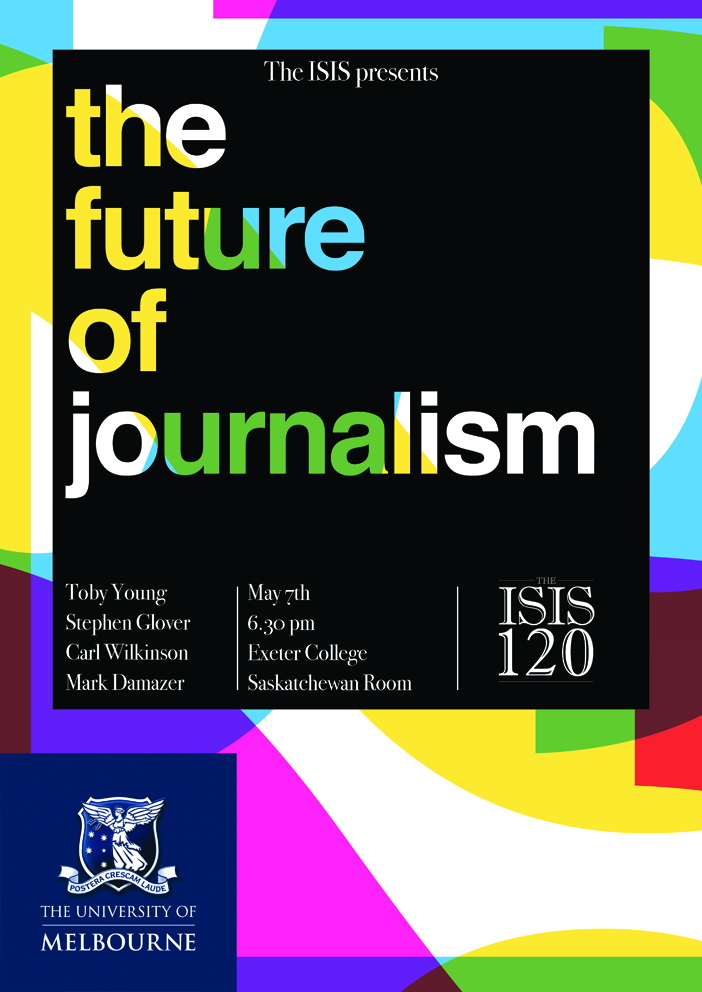
The Future of Journalism Panel
THE FUTURE OF JOURNALISM PANEL DISCUSSION // Are newspapers viable in the 21st Century? // // Ho

The Isis at Fresher’s Fair: Stall
Incase you missed us at Fresher's Fair, e-mail [email protected] to sign up to our mailing