
Under Review: Gainsborough and Shonibare
Thomas Gainsborough’s painting ‘Mr and Mrs Andrews’ (1750) and Yinka Shonibare’s sculpture ‘Mr and Mrs Andrews without their heads’ (1998) sit down to have a conversation. For the first time ever Shonibare’s piece (a life-sized 3D replica of the scene in Gainsborough’s painting) has been put on display alongside its inspiration. Standing at the doorway to the exhibition – a collaboration between the National Gallery and the National Gallery of Canada – you can see both pieces at once.
The orientation of the room is symmetrical, so neither artwork or artist is given preference in your hierarchy of attention. There is the same amount of space dedicated to each piece, the same tone in their explanation and the same number of lines dedicated to their descriptions. For Gainsborough, it’s the 300th anniversary of his birth; after this exhibition, his painting will be sent to where it was painted. For Shonibare, this display is yet another jewel in his crown in the past decade. He was named Artist of the Year in 2022 by the Princess Estelle Cultural Foundation and is currently designing a national memorial to Queen Elizabeth II in St James’ Park. In this exhibition, there is no hierarchy of master and student or past and present or even painting and sculpture. Rather, two works from two culturally relevant artists are simply allowed to co-own this exhibition room until February.
Thomas Gainsborough was born in 1727 in Sudbury, England. He left his hometown to study art in London and became a prolific English portrait and landscape painter, although his real passion lay in landscape. He was a founding member of the Royal Academy, which Shonibare would later become an Academician of.
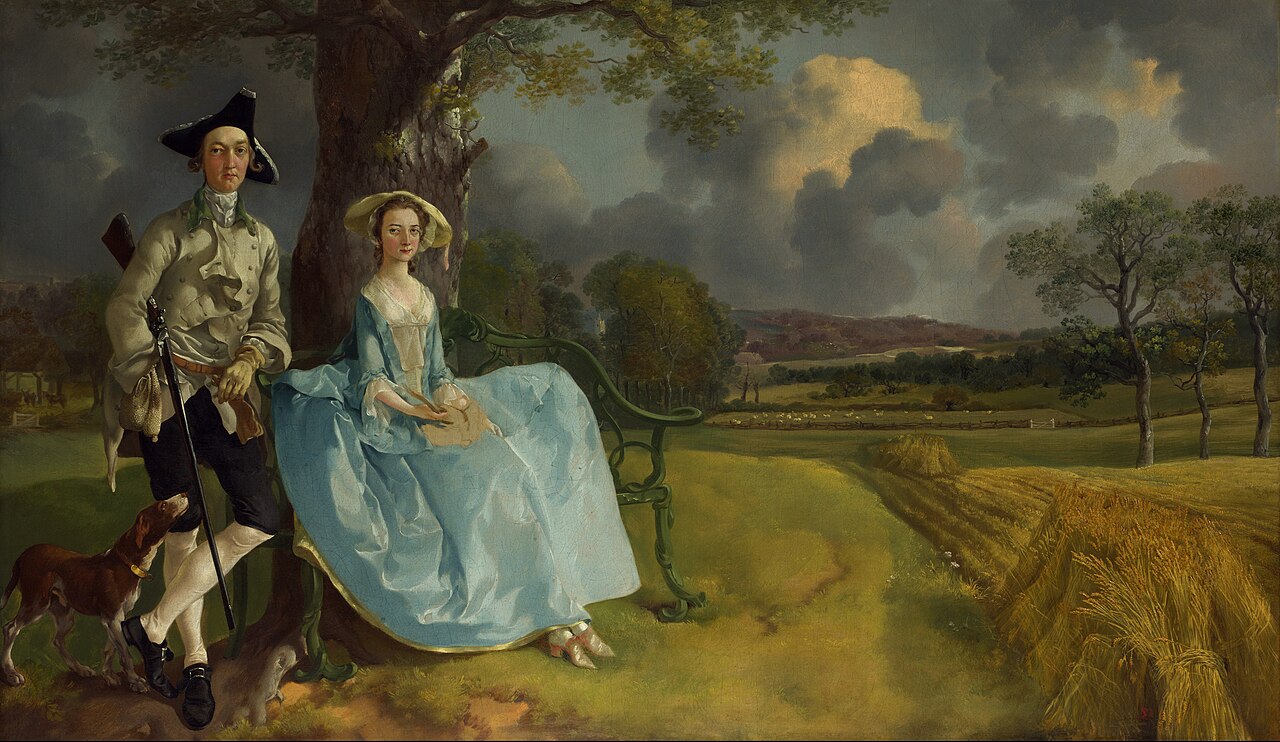
His interest in realistic natural environments was unusual for his time, and is demonstrated in this particular painting. Despite being commissioned to depict the recently married couple, it desperately wants to be a landscape itself. In the exhibition notes it’s described as “not just a double, but a triple portrait of Mr Robert Andrews, his wife Frances and his land”. The composition, a landscape canvas, is half entranced with the rolling hills and the harvest behind the newlyweds, as though the painter shifted his gaze halfway through painting and couldn’t quite look back at them afterwards. The couple themselves are placed to the left-hand side of the pastoral tableau, though neither figure seems concerned by the painting’s infidelity.
In the painting, Mr Andrews is posed beneath an oak tree with his hunting rifle and dog. His wife is perched at his elbow, her skirts blanketing a quaint green bench and a curious unpainted section in the middle of her lap. Presumably, here she’d hold a bird he’d shot, though why Gainsborough left it unfinished is subject to speculation; perhaps to show the lady’s disdain for the corpse, perhaps in sexual innuendo, perhaps a reference to a newborn child or perhaps just as an inside joke between the two men that Mr Andrews was a bad shot. It’s hard not to find something playful in the blank.
Surrounding this blank space is Mrs Andrews’ gorgeous pastel blue dress. Wearing it, she wouldn’t be out of place at a dinner party with any of Gainsborough’s other beautiful European women, with Mr Andrews in his matching stiff cotton suit. Shonibare’s assessment of the couple as wearing a kind of ‘costume’ of British aristocracy is hard to ignore when considering the two as a set. Both are pristine despite the farmland they’ve presumably walked through to get to this tree, and though they are incorporated into the scene well, they still look too polished to truly live in it. Almost as interesting as the figures who are there are the figures who aren’t, which the curator, Rab MacGibbon, makes note of in his speech. The farmhands, whose presence is implicit in the harvested corn and carefully-constructed fences, are notably absent from the finished piece.
Yinka Shonibare, meanwhile, was born in 1962 in London, but spent his childhood in Lagos, before moving back to England in 1989 to study Fine Art at Byam Shaw School of Art. He first encountered ‘Mr and Mrs Andrews’ at school, where he saw it as an ‘icon of Britishness’. For Shonibare, this iconography is woven into the very material and landscape. It’s these elements that he so lovingly refashions in his piece, alongside the married couple.
‘Mr and Mrs Andrews without their heads’ dominates its half of the room, despite its background being entirely blank. It consists of two life-sized wooden mannequins in the exact same composition as the couple in the painting. Shonibare has, however, replaced their pastel cottons with African print Dutch wax cotton (ankara) and their fields with a white background. Central to this style is absence, in this case the absence of their status signifiers and identities of power. Removing the newlyweds’ heads can be read as a shorthand for anti-authoritarianism, calling to mind the French Revolution that took place in the generation after Gainsborough’s. It is also just eccentric, delivering its iconoclasm with a wink by using the Andrew’s figures as clotheshorses for the ankara fabric.
Yet the fabric itself is not necessarily an ‘authentic’ West African fabric. Rather, it is indicative of Shonibare’s self-identification as a ‘postcolonial hybrid’ between Africa and Europe; the fabric was initially introduced to Africa by Dutch merchants in the 19th century. Here, the fabric is a means of an exchange, as in Shonibare’s words he, ‘removes their [the Andrews’s] identities and the landscape and replaces their costumes’ with something altogether different. Identity in this exhibition works in negotiations, and including Gainsborough’s artwork and his sitter’s identities into these negotiations is as bold as it is necessary. Such a technique works well in a conversational exhibit, because it is intentionally and inherently built to be a response to something.
What does it mean, then, to call this exhibition a ‘conversation’? The intimacy of a ‘conversation’ almost hides how daunting the topics Shonibare’s work contends with can be; particularly postcolonialism, anti-authoritarianism, and deconstructing empire through art. Yet his piece is funny and lively and in my opinion does manage to exchange ideas with the Gainsborough painting. It helped me to better see the subtle comedic snubs Gainsborough made himself, and also to consider his sitter’s clothing in much more detail. Moreover, the language used by the exhibition to describe the two pieces’ relationship was always warm, focusing on admiration and inspiration rather than implying that either one reduces the other.
In his speech, the curator MacGibbon never set the two pieces in opposition to each other. Rather, he highlighted dialogues, telling us that ’artists have always emulated, challenged or rivalled the art that came before them.’ This applies just as much to Gainsborough as it does to a modern artist like Shonibare. After his presentation, I went over to ask him about the exhibition (as well as to compliment his incredible woven tie) and he gave me directions all across the National Gallery to find more pockets of dialogue between artists. This exhibit is a particularly loud example and an excellent starting point, but there are quieter conversations all across the gallery if you have ears to hear them with. He talked me through the entire artistic pilgrimage you can walk between rooms 15 and 18, where Gainsborough is in dialogue with Reubens and other Old Masters; a new link he’d only discovered recently. Something in his still fresh excitement over that fact cast the museum in a much more vibrant light to me. These constantly emerging transhistorical dialogues can expose new elements of old pieces (for better or for worse), give non-canonical pieces more attention or even just pull old works out of well trod analytical footpaths. The dialogues are best when they go both ways.
Ultimately, as I walked away from the exhibition, I felt I understood both artists better for having seen their pieces so closely together. There is a danger in reducing pieces to ‘inspired’ or ‘inspiration’, but for me the space these museums have created successfully resisted these reductions. The two pieces were simply allowed to converse, and in-so-doing reached for something far more interesting than if they had been displayed separately.
Words by Rhiannon Bullivant.
Image via Wikimedia Commons. Art by Georgia Graham.
“Yinka Shonibare and Thomas Gainsborough: A Conversation” showing at the National Gallery, London, until 7 February 2027.
You may also like

Portraying
Hetta Garber had been his muse. She was sitting on a divan, watching him paint her. If she leant bac
Tea-time: in conversation with Na Kim
Na Kim is a Korean graphic designer based in Berlin. In the past, she has trained at the Werkplaats
Seeing Double
Squirrelled away in Room 65 of the Ashmolean Museum are two remarkable landscapes. The paintings han