

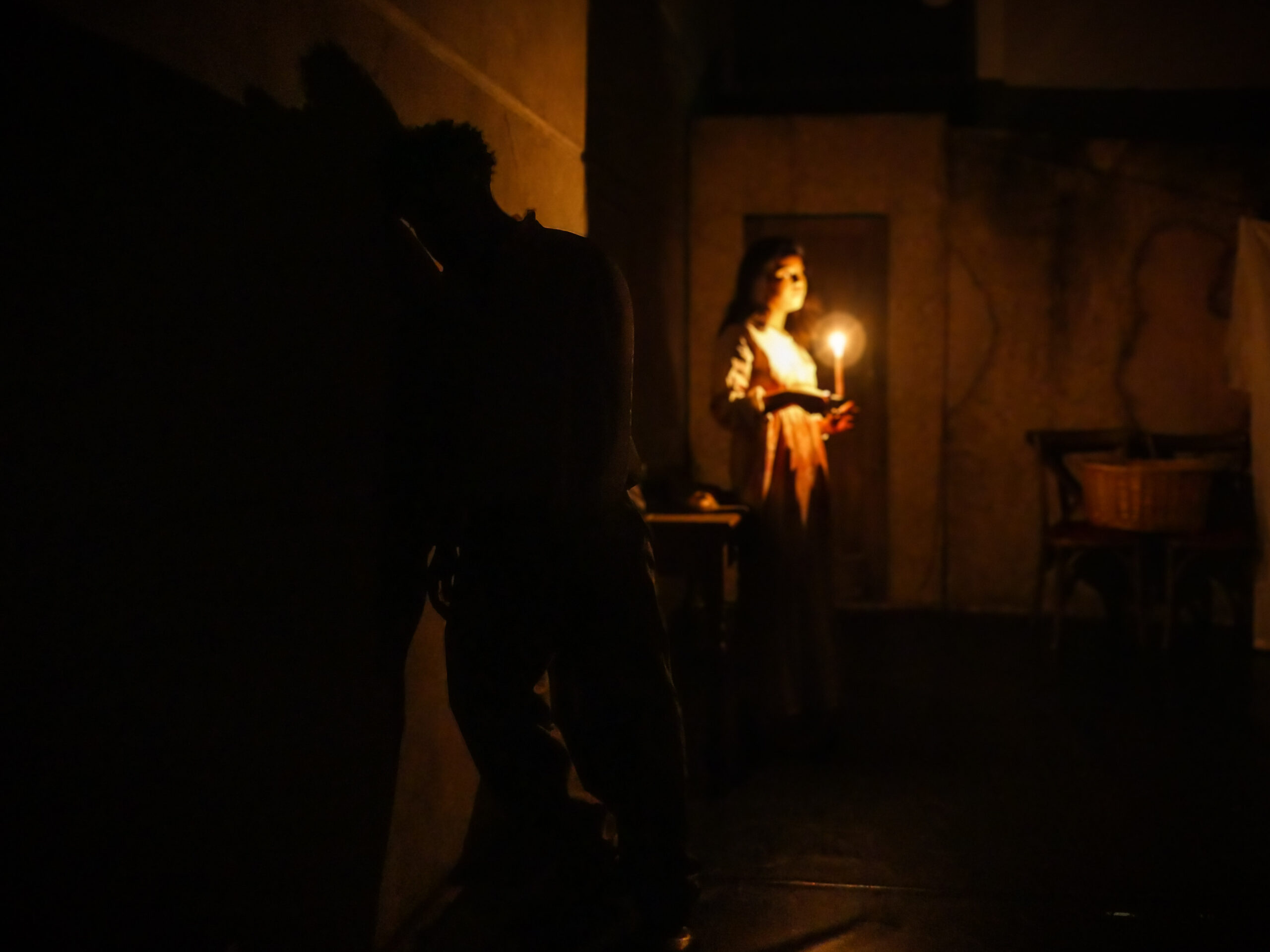
Pre-Show Interview: The Welkin
On an icy morning in the Lamb and Flag, I sat down with theatre director and fellow Joshua, Joshua Robey, aboutFennecFox Production’s upcoming performance of The Welkin by Lucy Kirkwood.
Describe The Welkin in one sentence and three adjectives.
The Welkin is a legal thriller about women that asks about the price of justice. [A pause]. I can give you three nouns: mud, blood, and tears.
These are visceral nouns, perhaps unexpected for a legal thriller. In what form are they present in the play?
The play is centred around fourteen women and three men who debate the circumstances of a child’s violent murder. A male jury has already declared the defendant guilty. The women, who constitute a jury of matrons, must determine whether the defendant is pregnant. The defendant’s life hangs on the line. If she is pregnant, she will only be transported to America, rather than executed.
[The Welkin] is interested in bodies and how abstract legal ideas interact with the grim physical reality of life. The play is set in 1759, where so much domestic labour is done by women. These characters go through constant physical exertion: doing the laundry, cleaning, childbirth—all brutal, grueling experiences that bond the ensemble of female characters together. That is the mud.
This society is steeped in blood; the murder of the child horrifies but the everyday potential of execution and the constant deaths of the poor are seen as normal and natural.
As for tears, you’ll have to come see the show.
But the audience won’t be shocked in quite the same manner as the characters.
Well, some of the characters are unfazed by the murder; they’ve been brutalised by life, and their expectations for justice and humanity are much lower than those of people today. But the forces oppressing them still exist, alongside their power to shock a modern audience.
How did you decide on this play at this time?
I’ve always been interested in Kirkwood. My first play was The Children, and I did my masters dissertation on her work. I’m interested in how she works with political change: The Children was quite optimistic in that regard, while The Welkin holds a take which is both optimistic and pessimistic. More immediately, I chose The Welkin because I have not yet done an ensemble play on this scale. Company [a previous play Joshua directed] had fourteen characters, but they spent most of their time on stage in little groups. For roughly half of The Welkin, all fourteen characters are on stage at once, and I wanted the challenge of keeping all their relationships alive and interesting.
With this many characters you can work through an issue from several angles. We found in rehearsal that almost every character in the play is shaped by past violence in their attitudes to the world, sex, relationships, and justice.
How does your production differ from previous ones such as in London and NYC?
Design is a way to create unique atmosphere. The design used in the National Theatre production had a timeless quality through its minimalism and lack of period-specific decoration, while ours aims to be similarly timeless while having a more expressive quality. The play is really shaped by the environment in which you’re doing it, some moments are definitely sharpened by being performed here in Oxford.
It’s also a play constantly being reinformed by contemporary events. There’s a lot of discussion about culpability: the extent to which people can be said to be culpable for their actions or not, either through medical reason or coercive control.
How does the nature of student theatre affect the production?
The play is very interested in ideas of community and its formation, so doing it with students resonates well in that regard. It’s quite an unusual play for an Oxford student production. It’s rare for there to be this many female characters in a play. Often, in something like Shakespeare, you genderswap some characters to make the production more representative. Here, the characters played by actresses are originally written as women. In fact, the only man present through most of the play is forbidden by law from speaking.
Any final remarks? Favourite cast member?
There are no favourites. It’s a glorious ensemble show; even the leads share stage time and responsibility with all the other characters. The play is a real challenge for the actors, but they are rising to it phenomenally; there’s a real heart, action, and richness in their performance.
Words by Joshua Robey and Joshua Tobin.
Photo by Camille Branch.
You may also like
Is conscious rap still conscious?
I remember standing in the crowd at Kendrick Lamar’s DAMN. tour, hearing “Alright” live for th

Pest Control
Around mid-March, my mother developed an obsession with killing wasps. The weather was still

Did We Get Marie Kondo Wrong?
That manky old jumper doesn’t spark joy anymore? Bin it. What about those trousers you never wore?