

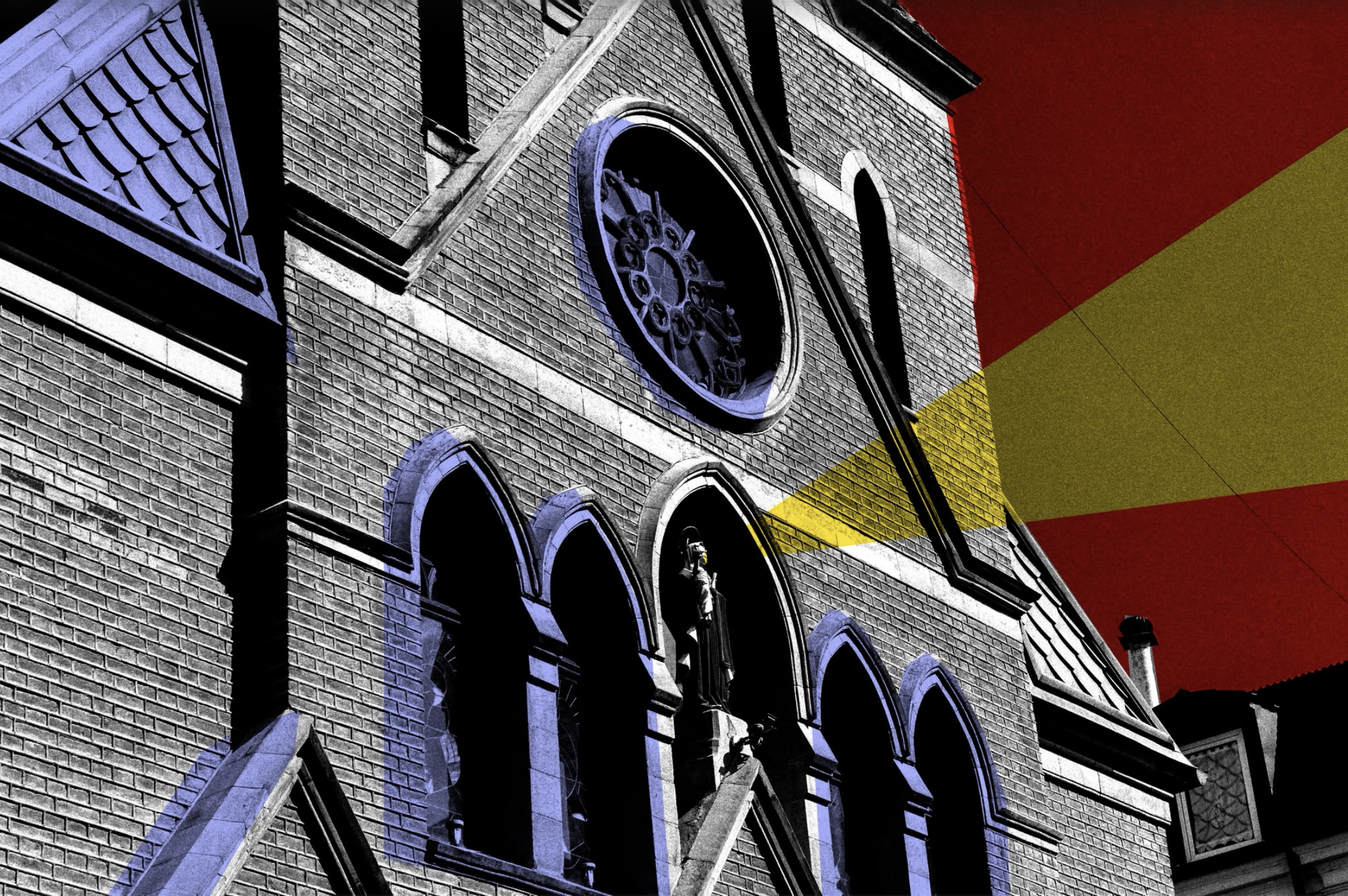
Guillotine: Religion’s Treatment of Women
Religion shapes the lives of every individual, whether that be through a person’s adherence to their respective faith or an individual’s decision to reject the institution. With approximately 76% of the world’s population practicing a religion, its influence over us is undeniable, and its interrogation vital. Whilst there has been a growing tendency to dissect religion and expose its dangers, one tendency remains generally overlooked: the unjust treatment, and oftentimes exploitation, of women.
Take Christianity for example, because the Bible has demanded their silence (1 Timothy 2:12), women cannot be ordained in a Catholic church. And yet, the 2010 Equality Act criminalises gender-based discrimination within the workplace, something which the Church is inexplicably exempt from. If it’s not permissible in the typical workplace, how can it be justified in the Church, the same institution that vows to protect and lead its followers, including its female devotees? What could possibly justify this systematic exclusion of women? Equally, a similar hierarchisation of men over women is prevalent in other Abrahamic religions such as Islam in which women are physically isolated from men during prayer in the name of modesty. Whilst this appears innocuous enough in its supposed protection of focus and virtue, this isolation often subjects women to cramped conditions where they must rely on speakers to hear the Imam’s words. This normalised subpar treatment then exemplifies the position of inferiority which they are forced into even in ordinary life.
At the extreme, religion has also been used to justify outrageous demonstrations of gender-based violence. In Afghanistan, the rule of the Taliban has completely destroyed the lives of women and ripped away their human rights. Prior to Taliban control, Afghan women could vote, attend university and sport whatever clothes they wished to wear. Now, these same women are restricted to the confines of their homes and burkas and are deprived from pursuing an education after the sixth grade. Men, on the other hand, are similarly restricted by Afghan law in terms of their conduct and appearance but face no similar affront to their human rights. In fact, they remain a woman’s closest source of freedom as it is the presence of a male chaperone (a mahram) which permits them to venture outside. Voicing their suffering has since become a “privilege”, a privilege which they cannot access, as the 2024 “vice and virtue” laws forbid a woman’s voice from being heard in public. Now what is it that makes a woman’s voice a “vice” whereas men can vocalise their opinions with comparatively less restraint?
The existence of religion and society’s obsessive adherence to it, has consequently enabled both these small- and large-scale displays of misogyny. In a world where those who question the corruption and exploitation present within religion are condemned, Catholicism is thereby excused for its exclusion and silencing of women whilst the Taliban abuses Islamic doctrine to justify female oppression. When will it end?
Therefore, what religion does is take a previously autonomous woman and reduce her to a caged bird, unable to both fly and sing.
Words by Mariza Fernandes Rodrigues.
Art by Naia Searight.
You may also like

Ode to Joy
When I first began to touch myself it wasn’t “masturbation”—it was nothing but an expressive
My Sister Says the Strangest Things
Press play to listen the accompanying music as you read… Where was I? On the top of the night

A Concert in the Ante-Inferno
[Inspired by Inferno, Canto III, where Dante and Virgil travel through the Ante-Inferno and cross th