

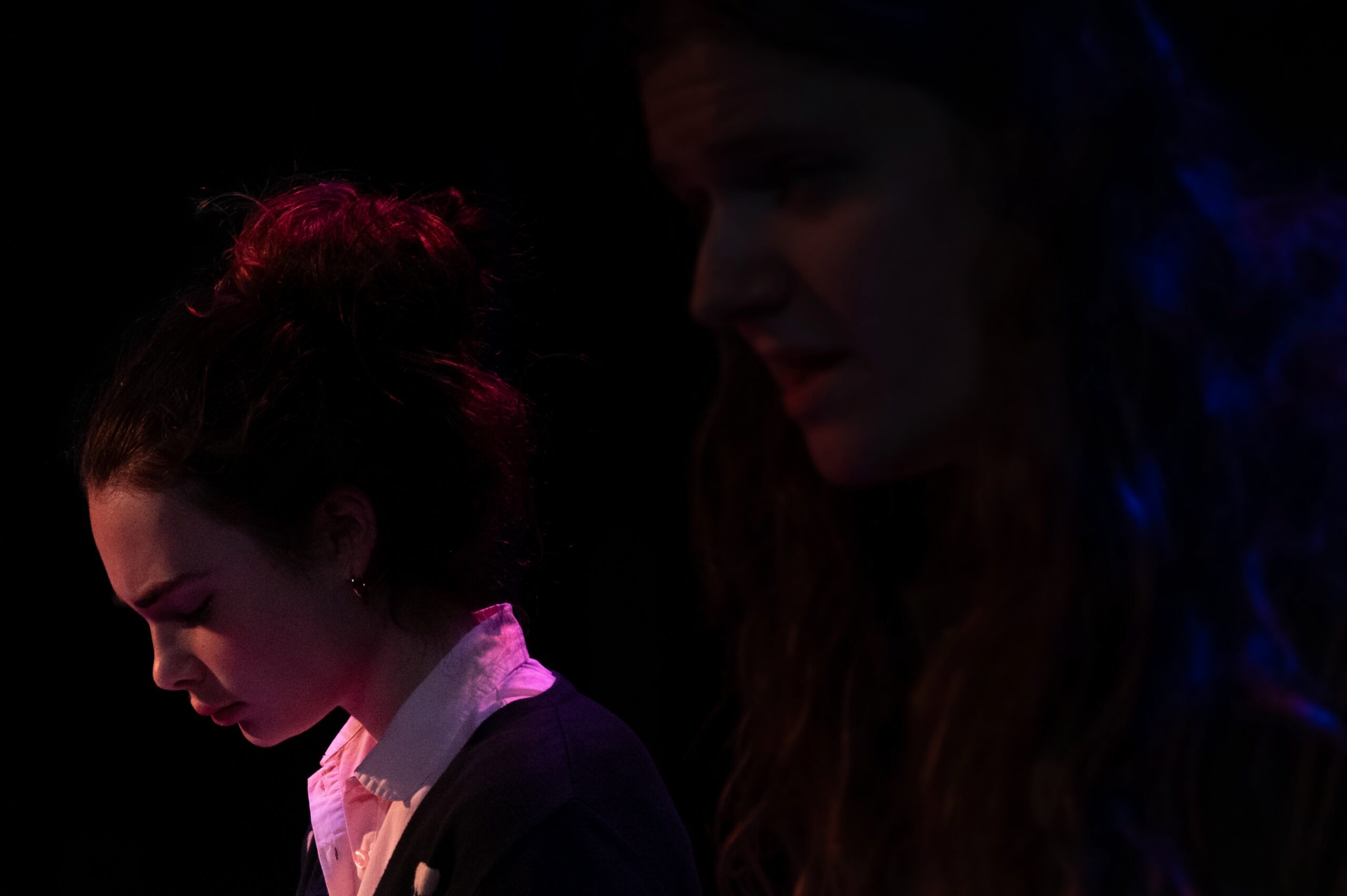
Under Review: Completely Bloody Incoherent
Despite what its title might tell you, Completely Bloody Incoherent unravels itself with impressive lucidity. Splinters Production’s latest play refuses to resign itself to a single category, embracing fragmentation to fully capture the disorienting overlap between who we are and what we create. The title itself references a quintessential criticism, launched by men at female written and directed postmodern theatre. A pre-show conversation with writer-director Sasha Ranawake produced an additional layer of meta-theatricality: she describes the play as an interrogation of which stories are considered viable, what it truly costs to be an actor, and how women’s success is so often caveated by a destabilised personal life. Art, Ranawake suggests, becomes the only language through which some people can be truly understood—even if it is incoherent to others.
The premise is deceptively simple: writer-director Dahlia (Hope Healy), her striving actor boyfriend, Luke (Ollie Gillam) and a couple of nameless actors cohabit the stage, in a fated collaboration that slowly breaks down the relationships beneath it. We are led to question this seeming simplicity upon entering the Pilch, transformed by set designers Elodie Yip and Falak Shah into a Brecht-inspired… theatre? The space is mind-rackingly ambiguous: the blacked-out furniture asks us to believe what we are watching; the exposed, erratic lights (designed by Ben Tilley) tell us that what we are watching is fictitious. Most interestingly, pages from the play’s script are crumpled and strung along the walls, teasing that we might be somewhere intangible, trapped between Dahlia’s internal struggles, and a play that acknowledges its own fabrication.
It would be impossible to dissect the characters of Dahlia and Luke without exploring the implications of class identity, both on and off stage. Dahlia is affluent and well-educated; opportunities fall into her lap with seemingly little effort. A chance meeting with Luke in a theatre’s audience marks the pair as polar opposites. He mocks the “new writing” and “shitty black box” in which they’re sat, drawing us back to our own viewing experience. This could very well be a story set in the Pilch, or Oxford more widely, where financial security allows some the freedom to safely explore the niche, exclusive fringes of theatre. Unbeknownst to Luke, the play they are watching was written by Dahlia. This forms the start of the pair’s romantic relationship, built on Luke’s jealousy and Dahlia’s discontent. Gillam’s bitterness was highly convincing, and his formidable stage presence almost makes you wonder why Luke never had his big break. He brings an easy, lived-in warmth to the domestic scenes, which is then methodically stripped back; the charisma that made Luke so watchable early on quietly drains away as the play progresses. He may think that he wears the trousers, but the trousers in question are a pair of inside-out pyjama bottoms. His apparent refusal to get dressed chronicles a loss of motivation that deepens scene by scene, as he turns down small-scale roles and resigns himself to watching TV static.
Dahlia cannot understand Luke’s refusal to work, in the same way that she cannot understand the humiliating struggle of climbing the acting ladder as a working-class creative. Her chic, slightly undone style (curated by Thea Hughes), coupled with Healy’s progression from wry to reticent, reveal an entirely different world, one which forecasts a charmed life. Success at the expense of personal fulfilment. Slowly losing her spark, Dahlia retreats into secret-keeping, and tyrannically directing her actors. The starkness of her regression seems a grim answer to the age-old question of whether or not women can in fact ‘have it all’. Luke certainly seems to believe this an impossibility—the only thing the couple appear to honestly share is their mutual destruction.
Somewhat ironically, linguistic expression is pivotal to the play’s incoherence. Each character’s speech and lexicon is indicative of how they wish to be perceived—and when compared, the difference between real selves and ideal selves becomes obvious. Luke’s Americanisms reflect his desire for A-lister levels of success, which ultimately feels jarring when his Brummie background is revealed. This contrast takes on a painful tone when he is too embarrassed to tell his ‘Pops’ about the humiliating tissue ‘commercial’ he’s been hired for. Actor 1 (Seb Foster) and Actor 2 (Coco Scanlon) are intentionally opaque figures, so their speeches are initially bewildering. Actor 1’s spiral in the first half feels like an incantation: beginning with an ode to orange juice, he rapidly whirls his way into centre stage amidst a flurry of ever-lengthening, ‘pretentious’ words. We are presented with decontextualisation that seems to mock the loftiness so often associated with hot-shot Hollywood stars. Actor 2 is equally contrived in speech, but strives for realism. Monologing a one-sided domestic spat, she is emotionally unrestrained, before the stage is plunged into darkness. By the time the lights flick on again, the entire scene is rehashed; the same speech is resculpted into softness and containment. The lights die and reemerge repeatedly, and each time different lines from the argument are stressed, sighed, or shouted, in an effort to best manufacture naturalism. And as for Dahlia, her style of address is unconvincingly oratory. She explains her upbringing to Luke openly, if perhaps a little too perfectly for it to feel unrehearsed. But a gradual descent into caginess tears down both her and Luke’s identities. Siphoning parts of his life and identity for her own dramaturgical pursuits, Dahlia’s speech loses substance, as she fears Luke will discover her secret sampling. It almost feels laughable that she directs so austerely, explaining to her weary actors that words are too special to be wasted when she herself hides behind the words of others.
Arguably, what becomes most incoherent in the play is identity. What defines it? Does theatre draw it out, or drain it away? Perhaps none of these questions are definitively answered; perhaps we must wonder if they need answering at all. Actors 1 and 2 are uncomfortably anonymous, yet greatly impassioned in their performances, as if starving for spotlight. Foster and Scanlon are equally entrancing, and somehow able to balance the paradox of having enough personality to command the space, whilst remaining overshadowed by obscurity. Their invigorating performances are quieted by their all-black costumes, and they are surprisingly bashful when in their own clothes (for which they are chastised). It is almost as if they do not exist at all beyond their transient performances-within-performances. The audience is left with a sense of sadness that you never got to know them better.
The play’s preoccupation with artifice is neatly concluded by the motif of puppetry, which haunts Dahlia from beginning to end. With her love of storytelling stemming from her increasingly senile grandma, Dahlia projects herself like the shadow puppets of her childhood: we see the striking outline she casts, but never what lies behind it. We do, however, hear it. Leo Kilner and Lucian Ng’s sound design presents us with hallucinatory phone calls, which toy with memory, and ultimately stress the fragmentation of the human experience. A final phone call, at the end of the play, provides us with what might be the most coherent moment of the show, in which playground joy and bitter nostalgia prompt Dahlia’s most intimate moment, conveyed in her final monologue. Without giving too much away, it marked Healy’s performance as the most memorable in my eyes. Her progression into excruciating vulnerability was a testament to her versatility as an actor, and a bittersweet note on which to end the show.
What Splinters Productions have produced is something beyond a 90 minute student play. Completely Bloody Incoherent is a dizzying venture into what it means to be an artist, and how far the audience should sit from this abstract world. The genius of this play is that it becomes near impossible to tell what is intentionally incoherent, and where there should have been clarity. You cannot help but question each bizarre movement, each dazzling vignette, and the temporal confusion. And yet, every moment feels judiciously crafted, by both the persuasive acting and Ranawake’s clever script. Splinters have also produced a magazine, transforming the play into one part of a wider comment on what artistry could look like. With half of the ticket sales going towards Palestinian aid, it becomes apparent that whatever art means to the company, it is certainly not art for art’s sake. Suffice to say, I urge you to give this show a watch. It is completely bloody brilliant.
Words by Genevieve Kidd. Image via Sasha Ranawake
You may also like
Clive Wearing
Clive Wearing, a successful British composer and musicologist, lost his ability to form new memories
The Comedy of Successes
I first encountered The Comedy of Errors on a Shakespeare reading list, the only play success
Old English, Old Oxford
Two months ago, I found myself at an English formal with the rest of the English freshers at my coll