

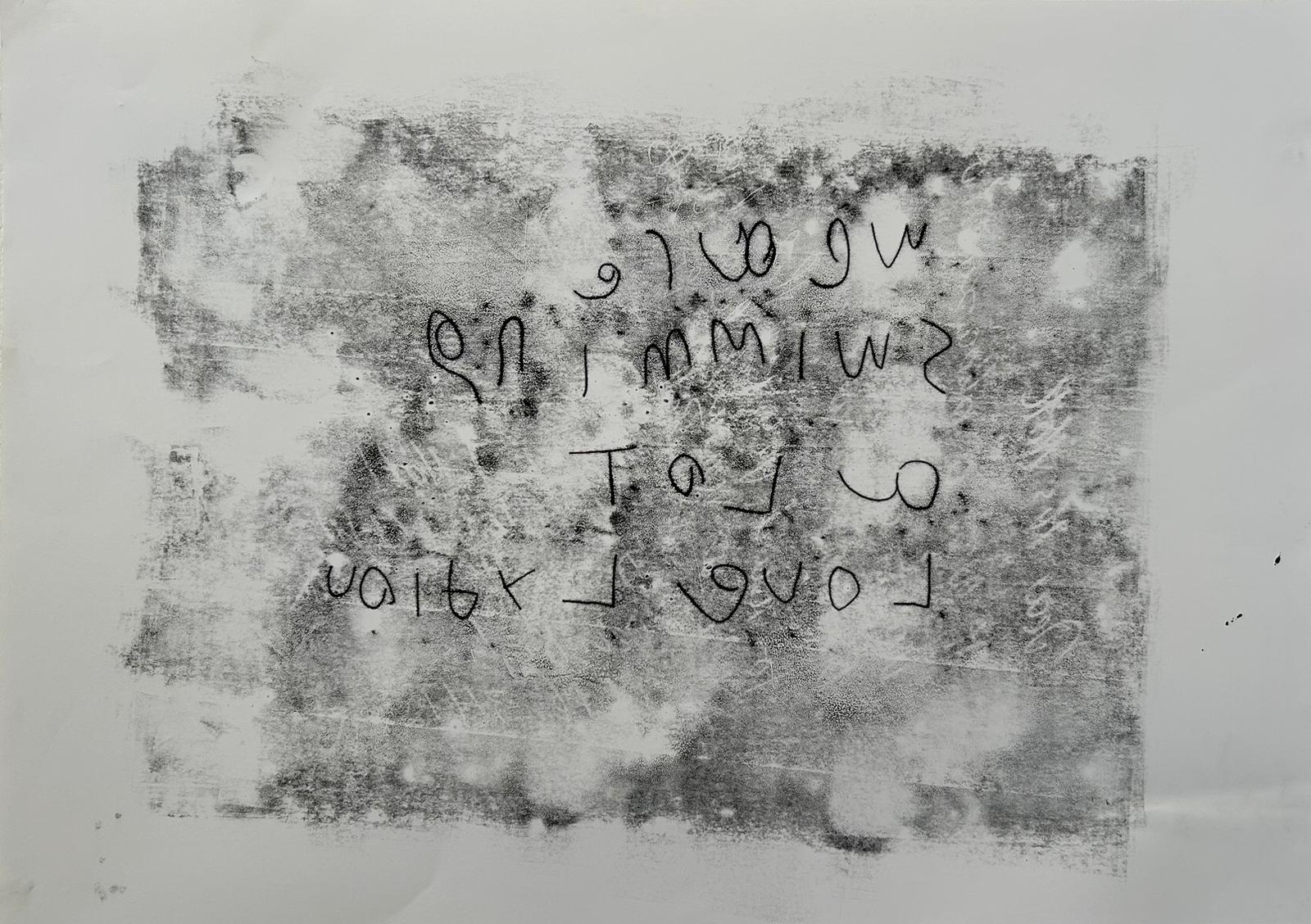
On the ‘para’ (পাড়া)
My childhood summers unfolded between the homes of my maternal and paternal grandparents in West Bengal, India. Each sojourn began in Kolkata, with legs sticking to the hot leather of an un-airconditioned taxi as we hurtled past blue-and-white flyovers crowded with towering billboards—‘Didi,’ the Chief Minister of West Bengal, folded hands pledging political competence.
‘Home’ for my paternal grandparents was a ten-storey apartment complex in South Kolkata, populated mostly by middle-aged professionals and small families drawn by the area’s schools and transport links. Our flat overlooked a main road, admitting a constant thrum of daytime traffic and, being near a crematorium, the Bengali chants of funeral processions were often heard by night. My grandparents seemed fairly indifferent to their new surroundings. The move away from the suburbs, arranged by my aunt, brought them closer to hospitals as their age encroached. Yet, their most attentive caregivers remained their two children, separated by thousands of miles.
Kolkata’s high-rises, like those in many urbanised cities, cultivate a self-reliance that isolates neighbours from one another. Daily life for my grandparents unfolds within vertical walls, leaving little room for kinship beyond annual Durga Puja celebrations or tokenistic communal spaces. Nobody is around during waking hours, confined instead in an unmoving commute to office cubicles and nine-to-fives.
Studies of Kolkata’s urban reorganisation suggest that vertically-extended, gated residences have largely displaced the para (পাড়া), the socially-clustered neighbourhoods that once structured communities. Driven by neoliberal imperatives of saleability and deregulation, the city’s densification has drawn a quiet but decisive line between those in service to the city and those who remain at its margins. Public provision for the elderly has thinned, and privatised care packages offer little emotional support. Within the sealed interior of India’s third-largest city, ageing bodies like my grandparents’ remain quietly vulnerable.
Growing up, weeks of high-rise confinement tainted my impression of Kolkata—its status as the ‘City of Joy’ felt hopelessly remote. The Kolkata I read of in Narayan Gangopadhyay’s stories or Anupam Roy’s romanticised lyrics seemed disconnected from the material realities of my family. Gated complexes left little room for the intimacy and shared rhythms which once defined the city. By contrast, weeks in Siliguri with my maternal grandparents revealed a different tempo of life, one in which the para was overt. Nestled in the Himalayan foothills between tea estates and transboundary rivers, the city unfolded through the navigation of both personal and public landmarks. Here, intimacy emerged through adda at the sweet-shop and the quiet hum of Tagore’s songs—people became cartographers of their community. The para generated collective memory and mutual care, transcending the hollowness of small talk or professional networking.
My mother and I often joked about how silence was so rare in the Siliguri home. Hot tea and sweetmeats were prepared instinctively should neighbours amble in unprompted, sparking idle conversation at any hour. Being retired teachers, my grandparents welcomed old students and family friends who filled the sitting room throughout the day. Social interaction required no particular cause—they never expected the elaborate meals or paraphernalia of a biyebari or nemontonno. Unlike the delineated apartments of Kolkata, the rusty orange gate of my grandparents’ Siliguri home was left open, inviting a social cohesion and closeness which animated my summer weeks.
Though elderly relatives passed away and the para’s inhabitants shifted, my grandfather and I remained entertained by daily people-watching from the veranda swing. There was the brown-vested teenager brushing his teeth at noon, doomed to repeat another school year; the pampered pomeranian, draped in sarees and jewellery on festival days; street-sellers chanting seasonal discounts in full-throated fervour. In these moments, the para revealed itself as a spatial structure resisting enclosure. Private pursuits take place on lanes or squares, fostering an indifference to being perceived, and a voyeurism without artifice.
Standard accounts of urban ‘cores’ and ‘peripheries’ do not map neatly onto cities like Siliguri. Economically marginal compared to the state capital, the city nonetheless functions as a regional hub for Nepalese, Bihari, and Assamese migrants. Its horizontal growth has resisted the vertical expansion dominating West Bengal, allowing paras to preserve a gradually bygone way of life.
When my grandfather died earlier this year, it was this para which became a site of resilience and mutual aid. My widowed grandmother received unbidden home-cooked meals from neighbours, while the hum of evensong threaded through daily life as the para’s residents gathered in the courtyard each dusk. At the cremation, the whole neighbourhood dispersed into individual rickshaws and motorbikes, only to unite once more around the funeral pyre. The burden of grief somehow feels bearable in a para. I could not help but fear the fate of my other grandparents, alone within the impermeable boundaries of a city that would go on without them.
The patriotic Bengali song ‘Dhono Dhannye Pushpe Bhora’, composed amid the First Partition and Swadeshi Movement, evokes pride in the land and reverence for an unnamed motherland without recourse to aggression. Its final line, আমার এই দেশেতে জন্ম যেন এই দেশেতে মরি, (‘My birth was in this country, let me die in this country’) resonates as a quiet testament to belonging and rootedness. The Bengal my grandfather died in has strayed far from the one imagined by these Swadeshi poets, no longer held together by the hope of a shared civic destiny. The para does not promise permanence of life, but sustains a form of social attentiveness which resists erasure. It is here where ageing bodies are noticed and grief is redistributed.
To write of the para, then, is not nostalgia for old forms of community, but a recognition of how care is spatially produced and bound to the forms of life it nurtures. Bengal offers no singular promise of care: its capacity to hold life, and loss, unequally distributed across its landscapes.
Words by Iona Mandal, Artwork by Milly Matthews
You may also like


“The British will go down in history for being the absolute assholes of the world” – Lawrence Weiner
MORE SALTPETER THAN BLACK POWDER / ENOUGH BLACK POWDER TO MAKE IT EXPLODE.