

You can’t stay buried for long: On Ruins
The thing that hath been, it is that which shall be; and that which is done is that which shall be done: and there is nothing new under the sun.
Ecclesiastes 1:9
Ivy breaches the masonry; It seems filled up with the past, as it indeed is. Did Sir Lancelot once ride here? Was some king once holed up behind its now tumbled walls? This building, though, has generated such impressions from its first moments of completion. For this is Hagley Castle, a folly, built on the grounds of Hagley Hall. Constructed in 1747, its purpose was never fortification. Stones were left strewn around its base, and its walls never climbed to the height imagination easily suggests they might once have reached. Yet what was fiction has become fact. A castle built to testify to its own illusory history now serves as a monument to a cultural moment which, whilst passed by 250 years, resonates down to the present today.
Why do ruins fascinate us so? No other process of decay is afforded the same respect. An apple becomes no more charming for having rotten. I posit that, in the architectural case, it is the suggestive qualities of ruins that are so attractive (eerily so). When a structure falls away from its initial construction, a new world of imaginative possibilities is opened up in the gaps where glass or brick or wood once stood. Despite this, various actors have attempted to freeze in place the significations of ruins, mobilising them as part of their effort to freeze society at large. We must not surrender the past to them and the ruin, with its great expressive possibilities, is a tool we must not let crumble.
In the first book of Wordsworth’s Excursion (aka The Ruined Cottage), the first words we hear from Armytage, rhapsode of the cottage’s decline and fall, are those evocative of the ambiguity of abandoned spaces: ‘I see around me here things which you cannot see’. He is a witness to the tragic events he describes but he brings The Excursion’s principal narrator into the fold less through the transference of facts and more through a call to imagination. Where once the hearth ‘through the window spread upon the road its cheerful light’, the house’s function now is transfigured, it is shelter for ‘The unshod Colt, The wandering heifer and the Potter’s ass’. In Wordsworth’s poem, then we can see a double motion that affects how we see ruins. On the one hand, the decay creates new uses. Parallel to this, the uncertainty of such spaces, their status as haunts of unknown ghosts, make any story told about them infinitely more plausible.
Reaching further back into history, Horapollo’s Hieroglyphica (surviving in a Greek translation from the Coptic) constructs an allegorical edifice (baroque in its splendour) seeking to explain the mysterious sigils that littered Egypt. He happened to be completely wrong, but with anyone who could tell him so long dead, the remains of Pharaonic civilisation were completely open to his fancy.
In the tomb of Ramses IV, a graffito left by a Christian visitor of late Antiquity records his dread at the terrible signs he saw around himself. Even though they were incomprehensible (or, indeed, precisely because they were) they could pervert his soul from its divine course. He’s drowning in a surfeit of meaning. This gets at the fundamental eeriness of a ruin. For Fisher, this sensation is conjured up by a failure of presence or by a failure of absence. The unintelligible writing on the wall (like at Belshazzar’s feast) is eerie for the lack of meaning where meaning ought to be. A failure of presence. Curiously though, this transmutes itself into an abundance of significations which overdetermines the writing. A failure of absence.
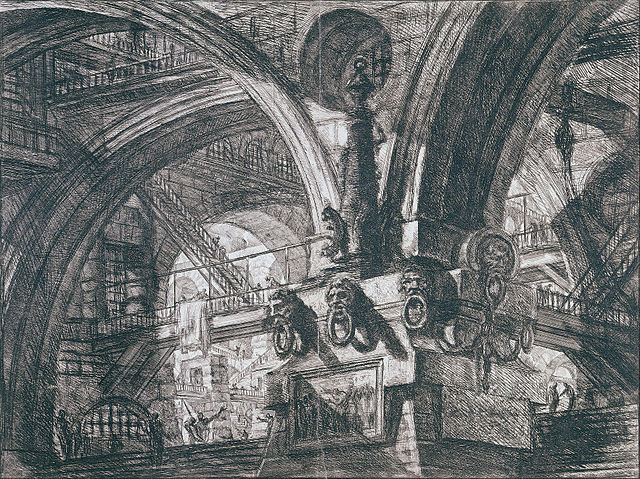
In Piranesi’s proto-Escherian series of etchings, Carceri d’invezione, the architectural excess and the tiny scale of the human figures acts in a similarly disturbing way. The baffling structures lack any coherent plan. Each individual form is recognisable, but the wholes never aggregate to a space we understand; if any principles lay behind their construction it is that of the termite.
Shirley Jackson’s Hill House is another eerie realm. This house, however, is an anti-ruin. Not because we can fully come to terms with it (that is surely impossible), nor even because it remains mostly intact, but because of Jackson’s insistence on the house’s malevolent self-determination. It stands ‘under conditions of absolute reality’, within, ‘walls continued upright, bricks met neatly, floors were firm, and doors were sensibly shut’. It actively resists enquiry from Dr Montague, an investigator of the supernatural. He observes that the house is arranged in ‘what I might almost call concentric circles of rooms’ (We might even think of Solomon’s temple). His investigations are therefore conceptually structured as a penetrative inward moment to its Holy of Holies. But Hill House resists at every stage. Its determination is to stay empty. It’s Lovecraftian in the sense that its workings seem intact and purposeful but are in the final analysis inscrutable.
Freud, in his essay Das Unheimliche, has a more idiosyncratic explanation for the origin uncanny/eerie (the exact sense of the German word being difficult to capture in English). The journey he takes to his conclusion (that we experience uncanniness due to repressed castration-anxiety) is more interesting than the conclusion itself. Along the way he proposes the importance of repetition and doubling in generating these emotions. He recounts how, in Italy, lost, he recurred three times to the same street of prostitutes, feeling each time his disquiet grow. Were I in a less charitable mood I’d attribute this to his subconscious sexual urges. At any rate, Freud notes that situations which involve ‘an involuntary return to the same situation, but which differ radically from it in other respects, also result in the same feeling of helplessness and of something uncanny’. Perhaps this is what is frightening about ghosts.
I recognise in this iterative explanation of the uncanny a reason why I find the follies discussed earlier so fascinating. They are a dark inversion of St Paul’s promise that ‘we shall not all die, but we shall all be changed’. The idea of the ruin (or the values that it, by synecdoche, stands for) are called to serve in contemporary political debates. In doing so, the interpretive possibilities of the ruin congeal like the blood in a scab. The folly’s evocation of the imagined splendour of the Mediaeval past in a rapidly changing Britain is but one example amongst many. Videos pitting clips of ‘Ancient’ and ‘Modern’ art/architecture against each other (set archetypically to MGMT’s song ‘Little Dark Age’) work in fundamentally the same way.
A striking 19th century example is Eugene Viollet-Le-Duc’s controversial restoration of Notre Dame. The whole process would be worth discussion but here I’ll focus only on the architectural drawings Viollet-Le-Duc made for his project. As would be expected of the man Le Corbusier would call ‘the father of modern architecture’, this architect was far more a rationalist than a Mediaeval mason. His drawings present the Cathedral as a neat composition of right-angles and regular dimensions. Its true crookedness was beaten back into shape; a multiplicity (of measurements, of craftsmen) is corralled into a more understandable shape, with a corresponding loss of detail.
This fascistic repression of deviance (if only in the blue prints of Notre Dame) came to its full fruition in the 20th century. We see it in the thought of Albert Speer, a Nazi worm whose avoidance of execution proves we live in an unjust universe. He was also an architect. Most of his ideas for a grand Classical rebuilding of Berlin went unrealised. Had they been, though, even their decay was to be of service to the Third Reich. His notion of Ruinenwert (‘ruin value’) held that these buildings would stand as testaments to German glory, a deutscher Parthenon. Whatever meaning we could have put to such a structure was pre-determined to be fascist, and they would no doubt have become a hotbed for Neo-Nazi sentiment. They were never raised, so they were never razed; that would have been the only appropriate response. Incidentally, Speer’s imagined Triumphal Arch would have been so heavy it would have sunk into Berlin’s soft soil. So be it.
It seems, then, that the ruin is totally lost to conservative impulses, with their only function being to idealise a long-gone past. However, this need not be the case. In Spectres of Marx Derrida coined the term ‘hauntology’ (a play on ‘ontology’ for in French the two words are homophones). Since then, the word has taken on a life of its own and here I will be using it as a tool to discuss how the past comes to bedevil the present, revealing obscured social forces in the process.
Nowhere do we have a more physical reminder of this than at Pompeii. If a photograph captures a single instant’s pattern of light, then Pompeii did the same for Roman social life. The contorted plaster casts seem far more alive than the stylised and satirical epigrams of Martial, an approximate contemporary of the burying of the city. The often crude and often erotic art uncovered there also seriously undermined Winckelmann’s Enlightenment notion of a perfect classical world.
In England, the bodies of dead monks have been read like logistical logs to divine their economic standing. Modern bioarchaeological analysis of monastic skeletons can give insight into their diets; and they seemed not to have been as dedicated to the life of poverty as their own writings might suggest. A sensitive attitude to the past, in the sense of taking in and interpreting subtle data of various kinds, perhaps reveals in a new form a latent class conflict that should be taken into account for our histories of the Reformation.
The unearthing of the monastic cemeteries, like Pompeii, was simultaneously an unearthing of the economic reality of historical change. They make the facts of inequality, immiseration, and class conflict unavoidable. As such, the ruin can inaugurate any kind of motion. Backwards, if we let it, to an imagined past, the Merrie England of conservative fancy, but forwards also, to a more conscious future.
Words by Alex Lafferty. Image via Wikimedia Commons.
You may also like

Ecology of a scene, or Why Oxford is, and always will be, a wasteland of musical creativity
Wherever you find one, a music scene manifests as a live, twitching corpus, comprised of a vi

Isis presents… Top of the Pops
This Wednesday, May 9, the Isis is taking over Babylove, playing all of the decades from 1960 onward
Sharper Than a Serpent’s Tooth: Spare Review
‘There is just as much truth in what I remember and how I remember it as there is in so-called obj