

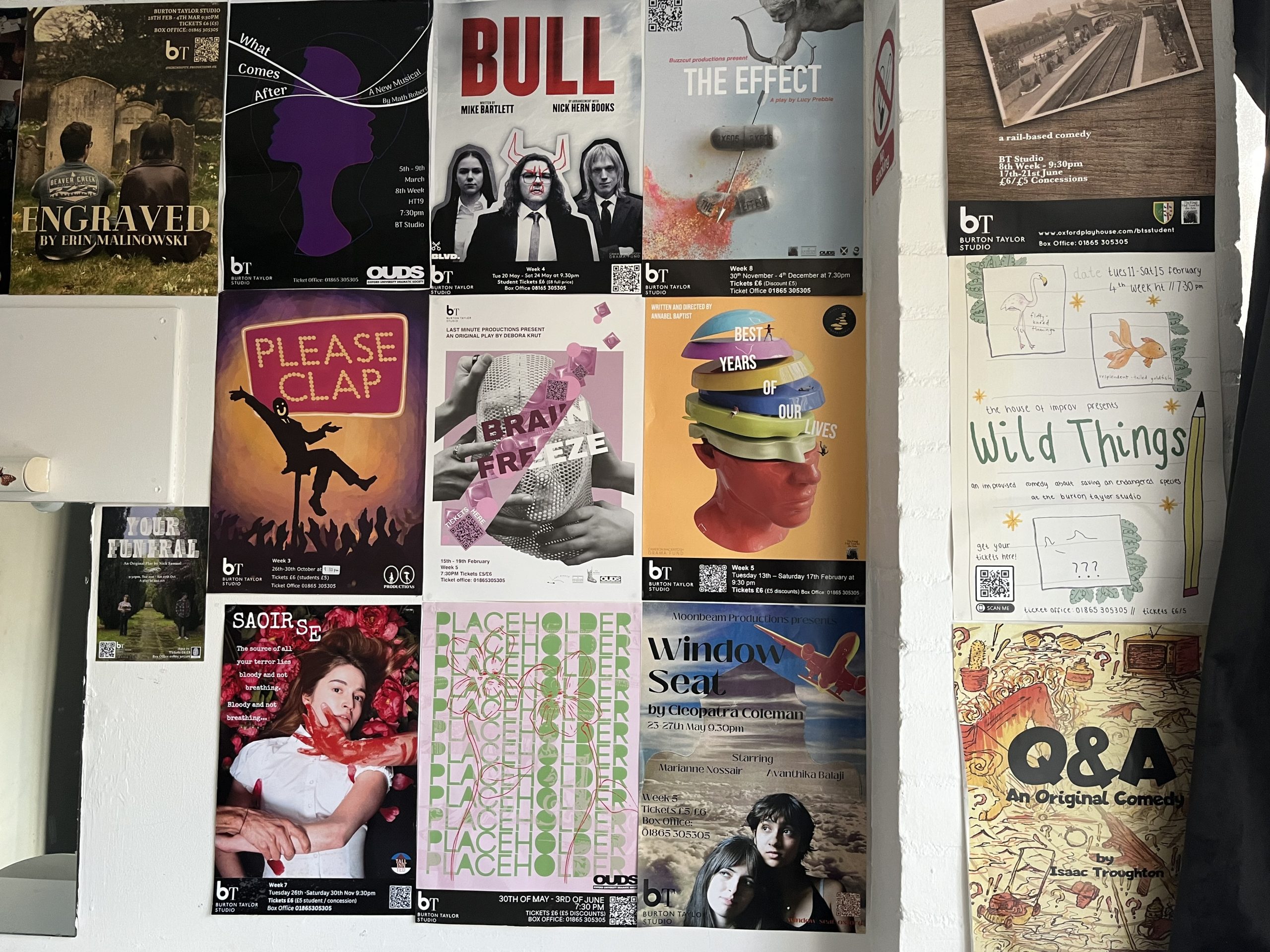
In Conversation with the OUDS Committee
Oxford theatre, in its student form, tends to speak about itself the way universities often do—as a community before it is an institution, an open door before it is a structure. It imagines itself as a facilitator of creative freedom rather than a body that governs or regulates. What emerges from my conversation with Oxford University Dramatic Society (OUDS) President Theo Joly, Black and Minority Ethnic Officer Sanaa Pasha, and Access & Outreach Officer Becky Devlin is not a lack of goodwill—all three are deeply earnest, thoughtful, and reflective—but something far more complicated and less comfortable. The OUDS committee is actively engaged in efforts to improve accessibility, yet they operate within a decentralised structural model that can both enable creative autonomy and disperse responsibility across the wider society. The result is a system in which bias can operate invisibly—a pattern that extends beyond Oxford and into the wider ecology of British theatre.
OUDS is the largest society at the University, consisting of a constellation of production companies, directors, actors, and creatives, who collectively produce work across a range of spaces, from black-box studios to the Oxford Playhouse stage. There is a prevailing sense that the scene sustains itself through sheer momentum: theatre as a collective project, held together by shared enthusiasm, labour, and a genuine love of the game. Structurally, however, the committee exercises little control over the production ecology it supports. Independent production companies can be formed by any student willing, with the freedom to direct, produce, and stage work with no direct oversight. Whilst this openness can be egalitarian, the committee holds no formal casting power, no bidding authority over venues, and offers limited formal training. Beyond registration and adherence to welfare guidelines, decision making is left entirely to individual directors and producers—students who may arrive with years of theatrical experience, or none at all.
This decentralised model is defended by Joly, Pasha and Devlin as central to OUDS’s ethos—a necessary alternative to the more centralised structures found at other universities, designed to protect student creativity, autonomy and the freedom to make work without institutional constraint. Decentralisation, they argue, allows student theatre to remain responsive and self-reflective, enabling the society to hold itself accountable rather than deferring responsibility upwards. At the same time, this structural looseness can allow certain concerns—pre-casting, repeat casting, and audition cultures that can feel inhospitable to newcomers—to surface without clear mechanisms for resolution. OUDS can advise, but it cannot enforce; and when conversations turn to access, class, race, and gender—questions that demand structural engagement rather than goodwill alone—the challenge becomes not whether decentralisation is the right model, but how it might be better equipped to support the forms of accountability it already aspires to.
As someone who has been a part of this ecosystem, and will continue to be during my time at Oxford, I recognise the undeniable value of what OUDS enables. There is something rare and sustaining about the creation of theatre by students who are deeply invested in the work, and truthfully moved by the discipline—a point Joly, Pasha, and Devlin all emphasise. Yet appreciation does not preclude critique. Devlin noted that the barriers to participation often emerge ‘well before the audition room itself.’ If a student does not feel they possess the requisite background or confidence to audition in the first place, the opportunity is already foreclosed. This particularly affects state-educated and lower-income students who have not had access to the extensive drama provision common in private schools. It is in response to this that the OUDS committee has introduced acting and audition workshops aimed at demystifying the process, alongside state-school socials intended to foster confidence and community. These measures gesture towards an understanding that widening access requires not only opportunity, but sustained attention to the conditions that shape who feels entitled to take up space within student theatre in the first place.
Questions of pre & repeat casting surface repeatedly in conversations with students, and sit at the centre of many of the tensions surrounding access within OUDS. Over time, certain performers inevitably become highly visible, their frequency raising concerns about fairness. This language crystallised following Labyrinth Production’s recent Oxford Playhouse production in which the cast was hailed by Kalina Hagen as comprising ‘some of the most talented and well-known names in Oxford drama’ Joly described this rhetoric as something the OUDS committee ‘completely disagrees with,’ whilst Devlin was equally clear that such language is ‘very harmful and not something we are trying to encourage.’ Their discomfort is telling. The issue is not simply the existence of familiar faces, but the way familiarity is framed, celebrated, and circulated. Language matters. How production companies describe their casts and market their plays shapes how prestige is understood, and how legitimacy is distributed. To speak of ‘big names’ is to import a logic of fame into a student theatre culture that officially rejects it, and in doing so, normalising hierarchy where none is meant to exist.
What accountability exists, then, if a production company is repeatedly non-diverse in its casting? Or if roles circulate in a production company within the same narrow group of white, privately educated performers? There is little recourse beyond informal concern. Pre-casting—often difficult to prove and easier to deny—becomes possible precisely because decision making is so decentralised. In this context, the assumption that the most ‘trusted’ performers also happen to be the most visible ones begins to take on structural significance. Trust is rarely neutral. It is shaped by social proximity, shared backgrounds, and cultural ease—all of which are themselves inflected by class and race. When social presence within the scene determines whether a director knows you, thinks of you, or imagines you as right for a role, casting ceases to be a simple question of talent. It becomes bound up with recognition, memory, and a tacit sense of who already belongs. Familiarity can feel reassuring, but it can also be exclusionary. A structure designed to maximise freedom can at times disperse accountability, allowing questions of fairness to slip through the cracks.
The consequences of this structure are particularly evident in questions of racial representation, beginning at the level of imagination itself. Student theatre ostensibly offers remarkable flexibility; characters need not adhere to fixed racial markers, canonical texts can be reinterpreted, and casting need not reproduce professional industry norms. Yet, in practice, whiteness often functions as the unspoken default—in how characters are envisioned, in which plays are programmed, and in who is assumed to ‘fit’ a role unless specified otherwise. This mirrors a broader tendency within British theatre, where whiteness is treated as neutral whilst racial difference requires justification or explanation. Without oversight or longitudinal data, patterns across productions remain difficult to identify, let alone challenge. A director may genuinely believe they are casting openly and fairly, but without collective visibility, unconscious bias cannot be corrected, it is simply reproduced and dispersed across individual decisions.
Questions of racial underrepresentation in OUDS cannot be separated from class, nor from the uneven distribution of cultural capital that precedes arrival at Oxford. As BAME officer Sanaa Pasha noted, attempts to encourage participation from ethnic minority societies have sometimes been met with ‘limited appetite’—not necessarily because of disinterest, but because theatre can appear alienating long before one reaches the audition room. For students from working-class or state-educated backgrounds, particularly those from communities of colour, theatre may not have been a space of early encouragement or institutional support. In this light, the autonomy afforded to production companies can also create conditions in which social exclusivity may be masqueraded as artistic preference. Whiteness becomes the default not because others are excluded outright, but because the scene is calibrated around forms of ease, experience, and self-assurance that not everyone has been given the opportunity to develop.
Against this backdrop, Pasha’s work seeks to intervene not only at the level of numbers but at the level of imagination. She described ongoing conversations with cultural societies across the university, alongside plans for events foregrounding global theatre practices. This year has already seen the emergence of a production company centred on Chinese theatre practices, with discussions underway about introducing Kenyan theatrical traditions into the OUDS landscape. These initiatives matter not simply because they diversify the programme, but because they challenge they assumption that British theatre—and by extension Oxford theatre—is the neutral centre from which all other forms deviate.
It is within this broader reorientation that the newly launched Centre Stage Festival, debuting in Hilary Term 2026 will take place. Conceived as a reimagining of the annual BAME show, the festival marks a deliberate shift away from tokenistic inclusion—where representation risks being reduced to casting alone—towards work that is authored, structured and thematically grounded in specific community narratives. Across three productions, each centered on East Asian, Middle Eastern & South Asian and Black experiences respectively, Centre Stage aims to place BAME stories at the centre of theatrical attention rather than at its margins. Crucially, the festival is designed as a point of entry, an accessible invitation to those for whom student theatre has previously felt opaque or daunting or is simply new for. Accompanied by a programme of events featuring invited speakers, Centre Stage extends beyond performance to cultivate conversation and continuity, suggesting a model of access that is sustained, thoughtful, and embedded within the wider cultural life of OUDS.
Theo Joly spoke with enthusiasm about the diversity of voices emerging from student written theatre and OUDS’s New Writing Circle, which he identified as one of the most generative spaces in contemporary Oxford drama. Recent productions—including Juliet Taub’s Anthology of Pairs and Melissa Chetata-Brooks’s So Far So Good, have foregrounded marginalised perspectives with a formal and cultural confidence that has marked them out as extremely strong work on the student stage. New writing has become a site where representational questions are not simply appended to existing structures but embedded within the work itself.
Material interventions are also beginning to take shape. Joly described the creation of a new BAME fund, drawn from the legacy finances of a former BAME theatre society, intended to support events, workshops, and practitioners. More structurally ambitious is the proposed Equal Opportunities Form, which aims to track demographic data across applications and cast lists. This includes socio-economic indicators such as state versus private education. The intention, as articulated by Joly, is not to discipline individual productions but to identify ‘structural patterns’, such as who applies, who is cast, and how these dynamics shift—or fail to—over time. At present, no such data exists, production teams under the Equality Act of 2010 are not required to record it, although strongly encouraged too. Whether the form will meaningfully reshape practice remains unclear, but the decision to collect it represents a significant shift in institutional self-understanding, an acknowledgement that without measurement, inequity remains anecdotal, deniable, and therefore unaddressable.
What emerges, then, is an attempt to embed what Pasha described as ‘good practices’ into the fabric of the society whilst those currently involved have the capacity to do so. Her emphasis on legacy is instructive. Oxford student drama has long functioned as a training ground for British theatre, producing actors who go on to shape the national stage. If those futures are being forged within institutions that fail to interrogate their own defaults—particularly around whiteness, class, and cultural legitimacy—then the consequences extend far beyond the university. The question is no longer whether OUDS values diversity in principle, but whether it is willing to confront the structures that quietly determine whose talent is recognised, whose stories are centred, and whose presence is still treated as exceptional.
What emerges, then, is not an institution resistant to reflection, but one in the midst of it. The OUDS committee are already beginning to see themselves more clearly, recognising the patterns the society produces, the defaults it inherits and the ways in which well intentioned structures can, at times, reproduce uneven outcomes. Student theatre remains one of the most sustaining, collective, and transformative spaces Oxford University has to offer, and it should continue to be a practice that welcomes participation, risk and immense growth. But widening access is not a project that can be completed through outreach alone; to ask who exactly is missing first requires an understanding of who is already being centered. Accountability, in this sense, becomes perceptual—an ongoing practice of self-recognition through which the society can continue to align its values with its structures, and its openness with the conditions that make participation possible.
It is in these very acts of self-recognition that meaningful participation begins.
Words by Gabriella Ofo. Image by Rebekah Devlin.
You may also like
Artist of the Week: Joni Brown
Joni Brown is a visual artist. Tell us a bit about yourself. I’m a first-year student at LMH,
The Slav Defence
There are no windows in the Carlton conference hall, only chandeliers sagging heavy with diam

One Way Ticket To Mars
“My mum doesn’t just want me to explode in the middle of the atmosphere – and nor do I! That w