

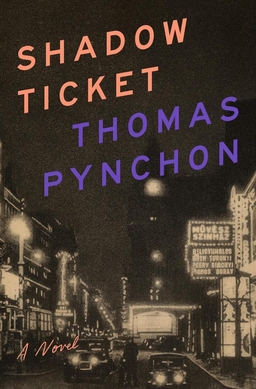
Shadow Ticket by Thomas Pynchon: A Review
Thomas Pynchon’s history is flat. If anything, historians tend to think the periods of history they study are the turning point; Pynchon does the opposite. His novels are most often historical fiction, but they use history in odd ways. His characters—no matter whether they’re in the 18th century Atlantic or World War II—all happen to be vaguely Buddhist hippie-types paranoid about the federal government.
Pynchon’s recent pop-culture presence came after his novel Vineland, released in 1990 after a twenty-year hiatus, was adapted into the film One Battle After Another. When David Foster Wallace first read Vineland, he wrote that it seemed like Pynchon had spent the last two decades smoking weed and watching TV. Maybe that’s why the protagonist of Shadow Ticket, Hicks McTaggart, is a sort of Patrick Star figure.
Hicks is not an interesting character. For an author whose protagonists have ranged from the ultra-conspiratorial to the psychosexual, Hicks McTaggart is boring. Shadow Ticket fits into the octogenarian Pynchon’s later detective novels, and its plot has 1930s private investigator Hicks McTaggart go from his hometown Milwaukee to Hungary to find the missing daughter of Wisconsin’s feared Al Capone of Cheese—‘Everything the Al Capone of Cheez was Al Capone of is now in your hands, you’re the Alcaponissima.’ Classic late-Pynchon territory: wacky characters, snippy dialogue, a detective unraveling a conspiracy.
But Hicks subverts the genre. He is not a good detective, mainly since he is deeply uncurious. Hicks was trained to be a union-busting thug, and the other characters keep reminding him. He basically lacks independent thought, but that’s why he was chosen for the case in the first place. It’s the 1930s, and every character seems to be passionate about either communism or fascism; Hicks is too boring to care for either.
The dialogue sounds like a 1930s radio play—as in, every character seems to be voiced by the same guy, and that same guy is Thomas Pynchon. This goes on for three hundred pages, but there are some great moments (After Hicks follows his ‘Uncle Lefty’, who happens to be a Nazi, into a secret bowling alley meetup: “we’re National Socialists, ain’t it? So—we’re socializing”).
The descriptions can be poor and fall nearly into self-parody. Pynchon loves to list objects or things happening while using a lot of participles and ‘more or less’ statements. When it works, it works, but he is noticeably worse at it than before. The two settings of the book are Milwaukee and Hungary. Milwaukee is in the weaker first half of the book but has some nice images; Hungary, despite being in the stronger second half, is noticeably more bland, featuring a Wikipedia-esque overuse of proper nouns about European areas and ethnicities. Maybe get vaccinated into Pynchon-tolerance by reading his earlier, better prose.
There was a fear that Pynchon would turn from his earlier social novels to more plot-heavy detective stories. He did not. Shadow Ticket is not subtle. The Airmont father and daughter are clearly Donald and Ivanka Trump—they even recreate the infamous photo of Ivanka on Donald’s lap in a nightclub—and the gluttonous American characters end up getting stuck in fascist Europe by the end.
This all takes place in the very strong second half of the book set in Europe. There’s room for a comparison between Tyrone Slothrop, the protagonist of Pynchon’s 1973 masterpiece Gravity’s Rainbow and Hicks. They’re both displaced Americans wandering around Europe, and it’s hard not to view them metaphorically. For Pynchon, it seems that America has changed. Slothrop spends most of his time with the side characters getting laid; Hicks usually just gets told off about how much of an idiot he is.
Slothrop is often interpreted as Cold War America: destructive, violent, imperialist, and sexually rapacious, yet always with a faux-innocence. If true, Hicks is America stuffed full after history’s end. He lives life by the book, literally. Hicks robotically follows his guide to being a detective, The Gumshoe Manual, an asinine counterpart to the ‘Proverbs for Paranoids’ in Gravity’s Rainbow. There’s also the ‘Oriental Mindset’, a mail-order self-help guide Hicks bought for 35 cents.
The vague, watered-down Buddhism of the Oriental Mindset parodies the vague, watered-down Buddhism of the hippie counterculture with which Pynchon is most associated. In its unstudied ignorance, the influence of the Oriental Mindset ends up being an easy tool for a shadowy government. Hicks, being Hicks, credits it for him accidentally not killing a striker in his union-busting-thug days.
The Wisconsin setting becomes a bit more interesting in this context. In a passage reminiscent of Mason & Dixon, Wisconsin ‘is possessed by some vast earth-scented spirit of Bovinity, docile herds of cows by the untold thousands all across the state every day at the same hour lining up shed-side in patient queues waiting to be milked’. To mix animal metaphors: they are sheeple.
In contrast to this Wisconsin Bovinity, Slothrop was modeled on Pynchon’s own ancestry of renegade Puritans in New England. Both are pawns, but their ancestry is different. Slothrop has agency, Hicks has an empty copy of Buddhism. He is Slothrop’s tragicomic parody.
It is a pessimistic turn for Pynchon, but he sticks the landing: the novel ends with a wonderfully dreary final motorcycle ride through fascist-ridden Europe and a pervading uneasiness which only such a free-ranging novel can provide. Shadow Ticket ends with a letter about leaving and going West: a prologue to some other story.
Words by Myles Lowenberg. Image via rawpixel.
You may also like

How one drag queen is confronting Brazil’s far right
“I like to be a boy, I like to be a girl.” Pabllo Vittar doesn’t waste time when it comes to e
PRESSURE POINT: Elon Musk wants to take over our governments. Why are we letting him?
On Sunday, the German parliamentary elections took place, with a majority of seats going to right-wi
Victoria Viatorum
I first met Maria on Friday. She stood in the street and talked at me in hurried Greek, and then whe