

The Resistable Rise of Arturo Ui: a study in unnecessary subversion
Being funny is harder than most people think. Being funny on stage is even harder. And being funny in the way that German playwright Bertolt Brecht’s work often demands of his actors— in a way that uses humour first as a tool of distraction, and then to force the audience to reckon with their own failings as the play marches on to its tragic end— is hard for even the most seasoned of actors to pull off.
The Resistible Rise of Arturo Ui is one of Brecht’s most well-known works. The story of the fictional Arturo Ui, a Chicago gangster, is used as an explicit and obvious allegory for Hitler’s rise to power. At its best, Arturo Ui is an uncomfortably slap-stick satire. In true Brechtian fashion, there is no real plot stringing the audience along— an opening prologue, performed in this production (somewhat unusually) by the anonymous Announcer (Ademide Obagun), introduces the audience to the play’s key characters. Anyone who paid a modicum of attention in GCSE History can recognise each character’s real life counterpart: Ui is Hitler. Dogsborough is Hindenburg. Giri is Göring. Givola is Goebbels. Roma is Röhm. This piece is obviously well-suited to our current moment, as so many strongmen flood our screens once again.
Brecht is an ambitious task for any student company. Full Moon Theatre’s production of Arturo Ui fell short of its ambitions at almost every key instance throughout the play. In its failure to adhere to some of Brecht’s stringent dramatic codes, the production proves too much and falls flat.
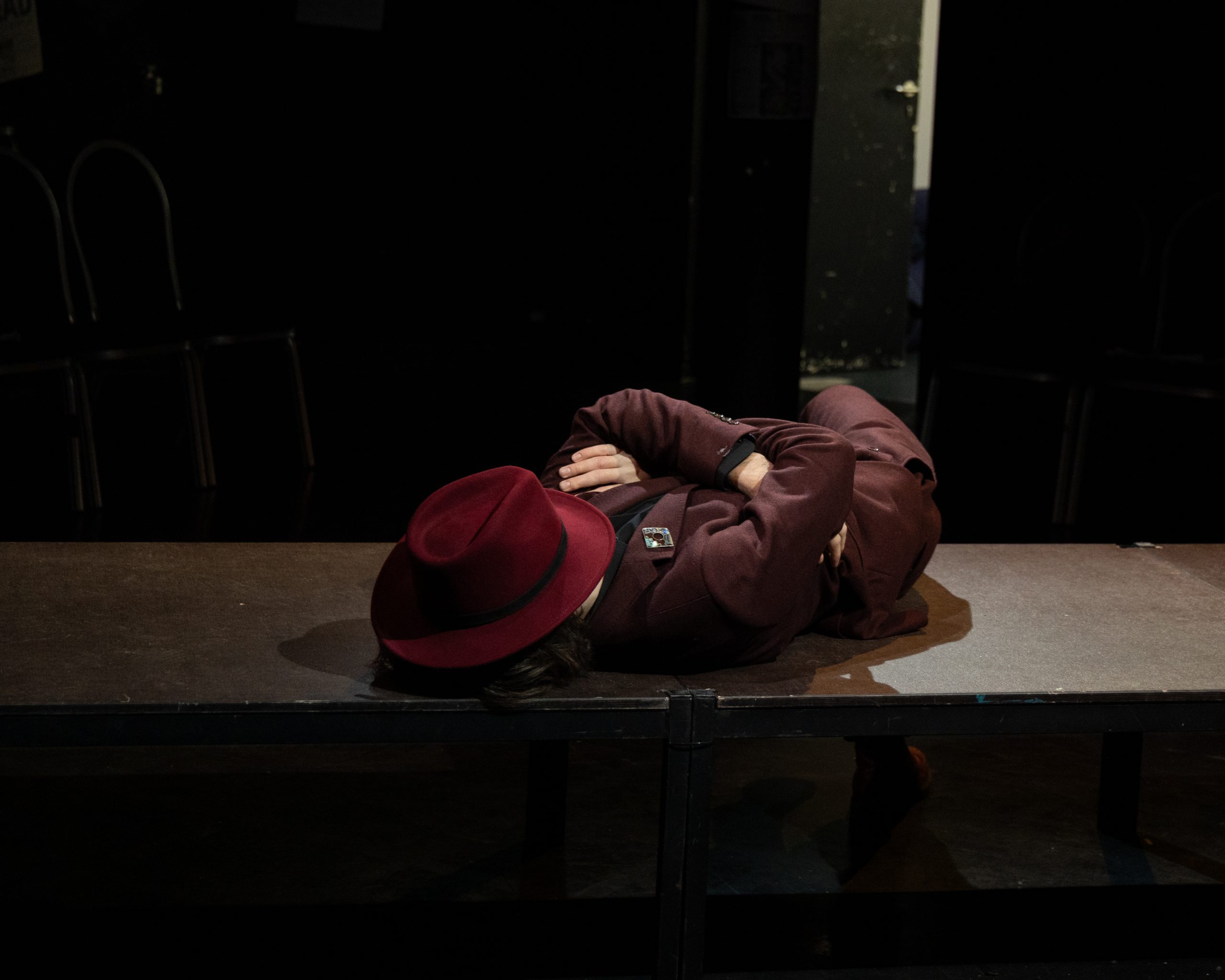
The production is staged in the round, with the Pilch plastered in newspaper clippings— some fictionalised, featuring actors from the play, some from the 1940s, and, much to my chagrin, many pulled straight from Trump’s press junket. The point of the set design is fairly obvious: to drive home to the audience that this play isn’t really about Chicago mobsters, and perhaps it isn’t even really about Hitler anymore. The design obfuscates the genius in Brecht’s script. If done right, no audience member will need to have their conclusions drawn for them. That gap between the tragedy on stage and what’s happening in the real world, where the audience is forced to make the cognitive step themselves, is what evokes the genuinely horrifying realisation that we are seeing history repeat itself. Brecht is, of course, known for hammering home his points to an uncomfortable extent. What this production misses, however, is that by removing that moment of independent realisation on the part of the audience, the hammer loses its force entirely. Not only that, it insults the audience’s intelligence, and feels insensitive. The play closes with the full cast on stage, dressed in black turtlenecks, staring menacingly at the audience as clips of Trump and Hitler overlay each other on the speakers. It’s a choice that feels juvenile, borderline offensive, and bastardises the obviousness that Brecht expertly uses as a dramatic device.
One of the challenges of this piece is its lack of plot. That is also the point: Brecht’s rigid tragic structure hides nothing from the audience, forcing them (in its original staging in post-war Germany) to confront their own implication in the resistable rise of a literal gangster (get it?). Each scene is meant to be a satirically obvious allegory to a real historical event during Hitler’s rise to power. Done right, this device is the play’s greatest strength. In Brecht’s original staging, each scene is followed by a written placard pushing the context in the audience’s face. These placards are a punch to the gut. This production chooses to omit the placards, replaced instead by the Announcer’s role (clearly inspired by the Emcee in Cabaret). I found that this made the play difficult to follow, and meant that all the scenes bled into one. It would have worked better were all of the scenes clearly and overtly separated, in a way that played up the horrifying satire of the piece. I couldn’t help but feel that the production was trying to twist Brecht into something it’s not: a genuinely entertaining tragedy. The result made for a confusing and unenjoyable viewing experience.
What the production lacked in staging and set design, it unfortunately failed to make up for in casting. Arturo Ui (Hugh Linklater) and Dogsborough (Harold Greenfields) are clearly good actors, but their talents felt continuously misdirected. Linklater was charming and roguish, and is clearly proficient in physical comedy. He had several moments where he was laugh-out-loud funny, but he did nothing to evoke an uncomfortably obvious satirical representation of Hitler. His Ui felt complex and likeable, when he ought to have been brilliantly flat. The supporting cast left much to be desired, with the members of the Cauliflower Trust (Prussian Junkers) being the weakest link. Their performance felt indecisive and vague, to the extent that it took me reading up on the play during the interval to work out who their real-life counterparts were meant to be.
I’ll reiterate the point I made at the beginning: Brecht is notoriously challenging. One of the aspects that makes his work most challenging for student productions, I think, is that it precludes subversion. Brecht works when you lean into his stringent production requirements— a Spartan set, stage directions on placards, flat and archetypal characters. This strict adherence goes against the instincts of most student directors. One of the great things about student drama is that it’s made up of talented young people unafraid to go against the grain: to break form, to go too far, to do something new. When it falls flat, this kind of subversion can act as a cheap circus trick, masking confused direction or incapable actors by distracting the audience. Brecht is difficult for students because it resists this kind of gimmicky rebellion. Perhaps adherence could form the basis for a kind of rebellion in and of itself: take away the scandalous marketing campaigns, the OUDS BNOCs, the goats on stage, the clips of authoritarians interspersing one another, and what are you left with? A production that’s either good or bad. Relevant or irrelevant. True or false. I wait with baited breath for the student director who strips it all down, and still pulls it off.
Words by Kalina Hagen. Image by Sam Bankole via Full Moon Theatre.
The Resistable Rise of Arturo Ui is at the Pilch Studio until the 15th of November. Tickets can be purchased here.
You may also like

THE GO ISSUE: OUT FRIDAY 18 NOVEMBER
The Michaelmas 2011 issue of the ISIS is out Friday 18 November (6th Week) in common rooms, pidge ro
A day with DIVA Magazine
The usual suspects end up being the last recipients of progress: women, people of colour and those w

PRESSURE POINT: Drawing the line in the Middle East
Bad ideas are being drawn up over the Middle East. Donald Trump has called for a US takeover