

Icon of the Week: Ruby Duncan
For Ruby Duncan, art is not just a reflection of the world but a means of interrogating it. She speaks about curation as a place where the act of being seen is never neutral. In Ruby’s hands, exhibitions are not simply collections of work but acts of revision exposing what official histories omit. Through her practice, art becomes a form of truth telling, as it speaks into the silences the archive has left behind and celebrates the vitality of Black British artists today.
Currently a master’s student in the History of Art and Visual Culture at Christ Church College, and formerly a Worcester College undergraduate in History, Duncan has already developed a curatorial voice defined by clarity and conviction. Her work reframes the relationship between art, history, and power within Oxford’s elitist cultural landscape. Each exhibition begins from a belief that to make Black art visible, to place it within institutions that once excluded it, is to contest the very structures that once denied its legitimacy.
Her first paid curatorial project, ‘Moses Bikishoni and The African Flags of Independence’ at Fusion Arts for Black History Month 2024, set the terms of that commitment. Working with Zimbabwean artist Moses Bikishoni, Duncan positioned his work within a larger history of liberation across Africa and the Caribbean. ‘I wanted to move away from the corporate, whitewashed version of Black History Month’ she explains. ‘I wanted to remind audiences that independence was not a gift. It was fought for, and the fight continues today across the world.’ For Duncan, curating such works is an act of restoration, ‘If racism and ideas of inferiority were built institutionally’ she reflects, ‘then placing Black art within those same institutions becomes a way of answering back to that history.’
Her next exhibition, created with Ghanaian artist and student Abigail Edu and shown at the Dolphin Gallery at St Johns College, took shape differently. ‘With Moses, there was already an existing body of work. My role was to find the story within it,’ she says. ‘With Abi, there was no pre-existing body of work, I gave her the conceptual framework and she created the pieces from that.’ Duncan described the show as, ‘a testament to the importance of solitude and retrospection when longing to be a part of a country in flux.’ ‘Artists often create from deeply personal places. I see my role as building a bridge between that intimacy and the audience’s understanding,’ she explains. ‘But it must be done with care. Before we began exhibiting Moses’s work for instance, I had to make sure he was comfortable discussing his memories of the independence struggle, that he wanted those stories to be public and shared.’
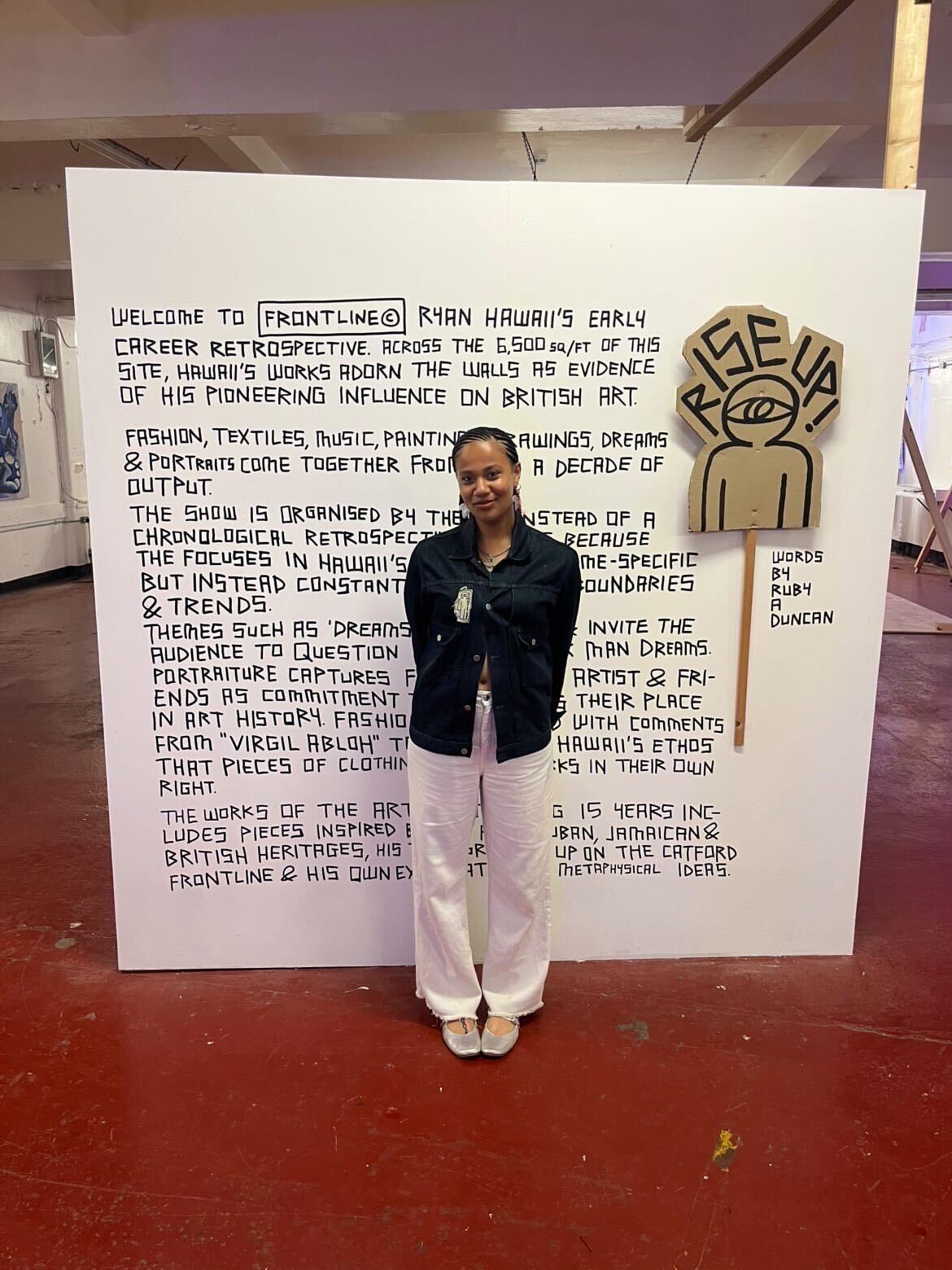
‘Frontline’, Duncan’s most ambitious project to date, opened in the summer of 2025 and brought together the work of Ryan Hawaii at Fusion Arts’ new Park End Street location. The exhibition served as an early career retrospective of the South London artist, whose practice moves fluidly between fashion, painting, and sound. ‘Ryan’s notion of the frontline, the space where community friction can happen, felt important for him to bring to Oxford’ Duncan explains. The exhibition, which also marked the culmination of her undergraduate years, unfolded as a space alive with experimentation and dialogue, where each medium invited audience members to consider different ways meaning can be made.
The understanding that knowledge and power are intertwined shapes Duncan’s broader view of curation. ‘A lot of my thinking comes from history. From questioning how race and gender were constructed, and how those constructions still shape what we consider art or knowledge.’ She concludes, ‘Representation is never neutral, even the act of showing something, or writing about it, is political. It decides who gets to be visible and how.’ Ruby credits a course taught by historian Meleisa Ona-George, ‘Black Women in British Society 1750-1865’, with reorienting her sense of what history can do. ‘It emphasised to me that the humanities can contribute to something larger.’ For Duncan, archives decide whose voices are preserved and whose are erased, but curating can begin to confront that imbalance.
What underpins Duncan’s practice is a persistent question about truth — who defines it and how it can be represented. ‘I think art can teach the historian that there are personal and individual ways to experience the truth,’ she reflects. ‘Whereas a historian might seek out consensus or factual evidence, art reminds us that the experience of living through history is subjective.’
This belief in the evidentiary power of feeling animates all her curatorial work. She resists the idea that museums and archives are neutral spaces, describing them instead as ‘institutions that have had a complete monopoly over information.’ Curation, for her, is a way of interrupting that monopoly. ‘Exhibitions can be democratic,’ she insists. ‘They can invite audiences to talk back to history, to write on the walls, to leave their own interpretations.’ This urgent belief in the necessity of dialogue extends to how Black artists can be perceived; ‘sometimes it’s frustrating that there’s still a sense of surprise that artists from our diaspora can be talented,’ she says. ‘Even when African art is celebrated, it’s often through a colonial lens, framed as discovery or novelty, as if creativity from the continent needs to be validated by the West. But African artists don’t need Western approval to be extraordinary. The art has always been there, it’s the gaze that’s been limited.’
Her language is calm but pointed when she discusses Oxford itself. ‘I didn’t begin with the aim of ‘taking on Oxford’’, she says with a slight smile, ‘but when funding gets cut, when people question the relevance of this work, my curations inevitably become interventions.’ Curating here becomes a form of quiet activism, its persistent reintroductions of neglected histories into public space. ‘We’re watching the humanities disappear across universities in this country and abroad, with entire disciplines being treated as dispensable. So, insisting on art and culture as forms of care is so important.’ ‘If I can create a space where people of different generations can meet and talk, — if a child responds to my exhibition in a way that inspires them — that means more to me than anything.’
When asked about her own legacy, she thinks carefully before answering. ‘I hope the work inspires someone,’ she says. ‘Maybe it’ll make them create something, or start researching, or just care more deeply about art. What matters is that spaces for Black art keep expanding, even as they’re being closed elsewhere.’ She adds, ‘If I could one day curate for my friend Jesse Akele who inspired a lot of what, and how I think about art — that would mean everything. Not because it’s career defining, but because it would be incredibly meaningful.’
Ruby’s practice is ultimately a vision of possibility, a belief that art can tell the truth, and that this truth lives in the delicate human spaces that open between people and the past. Her work creates spaces where creativity and community meet, where histories are explored, and the contributions of Black British artists are celebrated and made tangible.
Words by Gabriella Ofo. Image by Gabriella Ofo.
You may also like

Icon of the Week: ‘Disgusted of Christ Church’
If you’ve ever been cornered by someone really Isis-pilled— an Editor-in-Chief, perhaps, or the
‘Invisible to Mortal Sight’: Sargy Mann and the Art of Darkness
Her eyes meet yours with the guarded yet knowing gaze of age, staring out from within a fleshed but
Who cares about the Oscars, anyway?
Yesterday’s Oscars brought a shiny, glamorous conclusion to awards season. In the current politica