

The just will live by faith: Clint Eastwood’s ‘Juror #2’
Clint Eastwood’s final film pits a self-incriminating juror against a justice system that confuses verdicts for virtue.
Witches can be right, Giants can be good.
You decide what’s right
You decide what’s good.
Just remember:
Someone is on your side
Someone else is not.
-Stephen Sondheim, Into the Woods (1986)
Imagine you’re sitting on a jury for a murder case. Halfway through the trial, you slowly realise that you’re the one that’s done it. What do you do? This is the question posed by Clint Eastwood’s final work of his long and acclaimed career, Juror #2. Or so it seems.
In the story, Justin (Nicholas Hoult), a recovering alcoholic, is asked to sit on a jury— much to the chagrin of his heavily pregnant wife Allison (Zoey Deutch). Like any good law-abiding American, he reports to the courthouse and is assigned a murder trial, a civic slog he nonetheless shoulders with care. In a strange twist of fate, Justin soon comes to the realisation that he might be the true killer in this case. The defendant on trial, James (Gabriel Basso), is accused of killing his girlfriend Kendell (Francesca Eastwood) after a drunken altercation in the local bar. Kendell storms into the rain; James gives chase. That’s where the truth ends and the mystery begins.
In Justin’s version of the events, he takes a shot of whiskey— or he doesn’t, he’s not sure and you’re not either – and speeds home to his wife. Along the way, he hits something. A deer, perhaps? He steps out, sees nothing, and decides to move on. The prosecutor, Faith (Toni Collette), says that James deliberately pushed Kendell off the overpass, killing her instantly upon impact in the creek. The defence lawyer, Eric (Chris Messina), claims that Kendell simply twisted her ankle and fell, and that her injuries are the result of the speed of her collision with the rocks.
Written by Jonathan A. Abrams and presented as a classic whodunnit, the real star of the film is the appropriately named prosecutor, Faith. (Justin eventually confesses to her in what is perhaps the most striking – and only visually interesting – scene of the entire story. Faith steps out of the courtroom, having secured both a conviction and a re-election win for District Attorney (local official in charge of prosecutions), and sits down with Justin.
‘Sometimes you try to do the right thing only to realise you’ve got it all wrong. And when you figure things out, you realise the guy you’re after isn’t some … psycho. He’s not even really a criminal. He’s just a regular guy.’
[Justin tries to persuade Faith that it was an accident. Faith is unconvinced.]
‘It’s impossible to prove either way. Just like him not realising at the time when he hit someone with his car. You just have to trust him.’
‘Why would I do that.’
‘Because he’s a good person. He was caught in terrible circumstances.’
‘Mmm-hmm. No, you’re right. This is a …[chuckles] it’s a tough one.’
‘… what about justice?’
[Justin pauses]
‘Well, sometimes … the truth isn’t justice.’
To this, Faith responds with incredulity. Of course he would say that. But then, Justin outlines the reasons why justice would not be served by putting him away: Faith’s career would be destroyed, a bad person gets out onto the street again, and a good man’s family will be destroyed. What would you do?
Eastwood’s genius lies in shifting the choice away from Justin and onto the hands of Faith. As he stands up to leave, the Scales of Justice tremble, both literally and figuratively. Justin is a strange man. Throughout the trial, he seems keen to tighten the noose around his own neck. Lines of enquiry that were closed are forced open, settled questions are examined anew, and his own guilt becomes clearer and clearer. Perhaps that’s important, if his ‘goodness’ is to be preserved, if our sympathy for him is to be maintained.
Faith is Eastwood’s cruel joke and moral compass rolled into one: a prosecutor whose very name invites us to test how much trust we still have in the justice apparatus. She is equal parts careerist and confessor – re-election sash slung over a hairline crack of doubt – so when Justin unburdens himself, the scales tip off the bench and land squarely in her lap. Suddenly the whodunnit shrinks into a will-she-won’t-she, and every motive in the courthouse funnels through a single human throat. By making Faith the sole custodian of the truth, Eastwood exposes the system’s dirty secret: justice is never blind, it simply empowers whichever flesh-and-blood happens to be standing nearest the sword.
The broader question posed by the film is obvious: what is the meaning of justice? As any aspiring eighteen-year-old law student will tell you, ‘the law guarantees equal justice … and I want to use the law as a force for good’ (yes, that is actually taken from my own UCAS personal statement, which my tutor cheerfully told me that he did not read). I felt lost in school, and I put my faith in the law.
Three years and a majority of my law degree later, I have more questions than answers. Instead of finding the treasure of truth in the pages of law, I discovered instead a myriad of inconsistencies and compromises that shape our legal apparatus and our system of justice. Cases are rarely won on merit, but money. Prosecutions are dropped not because of conduct, but corruption. (See Corner House Research v Director of the Serious Fraud Office). Even laws themselves are often made not out of consideration, but convenience.
The real issue Eastwood exposes isn’t that our system of justice is imperfect. Of course it isn’t. Rather, there is something fundamentally wrong with the way we talk about justice. The gap between legal labels and moral reality isn’t confined to fictional courtrooms however; history is crowded with examples.
Consider the case of Al Capone. Dubbed Public Enemy No. 1 by local newspapers, the notorious gangster was able to repeatedly evade police action for his role in countless murders and killings due to his close working relationship with the mayor of Chicago and the police. He was finally jailed by federal officials for tax evasion, for his failure to declare income from selling bootlegged alcohol.
As Capone was imprisoned, residents of Chicago rejoiced that a ruthless criminal was taken off the streets and Chicago became just a little bit safer. But did I introduce Capone as the ‘notorious tax cheat,’ as I might have done if I was describing Elon Musk or Jeff Bezos, or indeed any other multi-billionaire? No, of course not. This is surely because everyone knows that Capone was not rightly charged or convicted for his crimes, though of course he was guilty of them. Was it just for Capone to have died only as a convicted tax evader, and nothing more? Is it right that if I was learning about Capone through court documents alone, I can only be satisfied that he was culpable solely for his failure to pay into the treasury?
Justice, of course, is a lofty ideal. I am in no way arguing that we should abandon the concept. However, we must recognise the limits of that concept as well as the limited value of our justice system. We should not be naïve about the inconsistencies in our rules of law, and we should be very clear about the fundamental separation between law and morality. Just because something is a crime doesn’t mean that it is necessarily immoral. Just because someone is a convicted criminal doesn’t mean they’re necessarily a bad person. Just because someone isn’t a criminal doesn’t mean they’re a good person.
Justice is a story we tell. Too often, the stories calcify into slogans. Eastwood’s Juror #2 exposes how easily ‘truth’ becomes a shorthand for rival tales: the hero-prosecutor’s win record, the defendant’s redemption arc, the public’s craving for closure. Capone’s tax conviction, likewise, proves that an official verdict can be both legally impeccable and morally impoverished. These examples are not outliers; they are reminders that every legal outcome is also a narrative performance shaped by who is allowed to speak, whose suffering is legible, and which facts fit the genre expectations of ‘crime’ or ‘punishment.’
If that sounds cynical, remember that language is also where reform begins. Once we admit justice is conversational – negotiated among imperfect actors using imperfect words – we gain the freedom to change the conversation. We can swap applause-line rhetoric (‘smash the gangs,’ ‘crack down on crime’) for questions that keep moral complexity in view: Who benefits from this prosecution? What harms remain unnamed? Which silenced accounts might make the verdict ring differently?
This reframing is not a plea for relativism; it is an insistence on humility. Law will always need bright-line rules, but the public square must remain nuanced, able to say in the same breath that Justin’s confession complicates guilt, or that Capone’s imprisonment both advanced and evaded accountability. When we speak about justice in that key, when we acknowledge trade-offs, name power, refuse the lure of tidy endings, we honour the ideal more honestly than any marble engraving or bronze statue ever could. Perhaps most importantly, we should be wary of placing our faith in a process that cannot live up to its promises. Every verdict leaves someone out of the story.
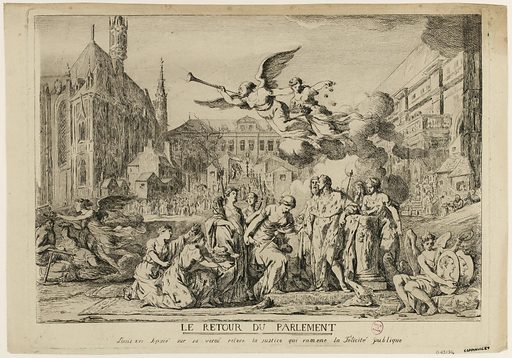
Words by Peter Chen. Image courtesy of Musee Carnavalet.
You may also like
Icon of the Week: Crepe O Mania
On many a cold frigid day in Michaelmas, or hollow awful afternoon of Hilary, or boozy and fl
The Count: Americans explain themselves
Trying to feel sorry for Americans can be a bit like trying to feel sorry for Manchester Unit

The Scam of the Morning Routine
What does a Successful Person do in the morning? The answer, it would seem, if you read enough artic