

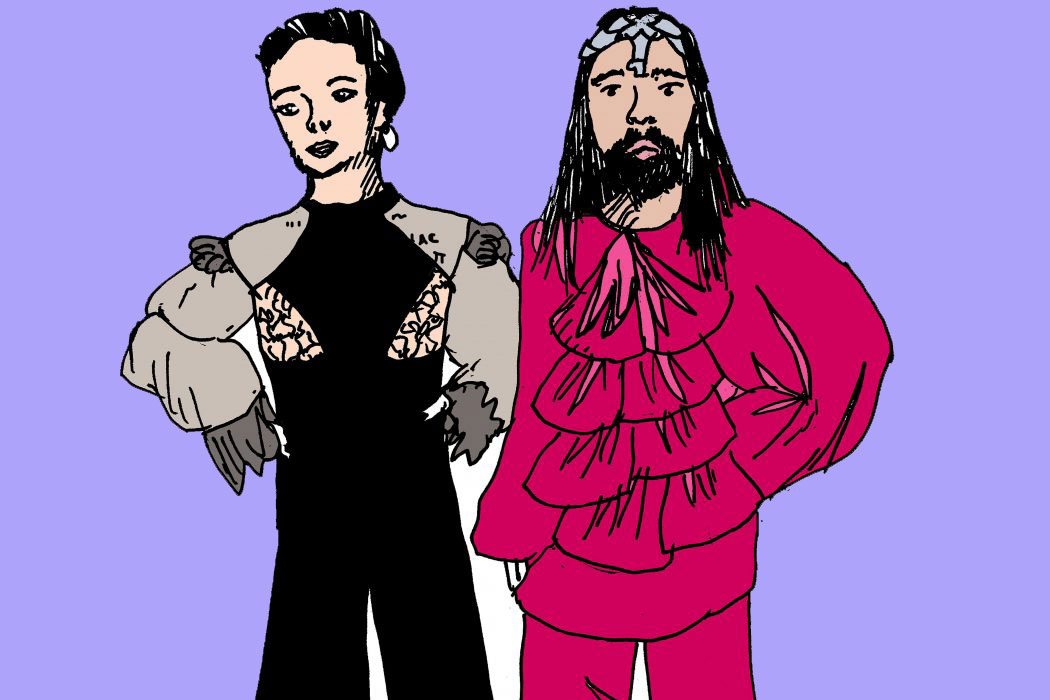
The Met Gala
Who would have ever thought “camp”, such a common, unassuming and frivolous, one syllable word would have ever come to saddle so many grandiose celebrity ambitions, political agendas and artistic projects? This year, “Camp: Notes on Fashion” is the theme for the Met Gala. The word was previously relegated to scouts with beaver hats before Sontag decided she needed a word for “the sensibility — unmistakably modern, a variant of sophistication” pertaining to the homosexual taste of the likes of Wilde, Cocteau and Caravaggio. But “while it’s not true that Camp taste is homosexual taste, there is no doubt a peculiar affinity and overlap. Not all liberals are Jews, but Jews have shown a peculiar affinity for liberal and reformist causes”. Thanks for clearing that up, Suz.
Sontag’s work was mischievous and deliberately disruptive at a time when feminist, gay and lesbian movements were just getting off the ground. The moment that the scandalous formula for “Camp” was uttered, however, it became the name of an enduring, established history of artistic development: “Fashion is inherently camp and so is the Met Gala,” says Jane Tynan, a lecturer in fashion at Central St Martins; as if “camp” constituted a set of specific doctrines, a singular, substantive perspective on the world, a particular theorisation of human experience that can be traced back to the first animal hides that Neanderthals fashioned together.”Camp” also harmonises very nicely with the Sontag’s second wave feminism and the contemporaneous identity politics, promoting the assumption that “camp “is some sort of advanced, postmodern identity, transcending both the feminist and the queer.
The word “camp” thus achieved what the words ‘gay’ and ‘feminist’ had been unable to: namely, the entry of camp into public vocabulary in the 1960s in a convivial, relaxed manner. Indeed, the word “camp” has been so successful in its dash into public culture that it seems to shirk off any of Sontag’s attempts to pin it down. “To define camp is to kill it. Camp can’t be canonised – if it is, then it dies,” says Dr David Russell, author and associate professor in English at Corpus Christi, Oxford. All this would be merely amusing, if the hegemony of camp hadn’t had the undesirable and misleading effect of portraying the majority of previous work in the gay community as frivolous, kitsch and in bad taste.
That does not mean all the consequences of the word have been bad by any means. The word has has re-opened the question of the relations between sexuality and gender, both as analytic categories and as lived experiences; it has supported non-normative expressions of gender and sexuality and it has underwritten a crucial cultural shift against homophobia and heterosexism.
But with the institutionalisation of “camp” at the Met Ball comes the opportunity to be even more problematic. While many used their appearance as an opportunity to scene steal (see – Katy Perry dressed as a candelabra or Lady GaGa wearing four “outfits” and stripping until she was just in lingerie), Lena Waithe pointed to the event’s potential for cultural erasure with her simple suit jacket, emblazoned with the slogan “Black Drag Queens Invented Camp”. Tynan agrees: “The camp theme fits in a strange and intriguing way with the Met Gala in 2019″, it “reflects the failed seriousness of current structures” but equally is frustrated by the simple fact that “there is not sufficient space at a red carpet gala to explore sufficiently.”
https://twitter.com/evanrosskatz/status/1125571061385441284
There is something odd, suspiciously odd, about the rapidity with which camp – whose claim to radical politics derived from its ethereal sensibility, from its shocking embrace of the abnormal and the marginal, has been embraced by, canonised by, and absorbed into our institutions in a way that LGBTQ politics never were. Camp has proven to be much more congenial to established institutions of the liberal media than Wintour and her cohorts would let us believe.
Indeed, it seems the scheme to use the word “camp” is a neat way to refer to but not engage directly with issues of queer oppression. “Camp” aims to gain cultural capital on the back of LGBTQ movements without actually lifting them up. It turns the Met Ball at once into a harmless qualifier of a politically active event whilst remaining merely an extension of what important people in fashion have already been doing for years. It can be folded back into the standard practice of the fashion industry without impeding business as usual. “Camp”, like “Punk” a few years before it, is being used by the Met Gala as a generic badge of subversiveness. If it’s camp, it’s both high fashion, extravagant and politically oppositional, right? So every celebrity who claims to be progressive (ranging from Cardi B to Lady GaGa) has a vested interest in owning a share of it and being the best at it. This has resulted in a paradoxical situation painfully illustrated at the Met Gala; as “camp” becomes more widely diffused throughout public culture, it becomes harder to figure out what “camp” is, let alone what’s so very camp about it.
In any case, if Anna Wintour and Andrew Bolton’s aim was to inquire into queer output within the fashion industry, they could have picked any of the last few Gala’s and examined queer men and women’s distinctive relation to mainstream culture. If “camp” as a word or as a concept is going to have the sort of future worth cherishing after this event, we will have to find ways of renewing its radical potential–and by that I mean not creating or organising some new or more avant-garde event but re-examine its capacity to startle, to surprise, to help us think what has not yet been thought. Some ridiculous ruffles, outlandish bows and a stupid amounts of diamonte worn by celebrities trying to make their mark was never going to be enough. ∎
Words by Holly Fairgrieve. All opinions are writer’s own. Quotes have been edited for clarity. Artwork by Kathleen Quaintance.
You may also like
Smoking. Hot?
The slim tube of paper rests elegantly between my fingers—I can almost inhale a swirl of sm
Keeping the Memory Alive (and Profitable): The problem of dead artists
There has never been a better or a worse time to be a dead celebrity. In 2012 the annual revenue gen

Exorcising Mississippi’s Cemeteries
“Mississippi had no art except in cemeteries”. These words of Eudora Welty’s, a comment on her