

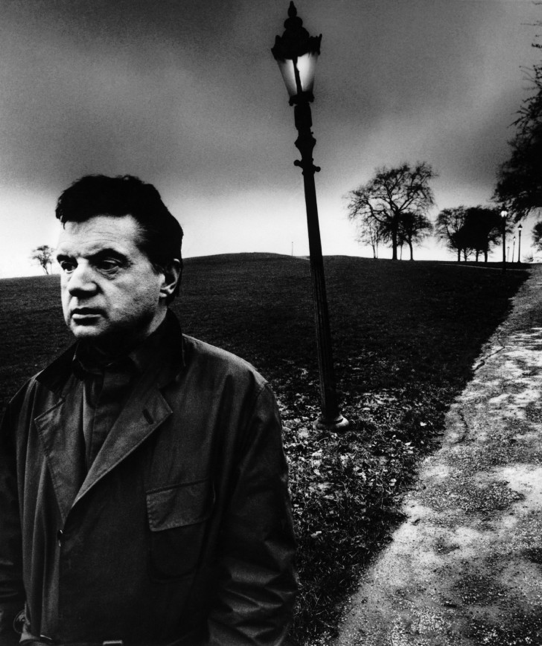
Francis Bacon, Primrose Hill. Bill Brandt (1963)
To a pedantic and dogmatic doctrinaire of photography, almost everything about Bill Brandt’s fêted snapshot is wrong.
Categorically, indubitably wrong.
Consider, for a moment, the warped composition of the picture. The central, yet uncomfortably off-kilter lamppost awkwardly brushes the very top of the frame. The fractured path to the right pulls our eyes off the main subject, without stemming from or leading anywhere significant. The subject himself — the renowned painter Francis Bacon — is caught to the extreme left, his steely gaze completely cut short by the edge of the main frame. The skewed horizon of the surrounding hills penetrates through the centre of the artist’s head.
Brandt has followed no ostensible ‘rules or ratios’: his picture breaks basic photographic conventions, and the atmosphere of the scene is downright uncomfortable, riddled with tautness and anxiety.
And yet, considering Bacon’s own work — his boldly raw, emotionally charged and often highly grotesque figurative paintings — has Brandt not in fact perfectly captured this portrait in a perversely fitting way, which mirrors the artist’s canonical form?
This snapshot, I believe, perfectly counter-balances my earlier piece on Ed Clark’s Navy bandsman Graham Jackson. Whilst the latter is perhaps the model case study, demonstrating how supposedly ‘excellent photographs’ are often a result of conforming to the ‘sacred rules’, Brandt’s example distinctly demonstrates how the very best photos can actually be the result of breaking them.
Whilst distinguished compositional techniques such as the rule of thirds, correct framing, leading lines and radial balance are of course fundamental building blocks of photography, an obsession with this rubric can render one’s pictures all-too safe and predictable in the long run.
The snapshot here exists as a gritty role model to any photographer looking to break the orthodoxy and capture the true, unvarnished essence of their subject(s).
After all, this is quite simply a picture of a man who painted deformed heads and animal carcasses at a horrifying intensity. A man who had an unhealthy obsession with screaming. A man who experienced a host of emotionally abusive relationships. This is a man who was once thrown through a window so hard that his eye had to be sown back into its very socket.
Somehow, I don’t think a colourful portrait of a grinning man, set against a neat, calculated background would have done the job.
Photo: Bill Brandt
You may also like


Madness, violence and so on
An interview with the stage director Robert Icke.
Too obscene for the screen
Imagine being a small restaurant owner in Newport Beach, California in 1971. It’s an average start