

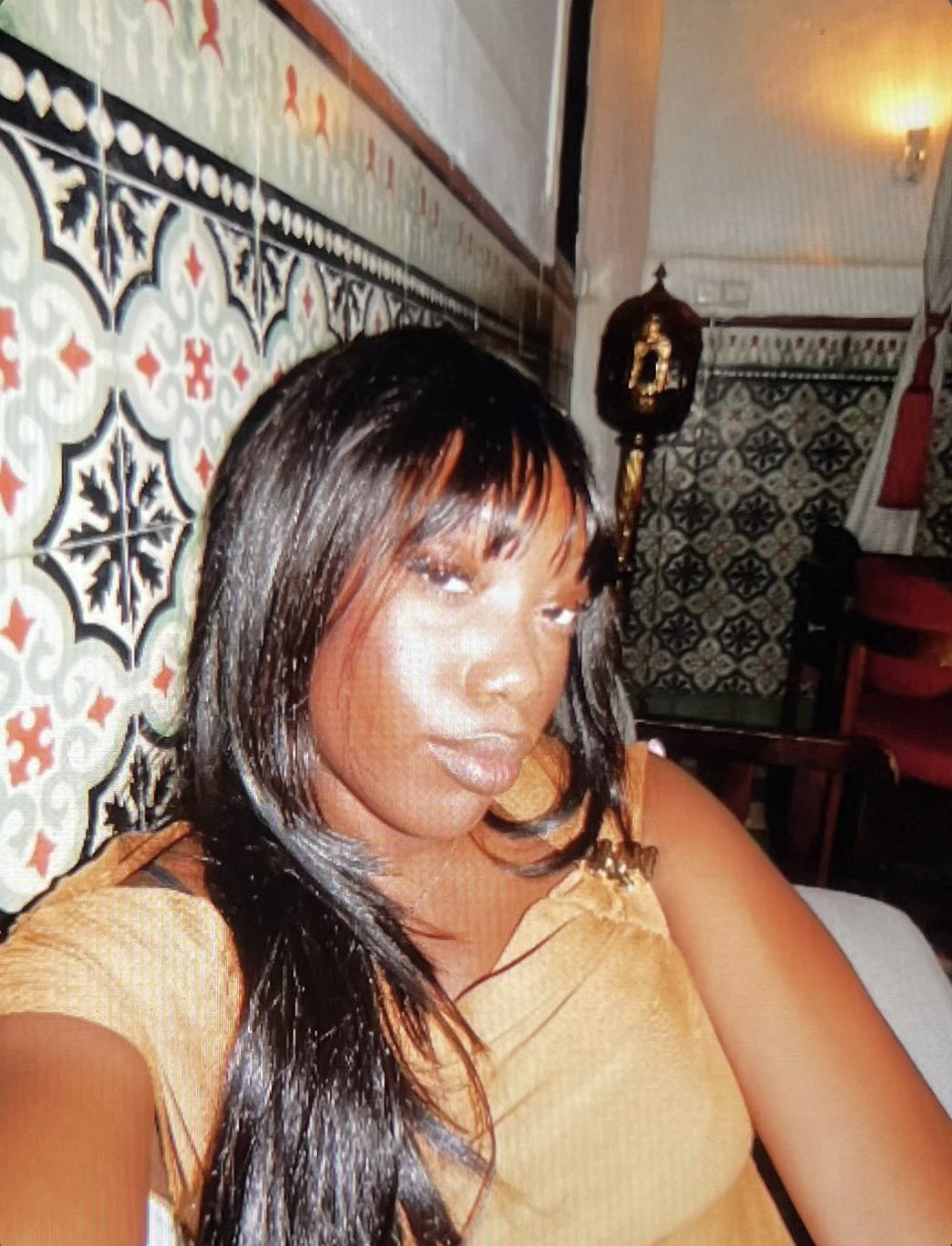
Artist Spotlight: Nyla Thomas
The heatwave has overstayed its welcome in Oxford. The stone that usually holds the city in a kind of grey composure is bright, hot to the touch, as I dodge the swarms of tourists on the High Street. I find relief, and Nyla, in Magdalen’s cloisters. I suggest Addison’s Walk and she agrees. We take the path slowly, the deer park to one side, the water low and bright on the other, until the college is just a tower through the trees and the heat feels, if not gone, then at least at a remove. The conversation begins as the all do in Oxford—tutorials, the alarming speed of Trinity term, Nyla’s year abroad closer on the horizon. We forget, for a while, that there is anything else to discuss. Laughing, I take out my recorder.
INTERVIEWER
Tell us a little about yourself—who you are, what you study, what you do.
NYLA
My name’s Nyla. I do Spanish and Portuguese at Magdalen, but on the creative side, I DJ—I’ve done such a range of different functions, the odd ball—and I’m also president of the Hip Hop Soc. So, you know. Busy!
INTERVIEWER
Where did music begin for you?
NYLA
Very early, actually—the ocarina was my first instrument, I was about three years old. Then I moved on to singing, and that became a serious thing for almost ten years. Classical, jazz, a real mixture—I had some great people leading the choirs I was in growing up, and big choirs too, so there was this real sense of something collective happening. Music as a shared thing rather than a solo pursuit. I think that’s stayed with me. I came to Oxford as a choral scholar at Magdalen, it felt like a natural continuation of everything I’d been building. And then it very much wasn’t.
INTERVIEWER
So what happened?
NYLA
I hated it. (laughs) I feel terrible saying that because everyone who’s still doing it… I’m saying a prayer for you. But it was so intense in a way I hadn’t anticipated. The choirs I’d been in before had this warmth to them, and Oxford was so different. Music began to feel more like a job, one I was struggling to prioritise to the extent that choir asks of you. I do joint honours, so that’s already two degrees worth of reading and tutorials and deadlines. Choir seemed more like a third! Six services a week, rehearsals on top of that, and on Sundays you’d do two services and rehearsals in the same day. The contact hours alone were more than most people have in a term. And the stakes felt so disproportionately high for what it was—if you got a note wrong at a feast day or an Easter service, you had to write a letter of apology.
INTERVIEWER
How did DJing come into all of this?
NYLA
I’d actually started at the end of A-levels—just getting a feel for the decks, messing around with the basics. It was something I’d always been curious about but never properly committed to. Then I got to Oxford, and the music scene felt kind of flat, and I remember thinking, I’m not going to sit here and wait for it to get better. Do something. So I did.
INTERVIEWER
The timing, coming out of choir, seems significant too.
NYLA
Oh definitely. Going from all that rigidity—the fixed repertoire, every note being up for scrutiny—DJing felt like the most freeing thing in the world. I could play anything. And the only metric of success is the crowd. If the crowd loves it, the crowd loves it, and if they don’t, you read the room and you pivot. I’d spent so long in musical environments where the goal was perfect execution of someone else’s vision. DJing was the first time the vision was entirely mine.
INTERVIEWER
What’s the biggest surprise about being a student DJ in Oxford?
NYLA
That it wasn’t as impenetrable as I’d built it up to be in my head. I spent years just thinking about it—messing around on DJ apps on my phone, telling myself I’d start properly soon, when I had more time, when I felt more ready. And then, when I started, the gap between thinking about it and actually doing it was nowhere near as wide as I’d convinced myself it was. Being a DJ is hard, I’m not dismissing that for a second. But getting in the room? Getting to a point where you can hold a crowd and make them feel something? That’s definitely accessible. I just wish I’d stopped deliberating sooner and trusted myself to figure it out as I went.
INTERVIEWER
What’s the student DJ scene in Oxford actually like? For those working in it, outside of sets?
NYLA
Very independent, honestly. The OUEMS group chat is useful—people post opportunities on there and it’s a good way to stay visible—but most of my bookings have come from someone seeing a set somewhere and just reaching out afterwards, or knowing through a mutual friend that I DJ. It’s very organic. People vaguely knowing you exist and deciding to take a chance on you. Word of mouth, essentially.
I think something nobody really prepares you for is the hours. Even if you’re the first to finish, you’re probably wrapping up at midnight or one in the morning. By the time you’ve actually left the venue, got home, come down from the adrenaline and had a shower, it’s three AM. And you’re wired because performing does something to your nervous system that doesn’t just switch off the moment you unplug. My sleep schedule last term was off-kilter, for weeks at a time. But when you’re standing in that room mid-set all of it feels completely worth it.
INTERVIEWER
What’s your favourite set you’ve ever done?
NYLA
The Oxford Brookes Psychology Ball. The energy in the room was so great. That kind of set, where everything lands, doesn’t happen all the time so when it does you just try to stay present and not overthink it.
But that night also made me think, because out of every DJ I’ve personally met and worked with at Oxford, only two I know of are Black girls. Two. And I love this city and I love what I’m doing here, but that number is stark. It’s very far removed from London, from the scenes that a lot of this music (or, the genres at least) actually came from
INTERVIEWER
Definitely, I mean, what genres do you like to play?
NYLA
A lot of the music I DJ isn’t hip hop, which surprises people. I love garage—proper UK garage, that’s maybe my first love in terms of DJing. House, Brazilian funk, reggaeton. Bad Bunny is basically a guaranteed win in any room. But what I really love is playing black pop in rooms that aren’t expecting it. Sade in the club. Solange. Even something like early Destiny’s Child, that people know but haven’t heard in years. People’s faces do this thing where they’re surprised and then immediately, completely in it, because the music is genuinely that good and there’s no resistance once it hits. There’s something really satisfying about being the person who gives a room that experience. It feels good, as a DJ, the only sense of credibility you desire.
I know what else is out there. Some Oxford events and it’s wall-to-wall Taylor Swift and ABBA from start to finish, which—fine, people love what they love, and I’m not here to be a snob about it. But I’m not that DJ, and I’m not trying to be. I think there’s a version of student DJing in Oxford that plays it very safe because the crowd seems to want safe, and I’ve never found that interesting. The most memorable nights are the ones where someone takes you somewhere unexpected and the room feeds off of a new energy.
INTERVIEWER
Are you intentional about who you put on? Does it go deeper than what sounds good in the moment?
NYLA
Very intentional, always. It’s the same sort of responsibility as being on aux (laughs) and I don’t mean that in a throwaway sense, I mean it seriously. You’re essentially deciding whose music deserves a platform that night, whose artistry gets associated with a good time and a full dancefloor. That has weight, and I think it’s something DJs should take more seriously, if I’m being honest.
So yes, for me, there are lines I draw. I’m not playing Kanye. I’m not the one, sorry. I don’t care how the crowd might receive it, I don’t care if it’s the obvious choice for a moment in the set. Because I want to champion Black music! Not selectively, when it’s the crowd pleaser or when there’s no cost attached to it. You have to be consistent. I think about the artists I’m playing as people I’m vouching for. I’m saying to everyone in that room, trust me, this person is worth your attention. It’s a small thing in the grand scheme, one DJ at one student event, but these small things accumulate! Especially in a place like Oxford, where there is so much room for me, as a consumer of more alternative genres, to introduce people to a genre they have never heard before.
INTERVIEWER
On that note, do you think DJing has changed the way you consume music?
NYLA
Oh yes definitely. Last term especially, I couldn’t listen to anything without immediately categorising it within a set. What BPM range does this song have? Where does this sit in a sequence? Retrospectively, I think it turned listening into work without me really noticing, and I think I lost the pleasure of music as music. It was only taxing when I stopped and remembered the bliss of just enjoying music.
INTERVIEWER
Do you feel like the demographic makeup of the scene in Oxford—both in DJing and in Hip Hop Soc—is something you think about actively?
NYLA
I try to do so carefully because it’s easy to get it wrong in either direction. A lot of the people who come to our events are black or from ethnic minority groups—that’s just the reality of who gravitates towards the space—and our entire exec is Black. But there’s no sense of anyone being unwelcome, and I think we get such a good range of people—real HipHop heads, people who’d discovered the genre at Oxford. And you don’t need to arrive with detailed knowledge of hip hop history. I certainly don’t have one, and I’m the president.
I also have to be careful not to conflate hip hop with blackness in a way that makes it feel like a black music society specifically, because that would be to reduce black music to hip hop. There’s definitely a balance between preserving the black influence in the music we share, and sharing it. Hip hop is Black music— that’s the history, and I’m not going to flatten that for anyone’s comfort. But Black music is not only hip hop. It’s garage, Afrobeats, it’s soul, it’s everything I play when I’m behind the decks. It’s Sade and Solange and Brazilian funk and drill and grime and everything in between. The breadth of it is the point. It is hard to find that balance, or at least explain it. But I think what we’ve got going on works.
INTERVIEWER
Who is your muse right now? A DJ, or someone you’re currently listening to?
NYLA
DJ Cuppy! Without question. She went to Oxford and she’s built this incredible career as a pioneer of Afrobeats in the UK. She’s DJed the MTV African Music Awards, works in policy and government. She has a profile that extends well beyond music into genuinely changing things. What gets me about her is that she holds all of it at once without any of it looking like a compromise. That integration is what I want. I see myself as a lawyer, yes. But I want DJing to remain a big part of my life, as I graduate. I refuse to treat one as the serious thing and the other as the hobby I’ll give up when life gets too full. The dream, the actual dream, is being the DJ in some random café at eleven AM on a Tuesday. Decks in the corner, lunchtime crowd, playing to people on their break before they go back to their desks. Mama does not need to be in the club at 2 AM. She needs to be doing this on her lunch break and then going back to work.
Words by Naima Aden. Image via Nyla Thomas
You may also like
A Voice in the Storm
I’m on the black list over there, all of my books are banned… But I must always be faithful to t

The ISIS is recruiting
The ISIS is recruiting staff for the HT12 team

Icon of the week: Becks Morgan
Many prolific artists are more multifaceted than we might first think. Joni Mitchell thinks o