

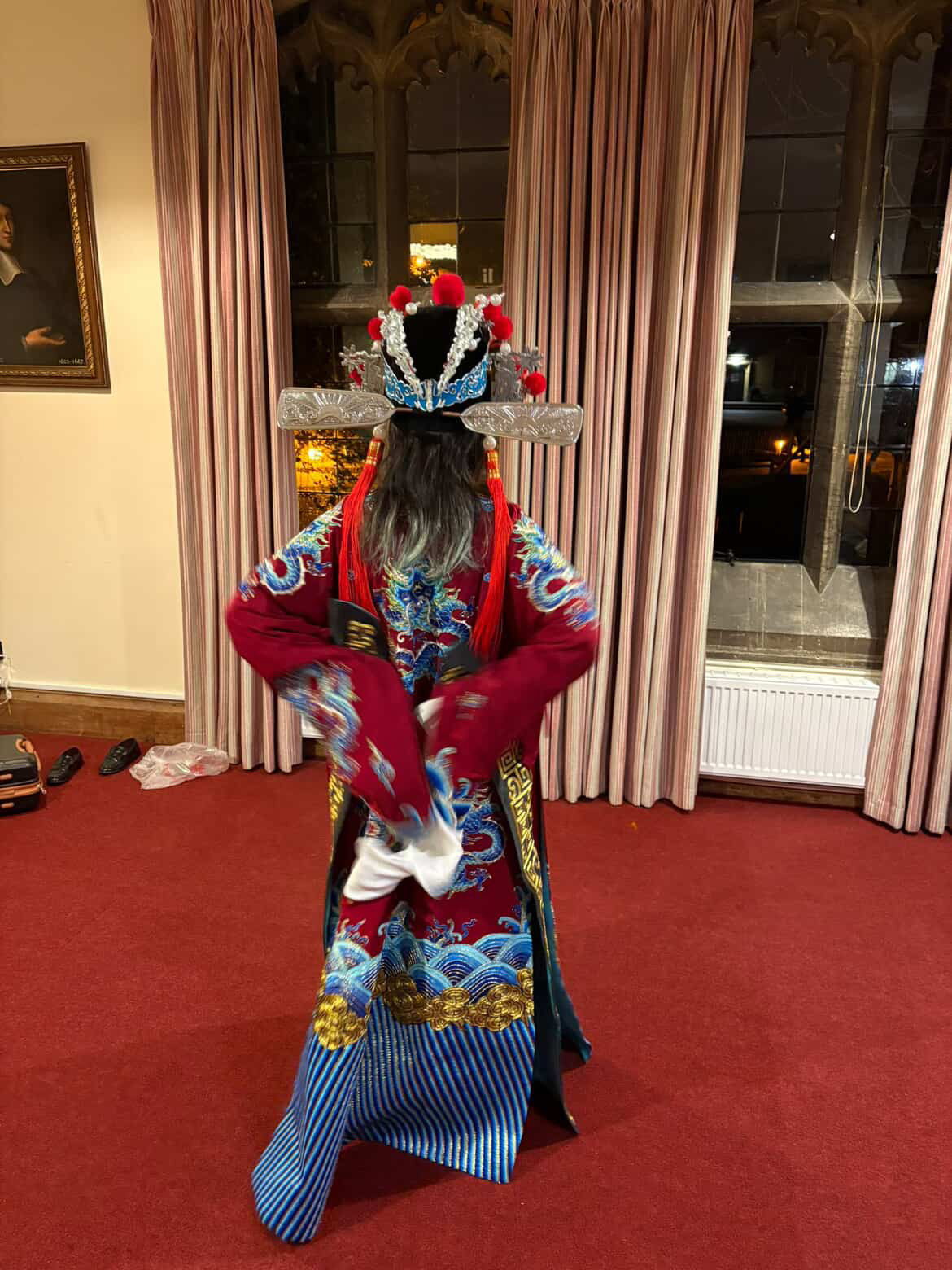
Prince Consort Ladygirl: Preshow interview
Red Threaded Theatre 4th-8th March O’Reily Theatre
As we know all too well, sitting an exam is about the most stressful thing expected of us in our young lives. Our main concern, of course, is failing. But for the cross-dressing protagonist of this spirited Chinese Opera (translated into English by the students of Red Threaded Theatre), this is the least of her worries. Trying to rescue her imprisoned beloved Li Zhaoting, Feng Suzhen picks up her brush and ink, disguises herself as a man and sets out to conquer the Imperial Civil Service exams. Little does she know that she will end up doing far too well…
This vivacious story is coming together in the principal’s room at St Hugh’s college. The space is ringing with activity. On one side of the room director William Want subtly choreographs a scene, on the other, the music of the Huangmei opera sounds out from the piano. At this stage, much of the production is still in formation. In the long and high-pitched melodies finding a space to breathe can be a challenge; form fits content here as Suzhen has to desperately make her case to the emperor.
The atmosphere is giggly, but not without a certain dedication. It’s clear that everyone involved is set on making something fantastic. What’s more is that this drive seemed profoundly collaborative. If a performer made an interesting enough mistake Want didn’t hesitate to incorporate it into the blocking, or even into the script. Want speaks of the challenge of bringing the Chinese text into English whilst maintaining the original music. The two languages are, of course, very different, and sentences that might work with a particular rhythm in one may be less suited to the other. This has led to a translational style that is more interested in preserving the dynamics of the original than its precise wording.
The translation of the production, then, works to expose a Western audience to an underrated medium (hopefully with a minimal degree of alienation). William Want says that Chinese opera ‘rarely gets any recognition in the UK or outside of China’, despite its delightful and creative music, dance, and stories. Want sees the show’s staging at the O’Reily theatre as a real advantage to this goal, noting that its schedule tends to be full of plays that are canonical in the English-speaking world. Thus, the inclusion of a classic from China is disruptive in one sense, but perfectly fitting in another.
In choreographic matters, the minute details of bow and gesture conform to the stylised traditions of Chinese opera, but this by no means stops the human feeling (and the laughter) of the story from shining through. The ostentatious sense of obsequiousness generated by the ornate bow works to comedic effect when it needs to be repeated after each address to the emperor.
The stylisations work well with the wry self-consciousness of the script’s own fictitious nature. At one point the princess is recounting a remarkable story (which we the audience know to have a striking resemblance to the events we have just witnessed). The prime minister is scandalised, but the emperor ironically defends it on the grounds that ‘We are not talking in reality here are we dear.’
When we spoke, Want noted that ‘there are loads of concerts and performances of music and performing arts from outside the Western Canon. They’re just not in main venues.’ Hopefully, Red Threaded Theatre can start to remedy this, and they’re in the right position to do just that. They’re not going anywhere. So keep an eye out.
Words by Alex Lafferty. Image by Thomas Zhang.
You may also like
Who’s Afraid of Music?
“Against music – for architecture”, proclaimed Salvador Dalí in his 1942 autobiography, a sta

“Every man has the f***ing his mother dream at some point”: a review of Robert Icke’s Oedipus
Oedipus’ mother Merope warns that “Knowledge in advance is the gift of the gods.” In th
Fellas, is it gay to read a book?
The Saturday before last was a particularly sunny one. Although I didn’t have much time in