

It is bourgeois to block your ex.
There is this thing Vladimir Nabokov’s Ada, his longest, most torturous (at least the first 20 pages), and certainly most arduous book to read. In it, Van and Ada, the twin protagonists, two lovers who have been together and separated for over 80 years, share this term for each others’ past flames: old friend of the family.
Old flings. Old flames.
Since we now have to vulgarly discuss everything in terms of psychology, the economy of the mind, support and demand, I was going to, begrudgingly, title this article, On the Emotional Support Ex.
But trust, I meant, old friend of the family.
My family doesn’t have many old friends. My parents tend to move on. When she was 13, one of the boys on the streets confessed to my mother. Naturally, she rejected him. A few days later, he was stabbed to death by the leader of a rival gang. It is the only thing my mother remembers of him.
The day I got blocked by an ex in Paris, I was staying in an attic room at a place in the Marais, one where you have to lock the door when you are in, and leave the key at the desk when you go out. Earlier that day I had coffee with a friend. We sat at the Bourdain spot on Saint-Sulpice. There was really loud music playing in the square and the carousel was singing ‘Colors of the Wind’. We said we’d give our exes six or seven years to become cooler. If it turns out to be six I will buy her a pack.
She doesn’t like Jane Austen. Nabokov did. Nabokov had this whole thing where he rated writers.
Austen, Jane. Great.
Dostoevsky, Fyodor. Dislike him. A cheap sensationalist, clumsy and vulgar. A prophet, a claptrap journalist and a slapdash comedian. Some of his scenes are extraordinarily amusing. Nobody takes his reactionary journalism seriously.
Marx, Karl. Loathe him.
Perhaps it is right, for aNabokovian topic, for this piece of writing to be as un-journalistic and un-sociological as possible. I really thought X would turn out to be an old friend of the family. I overestimated him. Just as we once overestimated one another.I wrote about him in the magazine. A stupid idea.
My friend doesn’t like Austen because she likes female writers who write like men. In her swan song, Persuasion (1815),however, I found, between the sentimental drips of an empire-waisted woman, a hardness:
She had used him ill, deserted and disappointed him; and worse, she had shown a feebleness of character in doing so, which his own decided, confident temper could not endure.
A feebleness of character is what I had shown. It is what Didion called, a lack of self-respect. It is what my own decided, confident temper could not endure. So I ran, only to lose more character.
People with self-respect have the courage of their mistakes. They know the price of things. If they choose to commit adultery (I did not, by the way), they do not then go running, in an access of bad conscience, to receive absolution from the wronged parties; nor do they complain unduly of the unfairness, the undeserved embarrassment, of being named correspondent. (Joan Didion, ‘On Self-Respect’)
I knew the price of things. The problem was that I was willing to pay. Whereas the cool thing, and the right thing to do nowadays, is to go running; not in the way I ran, of course, which was towards an absolution in the name of friendship, but to simply run:
I’m sorry. I can’t. Don’t hate me—
Listen, I broke character. I told stories. I had my eyes wide shut. I suffered, and perhaps complained unduly. But self-respect is beyond self-preservation. And seeing doesn’t always have to do with eyes. Oedipus sees after he has blinded himself. X believed too much in the empirical, as many in this country, and time, do.
Our age is one which has fundamentally misunderstood self-respect, and perhaps one which has fundamentally misunderstood truth.We make mistakes, because we ask too many questions. I have learned to stop asking questions. What makes Iago evil? I never ask.
Thus I am not too interested in why X blocked me.
There were two great moments in our conversations as friends. Once, when I told him, ‘there is a lot of narcissism in self-hatred’, after David Foster Wallace. He got angry. The second time, he told me it would be ‘useless to explain some things’, regarding our failure. I thought he was saying, you shouldn’t ask what makes Iago evil. But rather than suggesting the inherent impotence of answers, he implied there is one, just he wouldn’t disclose. He was always half a step away from the truth. An extremely private man.
Listen. Self-respect is not ‘self-care’, is not ‘self-help’. Self-respect is the recognition of yourself, and what you could be, and taking responsibilities for all your strivings. This current, narrow bourgeois idea of self-respect is, to me, extremely self-degrading, and infantilising.
If I may break briefly from manners, and turn to sociology—the idea of cutting people off is essentially a bourgeois one. The idea that you are something to be preserved, accumulated, like capital. (I also loathe such terms as ‘social battery’. Let’s just talk about what it actually is, energy and enthusiasm) In an increasingly atomised society, socialisation is no longer a mandate. It has, like everything else under capitalism, become a choice.
X was half right when he said, in one of our semi-inebriated chats, that had I been English, which I suspect he would have preferred, I would be one of those aristocrats whom Austen would describe as of ‘reduced status’. The aristocratic way of keeping your exes around, as old friends of the family, has become obsolete, just as big families were usurped by the bourgeois nucleus. In the postlapsarian world of love, in the Western world after the End of History, you are not allowed a past.
It is, once again, that opening monologue by Carrie Bradshaw in Sex and the City:
Welcome to the age of un-innocence. No one has breakfast at Tiffany’s, and no one has affairs to remember. Instead, we have breakfast at seven a.m., and affairs we try to forget as quickly as possible. Self-protection and closing the deal are paramount. Cupid has flown the co-op!
The last thing I said to him was, unprompted:
You need to become more prelapsarian.
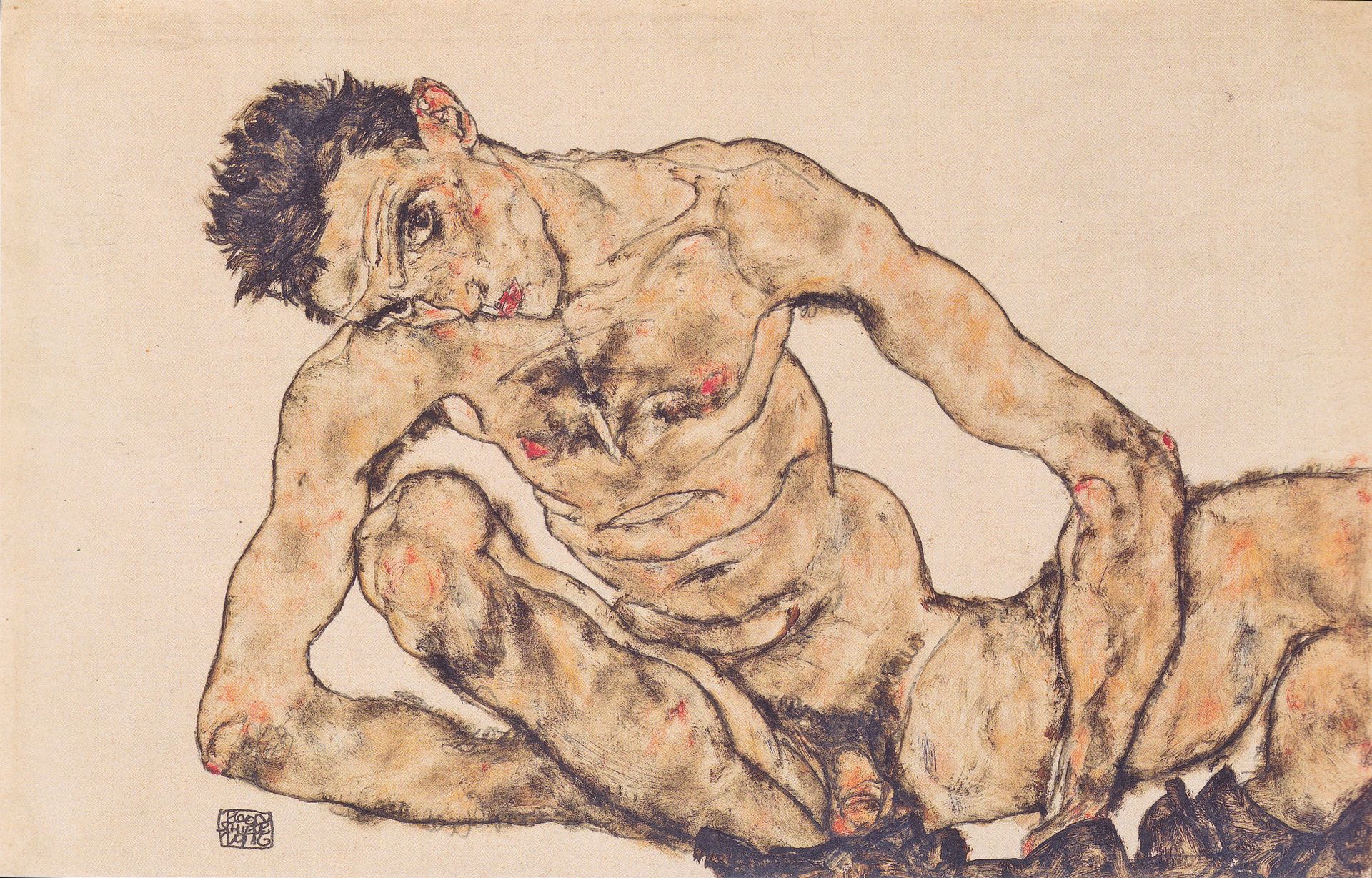
Words by Zac Yang. Egon Schiele – Aktselbstbildnis – 1916 via Wikimedia Commons.
You may also like

Sex work in the age of social media
“You’re posting naked pictures of yourself online… some people find it to be so scandalous or

‘Bird on a Wire’ Screening, with Director Tony Palmer
ISIS presents a screening of the classic documentary about Leonard Cohen’s 1972 European tour:

Icon of the Week: ‘Disgusted of Christ Church’
If you’ve ever been cornered by someone really Isis-pilled— an Editor-in-Chief, perhaps, or the