

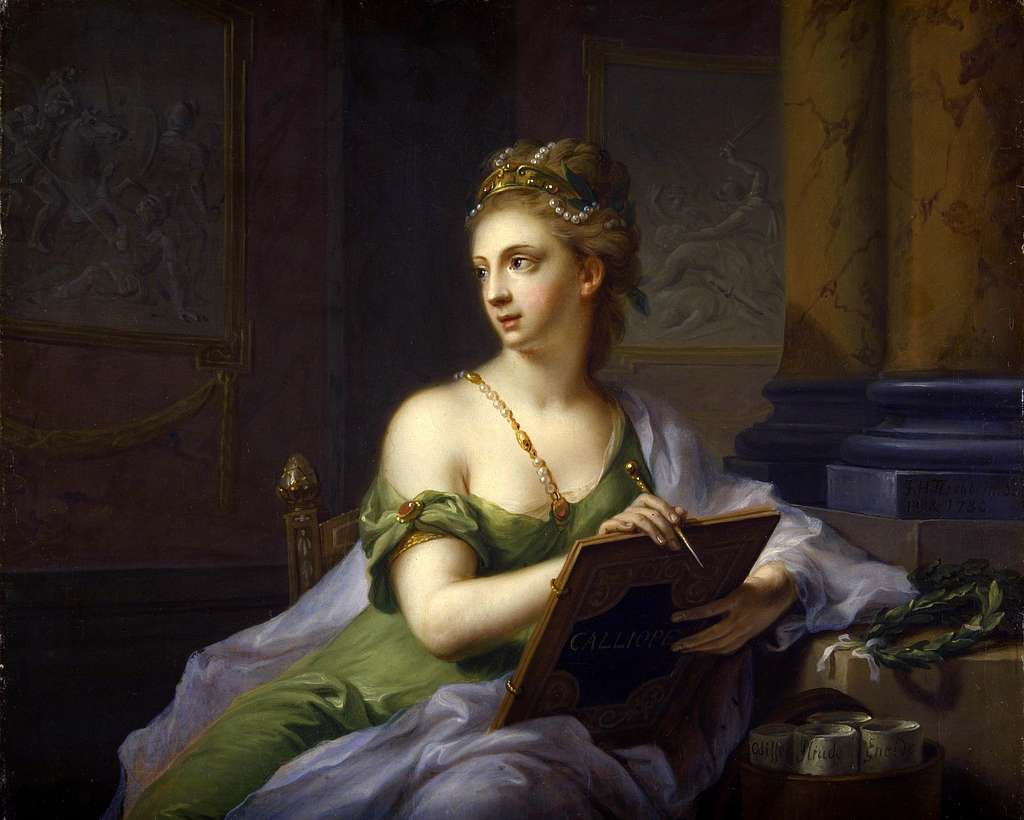
IOTW: Calliope, Oxford’s eldest daughter
Art historian John Rolfe was walking down an eerily quiet Broad Street in 2020 when he looked up and saw something peculiar: a crumbling Muse, or rather the ghost of one, teetering atop the Clarendon Building at the corner of Broad and Catte Street.
The Clarendon is one of those Oxford buildings that looks as though it has always been there: severe and rectangular in its English baroque massiveness. It was built between 1711 and 1715 in part from the profits of Lord Clarendon’s and once housed the Oxford University Press before it relocated to Walton Street in 1832. Now, its grand façade conceals a nest of administrative offices: the University Registrar, the University Chest, and the Proctors.
From the ground, the Clarendon is stately, almost dull next to its grand neighbors like the Sheldonian Theatre. Unassuming, that is, until you look up. There, lining the roof, stand—or rather, should stand—the nine Muses: Urania (astronomy), Thalia (comedy), Terpsichore (dance), Polyhymnia (rhetoric), Melpomene (tragedy), Euterpe (music), Erato (love poetry), Clio (history), and Calliope (epic poetry). A celestial sisterhood of inspiration.
The history of these Muses are riddled in ambiguity. Their designs have largely been attributed to painter Sir James Thornhill, evidenced by a 1720 drawing of his currently housed at Worcester College. However, there is reason to believe they were actually cast by sculptor John van Nost, who received pay from the University around this time. For unknown reasons, the University initially rejected the idea of putting the girls on its roofline, and they languished for two years before finally being installed in 1717, where they’ve presided ever since over Broad Street’s chaos of bicycles and tourists.
In myth, the Muses sing and dance, inspiring mortals to paint, write, and create. These were fun girls, divine patrons of creativity with a flair for performance. There is no canonically accepted hierarchy of the sisters, other than that Calliope, who was their de facto leader: articulate, commanding, the type-A eldest daughter of a problematic father (*cough cough* Zeus.) Poet Hesiod is credited with making this distinction of her superiority as he invokes the Muses in the opening lines of Theogony: ‘This is what the Muses sang, who dwell in Olympus, the nine daughters born of great Zeus, Clio and […] and Calliope, who is chief among them all; for she even attends august kings.’ [1]
So naturally, when the Muses ascended to the Clarendon, Calliope was given pride of place on the central portico, gazing down Broad Street like the embodiment of eloquence that she was.
It was a perfect placement. The Clarendon is the only outward-facing building in its cluster—the Sheldonian and the Divinity School both turn inward, their courtyards like closed conversations. The Clarendon, by contrast, meets the city head-on, its columns an invitation rather than a barricade. It is the building that speaks—and Calliope, Muse of epic, was its mouthpiece.
The sisters’ bodies were made with lead—heavy, solemn, and dignified with an iron rod for a spine. The material had a fatal flaw: once cracked and moisture crept in, rust bloomed and the whole structure began to tilt, slowly and silently, until the weight became unbearable. Two Muses fell this way in the late eighteenth century—a tragic swan dive from the heavens to Broad Street. Their remains shattered on the cobblestones, unrecorded, unmourned.
It wasn’t until 1974 that replacements were erected, funded by Blackwell’s—the local patron saint of lost causes and literature. But in the process, someone committed a cosmic administrative error. The new figures were made of fiberglass coated in resin mixed with lead powder (light, cheap, and destined to decay in about fifty years), and, more alarmingly, they were put back in the wrong places.
Melpomene, the Muse of Tragedy, took the central spot—sword drawn, face fixed in eternal anguish—where Calliope had once presided. It was an odd choice for a headpiece: tragedy instead of eloquence, fury instead of grace. The Clarendon’s new guardian wasn’t there to inspire but to warn.
Fast-forward to 2020, when Rolfe looked up and noticed the decay. The fiberglass was weathered and cracking. Yet something else was off; there were two identical figures on opposite corners. Two Euterpes, the Muse of Music, fluting silently into the Oxford air.
It turned out that the original Euterpe was still standing, minus her flute, which had long since fallen away. When the restorers saw her empty hands, they must have assumed she was a different sister. They never realized the original hadn’t fallen at all. And so, in a feat of celestial bookkeeping gone wrong, Oxford ended up with two musicians and no voice.
Because, of course, the missing one was Calliope. The eldest daughter. The leader. The one who spoke for the rest. She had been erased, quite literally, from the institution’s skyline—replaced by a tragic double and forgotten in the paperwork.
It was like a punch to the gut when I learned of this in a lecture from Rolfe himself. If you’ve ever been the eldest daughter, you know that quiet disappearance: the way responsibility hardens into invisibility. Eldest Daughter Syndrome. You keep the household standing, the siblings steady, the roof intact—until one day someone looks up and realizes you’ve vanished, replaced by a cheaper copy of yourself.
Calliope’s fall feels almost too poetic. The eldest daughter, the one holding the group together, shattered into the pavement, and no one even noticed. No rescue mission, no memorial, no divine intervention. Just silence, and maybe a shrug from someone on the ground who I imagine saying, ‘Ah well, we’ve got eight more.’
But that’s the thing about eldest daughters, divine or otherwise. If one of her sisters had fallen, Calliope would’ve been the first to organize a recovery effort. She was the glue. The translator. The one who knew which sister needed coddling and which needed a stern talking-to. But eventually she cracked under the pressure, and eldest daughters don’t get saved; they get replaced. Badly.
There’s something hauntingly ironic about that. The eldest daughter’s job, in myth and in life, is to keep everything upright—no matter how top-heavy or corroded it’s become. She learns early how to smile through exhaustion, how to hold the family together when it’s clearly crumbling, how to look composed while secretly rusting at the core. And when the inevitable collapse happens, when the weight finally wins, it’s treated like a mystery. As if she didn’t warn everyone. As if gravity weren’t involved.
Calliope’s absence went unnoticed for nearly 250 years. No one thought to ask where the eldest had gone. They just built another Euterpe and called it a day. And honestly, that’s the most eldest-daughter thing I’ve ever heard. She disappears completely, and everyone carries on comforted by the illusion that things are still fine, that the music’s still playing, even if the song is off-key.
Thanks to Rolfe’s long string of detective work, a large restoration project has been underway for several years. The project will return the Muses to their rightful places, with new lead statues (this time with stainless steel armatures replacing the iron) of Calliope and Melpomene to stand once more among their sisters. They also plan to repaint all the statues to match the limestone façade—how they looked when they first went up in 1717.
After decades of neglect, Calliope is finally bringing harmony back to her band of sisters. Though the girls are larger-than-life in scale, the portico makes it difficult to view the center statue. So, instead of being lifted back to her post, Calliope will be on view across the street at the Weston library in 2026. At last, she is getting her recognition, watching over Broad Street once again, unshattered and unmissed no longer.
[1] Hesiod, Theogony and Works and Days. Trans. M. L. West.
Words by Quinn Burke. Image via Wikimedia Commons.
You may also like

Faire Battre le coeur de la France: Benoit Hamon’s bid for French Presidency
I was told to open my bag, then my coat. All the volunteers were wearing thick coats, and were all v
Maybe I’m an anti-intellectual
A year ago, a friend from home visiting Oxford took a deep breath after my new friends left t
Shadow Ticket by Thomas Pynchon: A Review
Thomas Pynchon’s history is flat. If anything, historians tend to think the periods of history the