
Interfaith static in the Klang Valley
On Thursday, 15th August I stepped out of St John’s Cathedral into the sweet, warm darkness of evening in Kuala Lumpur. It was the Feast of the Assumption and I felt grateful for the obligation to go to church, a place where smells, songs, images, gestures and words were so familiar. Will and I had landed in Kuala Lumpur two nights ago, and this was my first time outside of Europe.
St John’s is only a short drive from the apartment building where we were staying but, not yet familiar with the rhythms of waiting for lifts and taxis, I arrived a few minutes late and rushed to take a pew. The Gospel was Luke 1:39-56. It starts by describing how ‘in those days Mary set out and went with haste’ to the town of her cousin, Elizabeth, and concludes with the Magnificat, Mary’s song of praise (‘My soul magnifies the Lord…’). I try to listen for a word or phrase that resonates. ‘Haste’ did: a reminder of ‘more haste, less speed’, a proverb my mum often says to me in honour of her beloved granny’s gentle chastening. When I was younger I hadn’t grasped its meaning, thinking it strange to be told go faster just with less speed. Now I realise it is closer to ‘the longest way round is the shortest way home’, a principle I read years ago in Mere Christianity and underlined furiously, although recently my housemate told me it’s originally from Ulysses, where Joyce begins ‘Think you’re escaping and run into yourself.’
Indeed, the priest’s homily spoke of Mary in terms of movement. Before her Assumption into heaven she journeyed from Nazareth to Bethlehem, and then Elizabeth’s town, Galilee, Gethsemane. Now she’s visited Guadeloupe, France, Ireland, Fátima. These are sites of Marian apparitions. I already knew this bit, keenly: late in the summer before my first year, a sequence of events quite spontaneously led me to Fátima. I stood at the exact point where, on 13th eOctober 1917, three shepherd children reported seeing ‘a Lady more brilliant than the Sun’. The journey took root in my bones, quietly, slowly, walking me to the Church.
But during the homily I considered for the first time how it was Mary’s journey before it was ours. I like playing with this idea, movement as Our Lady’s mother tongue. Dupront characterises pilgrimage as a ‘therapy of distance’ (une thérapie par l’espace) and essentially the act of leaving (le pèlerinage demeure essentiellement départ). In his seminal work The Cult of the Saints, Peter Brown (1981) explores how the veneration of relics in late-antique Christianity localised the holy, mediating between heaven and earth, circling between these ostensibly ‘contrasting poles’. ‘Hic locus est’ (here is the place) or simply ‘hic’, is a refrain running through the inscriptions on the early martyrs’ shrines of North Africa. The pilgrim could ‘feed on the facts of distance and on the joys of proximity’. Their struggle across space to ‘over there’ sought to remedy needs presently unsatisfied over here.
I find Brown’s extension of this dynamic especially compelling: pilgrim reaches shrine and is subjected to the same tension once more, the religious ‘art of closed surfaces’ heightening the sense of an ultimately elusive saint, though one whom they had travelled touch. And yet there becomes here/hic; not in spite but because of the pilgrim’s yearning, ‘praesentia’ (the physical presence of the holy) is given.
Six thousand miles away, my mum and sister are packing our belongings into boxes; amidst my seven weeks in Kuala Lumpur, they will move house. On our thirteen-hour flight I indulged in a kind of yearning only space can create and a question arose: is home where I leave from or where I return to? This thought has an enjoyable circularity. I reflexively turn it over in my mind again. All the distances structuring my life are shifting—its shape is changing. I am humbled by how much this matters, increasingly aware of myself as a person in a place. At least that much is certain. Listening to albums I have downloaded ‘Ultralight Beam’ plays, of course, Kirk Franklin shouting ‘You can never go too far when you can’t come back home again/That’s why I need Faith’.
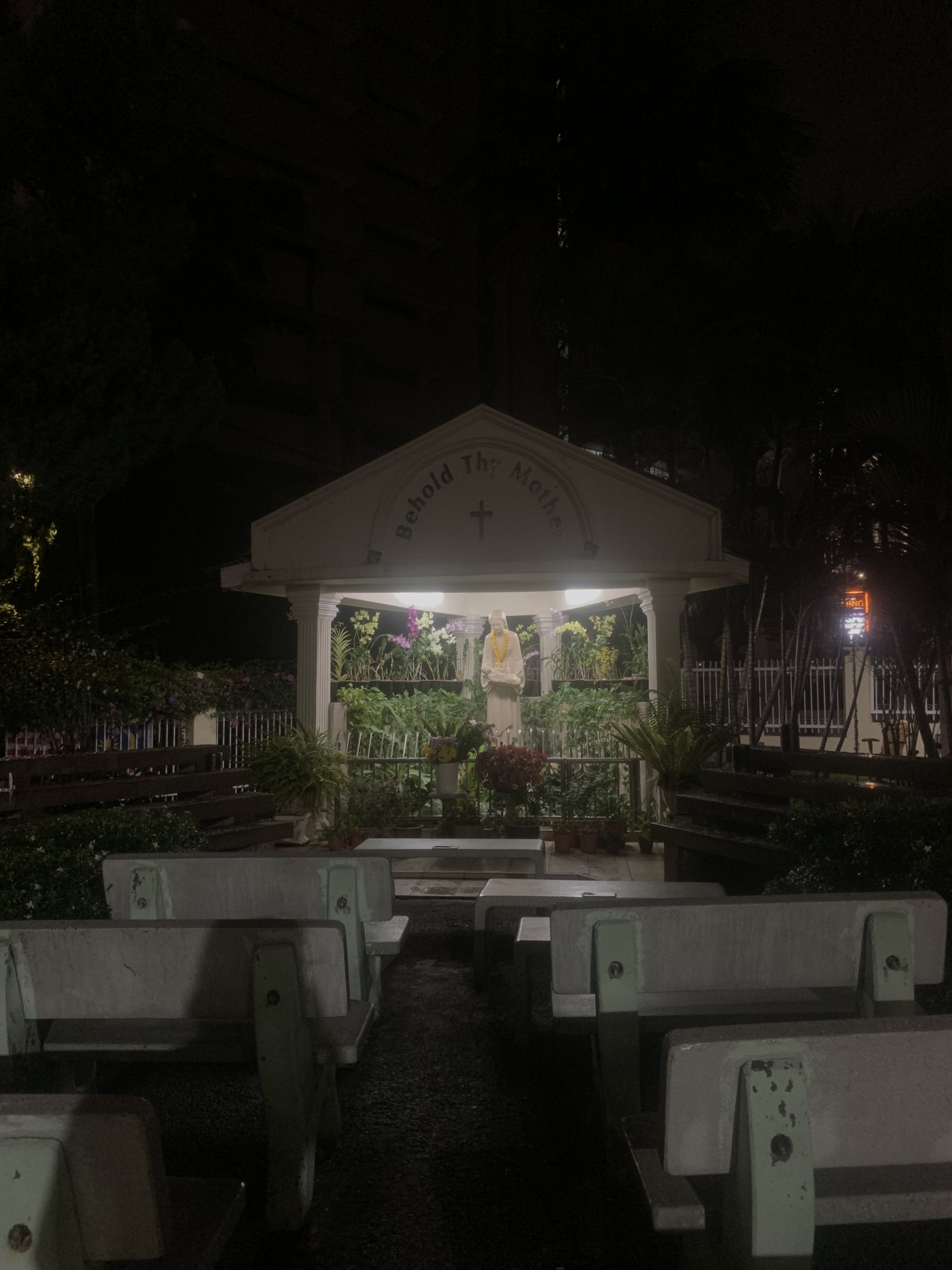
As I waited for my taxi outside the cathedral’s entrance I realised I was staring at a Marian shrine. I’d missed it in my previous haste. Her white statue was draped in a necklace of yellow marigolds, a traditional Hindu offering. She was enshrouded by sweet peas and bathed in bright fluorescent light. I stepped closer but did not sit, nursing faint consciousness of fear: the sudden intimacy of encounter.
The silence expanded and so did the noise: restless roads; surrounding skyscrapers buzzing with signals; the huge fan still spinning behind me in the cathedral, its doors strangely wide and always open. I caught the adhan dancing across the air, melodic voices becoming swelling echoes as they reached St John’s. Kuala Lumpur’s night is decidedly still so the mosque must’ve been nearby—another encounter. I was reminded of Eulogoius’ Memoriale sanctorum, which presents a defensive and apologetic record of the martyrdoms of four dozen ‘dhimmi’ Christians in ninth-century Córdoba from the perspective of a Mozarabic priest. At the time of reading I’d been struck by a handful of references Euologius made to Al-Andalus’s soundscape. Although charged with rhetorical irritation, given his intention to antagonise Umayyad rule and thereby reify his ‘martyrs’, they illuminated the way religious pluralism articulated itself and coalesced in a ‘kind of inter-faith static’ (Wolf, 2019), consistent ritual creating consistent encounter. I have been seeking a more precise language for my experience of Kuala Lumpur’s profound multiculturalism and, like Eulogius, I cannot help but think with my body. Here in Kuala Lumpur the sensory architecture of John Allen’s “city worlds” is palpable.
On Sunday, 31st August it was Hari Merdeka, the annual celebration of the Federation of Malaysia’s independence from British rule in 1957. In St John’s the hymns were in Malay for the first time since I arrived. We sang to ‘Allah’—God; the word is shared by Malaysian Muslims and Christians. At midnight there had been a big fireworks display around the Petronas Twin Towers, those silver totems of progress which were illuminated red, white, yellow and blue—the colours of the Malaysian flag.
The previous day Will and I had spent forty minutes talking to our taxi driver. I quickly forgot the traffic when he told us how his parents came to Kuala Lumpur: journeying on a boat, hidden in a drum. They were forced to leave their home in Singapore when the Japanese attacked in 1942. It was decided that his elder brother, only six months old, should stay behind with other family. Apparently when his mother learnt he was still alive, thirty or so years later, she wanted to go to him that very minute, hardly able to endure the time until morning when travel was possible with this new knowledge of a chasm that could be crossed. In the end her son stood at a distance in their family’s corner shop and did not forgive her. I was surprised by the taxi driver’s casual recollection of this story, which seemed more a source of fortitude, even pride, than tragedy.
About to get out, we commented on the coming national holiday and he abruptly offered reassurance that young Brits are not to blame for the past—anyway, he said, there would surely not be the same ethnic multiplicity which is so characteristic of Kuala Lumpur if it wasn’t for British rule, and they educated people too.
We soon reached Thean Hou Temple, a six-tiered fortress overlooking the city from the top of a hill. Chinese lanterns hang from ornate gold pagodas supported by red pillars. It is a beautiful building, and a popular venue for marriage registration; the garden, named ‘Love Fate Lane’, is complete with a wishing well and large heart-shaped sign reading ‘Love you forever’ in primary colours. Inside is a shrine filled by three statues of pale Chinese women, each perhaps fifteen feet tall: ‘The Goddess of the Waterfront’, ‘The Heavenly Mother’ and ‘Guanyin: The Goddess of Mercy’.
The literature describes Thean Hou Temple as ‘syncretic’, a place which bears witness to the assimilation of different beliefs and practices—in this case those of Mahayana Buddhism, Taoism and Confucianism—under the pressure of their encounters. Located at the junction between the Indian Ocean and China Seas and referred to as the ‘Golden Chersonese’ (golden peninsula) in Ptolemy’s second century Geographia, from as early as 200 BCE, the Malay Peninsula played a central role in global trade. These moving networks, including the spice routes and silk roads, deposited a rich cultural sediment in Malaysia. In the Islamic Art Museum Will admires traditional 14th-century Chinese calligraphy in the shape of the Zulfiqar (double-edged sword of the Caliph Ali).
There is little obvious distinction between the three holy statues in Thean Hou Temple’s shrine but a small sign on the wall provides some explanation, all more geographic than theological. ‘The Goddess of the Waterfront’ is a deity revered by the Hainanese who was sighted in the Port of Qing-Lan, in the town of Wen-Chang by a fisherman. She is believed to watch over the peaceful seas. ‘The Heavenly Mother’ is also a sea goddess. Originally named Lin Muo Niang, when she was born in 960 AD, the land was mysteriously covered by a purple streak, perfumed aroma filled every household, and a shocking golden halo appeared above the Lin house, attracting nearby villagers. During the Southern Song Dynasty, China’s trade in southern seas prospered so the Royal Court bestowed her the title Queen of Heaven, benevolent goddess of the Southern High Seas.
Finally, ‘Guanyin: The Goddess of Mercy’ is a bodhisattva (one who delays personal nirvana through compassion for still suffering beings), originally regarded as male in Indian Buddhism but female since the 12th century in East Asia. According to Buddhist scriptures, her father, King Miaozhuang Wang, enraged by her rejections of his marriage arrangements for her, ordered the monastery where she studied to be burned to the ground. Only his daughter did not burn. In Xiangshan Baojuan (The Precious Scroll of Fragrant Mountain) it is written that she ‘spits blood, which turns into red rain that quenches the fire.’ The king then instructed his guards to decapitate her but their steel blades broke in half. When a ferocious white tiger was let loose on her, it carried her on its back in search of safer ground.
Years later, on hearing that her father was seriously ill, the princess returned to his side and in an act of extreme, gruesome, sacrifice severed her own arms and gouged out her eyes to save his life, her body moved and transfigured by her mercy. Since then she has been revered as the Saviour of the Under-Privileged. Her original name, Miao-Shan, means ‘miraculously kind-hearted’. I like her especially and think about Mary once more: aware of distance, aware of proximity.
Words and image by Grace Reynolds.
You may also like

In Conversation With: Chris Hendricks, Club Penguin Composer
When I was waddling around Club Penguin’s virtual island as a small child, it was far from
ISIS magazine trailer Trinity 2013
A video by Hoagy Davis-Digges
IOTW: Calliope, Oxford’s eldest daughter
Art historian John Rolfe was walking down an eerily quiet Broad Street in 2020 when he looked up and