

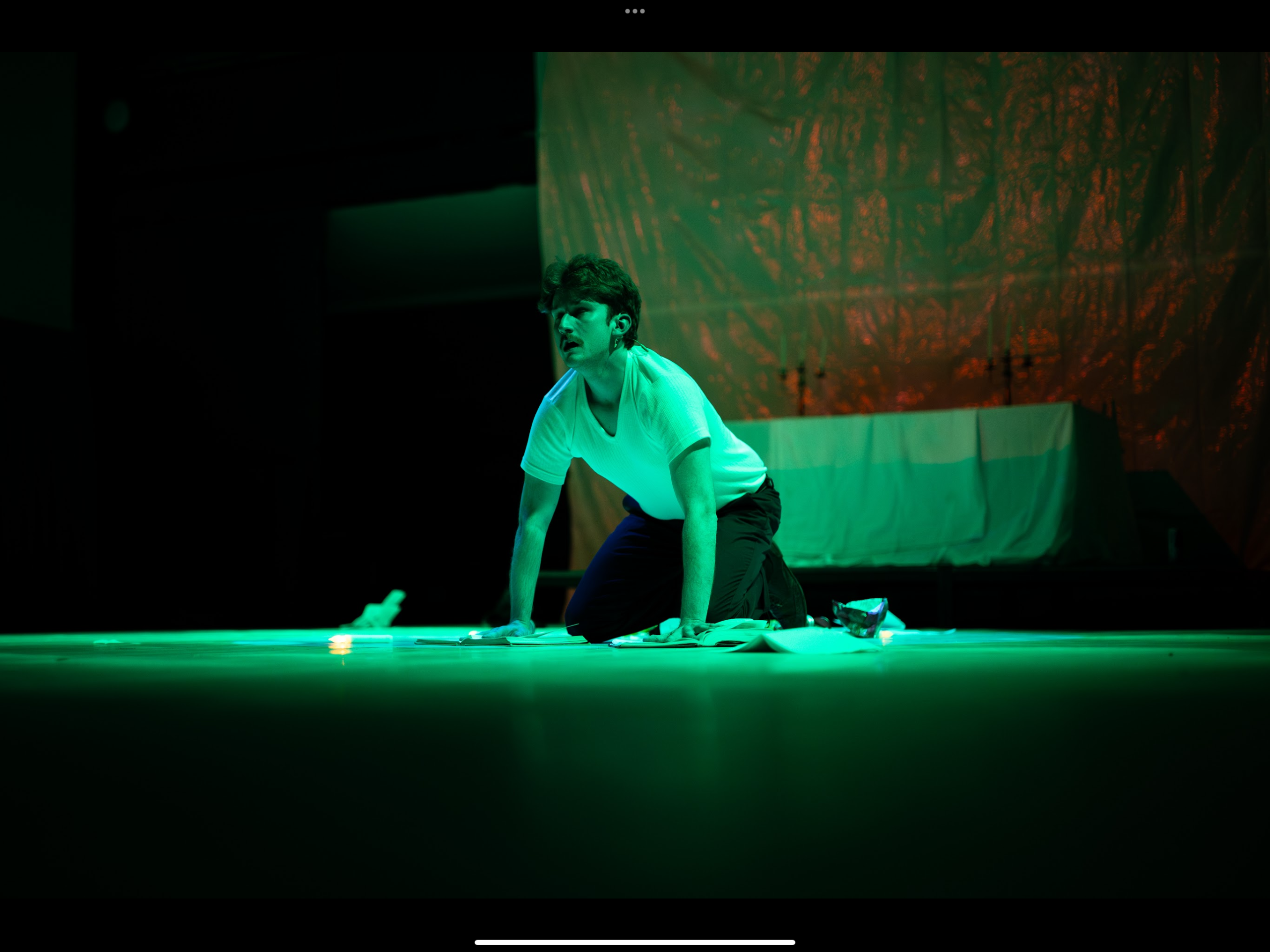
Dr Faustus got me thinking
What does an Oxford student director want to hear from a critic? How does that differ from an Elizabethan playwright?
As I sat in the Keble O’Riley on a rainy Wednesday night, I couldn’t help but notice how the Oxford dramatic scene is really a strange apparatus. There is a kind of Faustian bargain between director and critic, words for ticket, one ego for another, cropped sentences spread across a production Instagram.
As a result, there is always something missing in the reviews. In engaging in an actual culture-capital transaction, people forget that student theatre is primarily a social activity. Good Oxford theatre makes you feel. But this one gets you to think—about theatre itself. The possibility of it as a place of both experiment and fun. Dr Faustus shall not be overlooked.
Seabass Theatre’s latest production of Dr Faustus was fun to watch. Moreover, I sense the cast and crew were having fun too. On a technical aspect, it showcases the most interesting stagecrafts which student theatre has to offer as of late, not for being state-of-the-art but simply out of sheer innovativeness.
Unlike many self-styled ‘innovative’, techno-futuristic stagecraft I’ve seen of late, the design choices made here seemed less gimmicky, genuinely enhancing the story and making it immersive. The O’Riley might not be the Playhouse. There might not be a lightbulb descending from the ceiling as it did in Labyrinth Productions’ A View from the Bridge. But Seabass’ Dr Faustus showed how a simple projector, a bucket, and a handheld camera could really change the game. Lucian Ng did the sound, Ben Tilley the lighting, and director Sebastian Carrington is credited for most of the creative decisions.
Let me walk you through the experience. You enter the O’Riley, get your ticket checked, then descend to the -1 floor, perhaps already hinting at Faustus’ destiny—Hell. Through a darkened tunnel which resembles a high school haunted house, you arrive at the scene, the stage, upon which a mass—encompassing most of the cast—is taking place. There was no awkward silence, and immersion turned out to be a big part of the production. A theatre in the round but one side—the altar, the play utilises a broad sheet hanging from the balcony to project—at this moment—a cathedral background. The potential of the projector was later shown to be endless.
Briefly turn to the acting. Paul Thomlinson’s Faustus was excellent. Cameron Spruce’s Mephistopheles was enigmatic. One of the first clever moments of the play came as a homoerotic one between the two, the encounter, in which the summoner and the summoned seemed to mirror one another’s movements, reminiscent of Frankenstein and his Creature. The interactions between the two were always exquisite. As I noted, it was some real good ‘old man yaoi’. For a moment you forget these are actors around your age.
There was something wonderfully entertaining about the whole cast. Elizabeth Henderson-Millier’s Belzebub was wonderfully devilish, treading in platform boots like one of Rick Owen’s angels. The moment she and Aniya Boranbay crawled out onto the stage was genuinely unexpected, and magical. Ali Khan’s Lucifer was like an evil wedding host (it was the microphone). Maximilian Stecher was superb as the Bad Angel (who wears sunglasses) and Emperor (who does not). I genuinely thought there were two actors. That’s the spark of this play, with a trick as simple as sunglasses. Amber Messon had really emotive performances for all her characters. Graham Reid’s Pope was fantastic, that robe had amazing movements and really helped the characterisation. The costume department did a really good job at telling the story effectively. Shout out designer Ep Siegel, assistants Yolanda Zhou, Cayden Ong, Tina Zheng, and Isobel Powner.
I should mention at this point that the entire middle part of the play has been written for this production by director Sebastian Carrington. It was effective, particularly the Hitlerite speech made by Faustus to rally voters for the Emperor. In a moment in theatre which loves to rehash the image of the Great Dictator, in an already passé protest against the present, Dr Faustus did it in a refreshing way. There was a brilliant moment when Faustus (Paul Thomlinson)’s militant shadow was cast on the projection of Leni Riefenstahl’s Triumph of the Will. It was subtle, without the flashing of swastikas.
The use of a handheld camera which captures close-up of Thomlinson’s performances, during moments of high tension, and projects onto the sheet, brings home Seabass Theatre’s dedication to ‘putting the interior monologue front and centre’. It felt like one of the genuinely experimental practices in Oxford theatre as of late, a non-superfluous way of incorporating cinema into theatre, reinforcing a sense of the present.
Another brilliant moment was Faustus’ vision of the Seven Deadly Sins, which was staged like Berghain, with white texts flashing on the wall describing each sin. My favourite was:
lechery:
loves an inch of raw
mutton better than an
ell of fried stockfish /
ass > tits
Dr Faustus is a performance you shouldn’t miss, and one you should probably pre for, like an Elizabethan peasant going to the Globe.
Words by Zac Yang. Image by Freddie Houlahan.
You may also like

Icon of the Week: Lizzie Jones, Captain of Oxford University Korfball Club
By the time I arrived at Freshers’ Fair they were handing out the last of the tote bags. After rus

Talking Stunts with Kai Martin
So Kai, what have you been working on recently? I’ve been working on the Amazon Prime TV sho
Guillotine: Give all children unrestricted internet access
In case you were wondering where half the world’s capital ran off to, two hot new AI innovations d