

A Norwegian reviews Hedda Gabler
As a Norwegian, going to see an English production of an Ibsen play felt a bit like going to see Shakespeare performed in French. On my way to the Pilch to see Tiptoe Productions’ staging of Hedda Gabler (co-directed by Ollie Gillam and Gilon Fox), I could feel a sense of protective patriotism bubbling up within me. I was at once thrilled to see Ibsen— who is, of course, in my completely unbiased opinion, one of the greatest playwrights of all time— getting the recognition he deserves outside of our home country. At the same time, I couldn’t help but brace myself for an evening of mispronunciation and flat jokes.
I’d never seen Ibsen performed in English before, but had had some experience of his brilliance being lost in translation. His favourite play of mine, Gjengangere (YEN-gahng-eh-reh), is known in English as ‘Ghosts’, which is a bit like translating The Importance of Being Earnest as ‘Be Pure of Heart’. That play, like most Ibsen plays, also involves a woman who feels trapped by society and some very dramatic shooting towards the end. The point of it is that the characters fail to learn from their past mistakes, and complacently use their ancestral tragedies as unconvincing excuses for their inability to do anything useful with themselves. There are no ghosts in the play— ‘gjengangere’ is an untranslatable word which isn’t really used in contemporary language. In Norwegian, the word is a double entendre: it refers both to something of a cross between a ghost and a zombie from Norse mythology, but, more importantly, evokes the idea of un-breakable generational cycles. There’s something of the uncanny, the tragic, and the inescapable in the word. ‘Ghosts’ is a terrible translation. Upon explaining this to my English student friend who accompanied me to the play, I was shocked to discover that this was new information to him. Clearly, there is something lacking in the English scholarship of Ibsen, I thought. Then the house lights went down, and the play began.
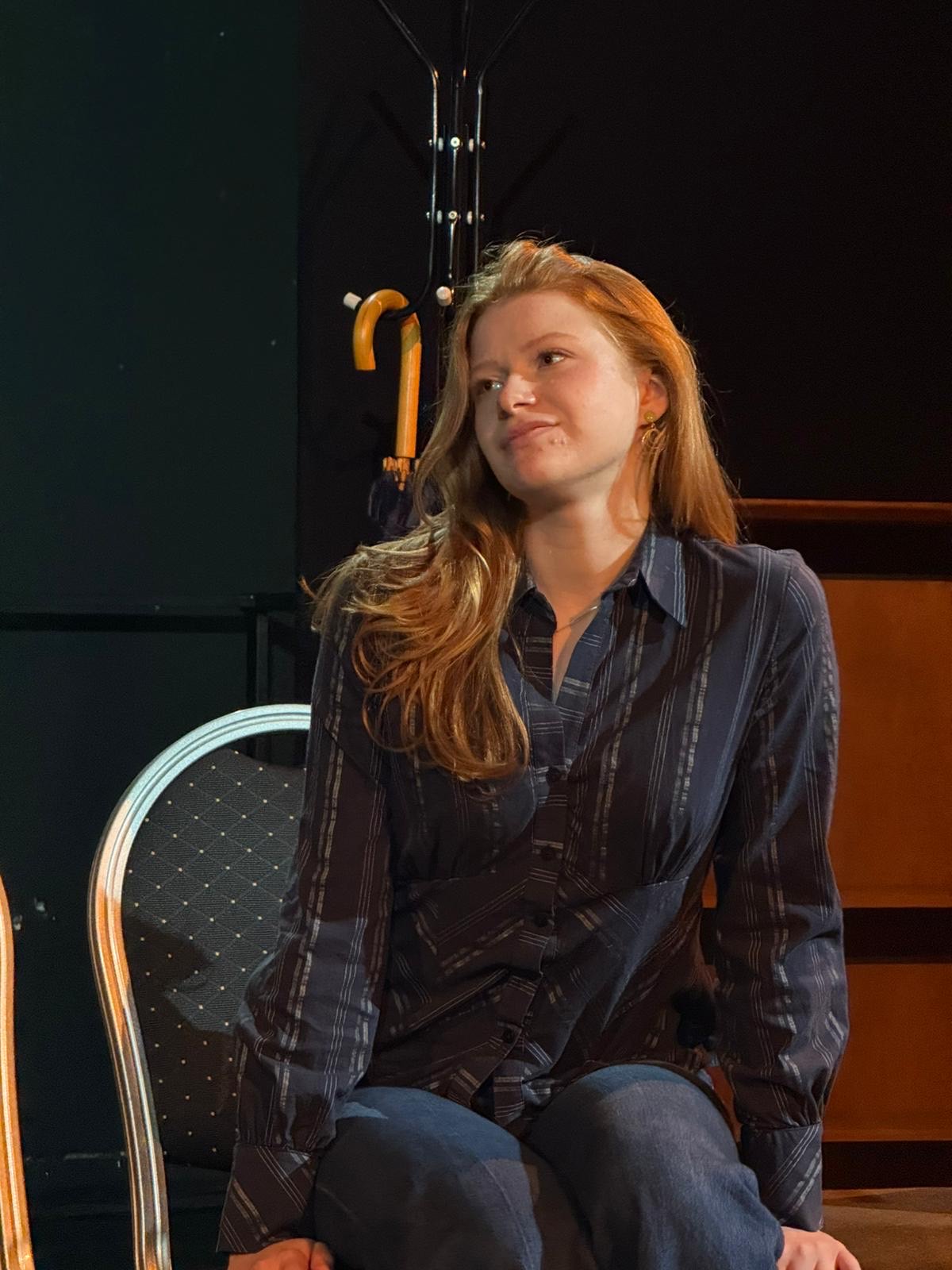
For those of you who haven’t had Ibsen shoved down your throats since birth, Hedda Gabler follows the play’s eponymous female lead (Georgina Cooper), an unlikeable, beautiful and complex aristocratic woman who has recently returned from an expensive and boring honeymoon with her academic loser of a husband, George Tesman (Samuel Gosmore) (properly called Jørgen Tesman— try pronouncing that, I dare you!). It is set entirely in the Tesman’s sitting room, symbolising how social norms entrap Hedda by virtue of her sex (yes, Scandinavia has always been woke). Throughout the play, Hedda schemes, manipulates, and deceives the rest of the cast to abate the intense boredom and frustration her marriage has brought her. By the end, her old lover, Ejlert Løvborg (Rohan Joshi) has been killed, her husband’s nose is stuck into a new academic pursuit, and she is no longer able to hide her pregnancy. All of this is so distressing for Hedda that she shoots herself.
This production was, on the whole, well done. The cast was generally very good, rising competently to the challenge Ibsen presents— heavy subject material, not much action, and lots of dialogue. Gosmore’s George was an excellently executed mix of harmlessly pathetic, annoying, and generally bumbling idiocy. It served as a great foil to Cooper’s Hedda, and provoked fits of laughter several times throughout the piece.
Hedda Gabler is a notoriously difficult character to play. It’s hard to get the audience to root for a total bitch. Very few have successfully pulled it off— when Hedda Gabler premiered in 1891, in Munich, critics reviled the play as a satanic offense to all women. Even today, her unlikeability is strikingly unusual— it is still rare to see truly complex, difficult women on the stage and screen. Cooper convincingly portrays Hedda’s self-serving deceit and manipulation. Her speech is inflected with a permanently judging, bitchy tone, which works well for the many backhanded quips her character delivers. At times, however, this makes the part feel over-acted— Cooper never fully lets Hedda’s guard down, never allows the audience to connect with the raw anger and frustration at the heart of the character. The scene where Hedda burns Ejlert’s manuscript, for example, falls just short. Overall, however, I have to admire Cooper’s ability to carry a complex and heavy piece like this as well as she does.
The supporting cast are similarly solid. Judge Brack (Ezana Betru) is convincingly creepy and conniving. I’d have liked to see the play’s other female characters, Juliana Tesman (Laura Boyd) and Thea Elvsted (Thalia Kermisch) fleshed out a bit more— at times, they felt like one-dimensional foils to Hedda. That is, of course, partially their role: Juliana’s self-sacrifice and social conservatism are meant to highlight Hedda’s callousness and emphasise her patriarchal entrapment. Thea, played by Kermisch as permanently flustered and weak-willed, highlights Hedda’s cold confidence.
Juliana and Thea, however, are also meant to add to Ibsen’s social commentary: they, too, are trapped by society in their respective roles, by virtue of their sex, class, and circumstances. They each break radically from the mould in different ways: Juliana remains unmarried, caring for her invalid sister, and chooses to take in a stranger when her sister dies— a radical act of autonomy through charity. In Boyd’s Juliana, however, this radicalism fails to come through at all. Thea, trapped and unhappy in her marriage, packs up and leaves her husband to be with the man she loves. Really, the character is the opposite of passive and weak. In fact, she does what Hedda dares not do: provoke scandal for the sake of her happiness. In her character, Ibsen shows the audience that Hedda’s suicide was not, as Hedda perceives it to be, her only option. Her final act is as much driven by her own psychological complexities, and obsession with avoiding scandal, as by stifling social norms.
Ibsen did what was then something totally radical with his female characters: he made them all different. Each of the play’s three women, when faced with the same stringent societal entrapment, makes a different (albeit radical) choice. This affirms them as individual, complex persons, adding vital nuance to Ibsen’s social commentary. That nuance did not, unfortunately, come through in Boyd and Kermisch’s characters.
Overall, however, the play was a well-acted, well produced experience that defied my expectations. I left generally impressed and unoffended, glad that the work of my national hero had been handled safely across the North Sea. Perhaps we Norwegians have more in common with the English than I’d previously thought: Ibsen’s wry humour seems to have translated well with a British audience, who laughed at all the right moments. Move over, William and Oscar: it’s Henrik’s world, and we’re all living in it. I can only hope that Tiptoe Productions will set a trend in Oxford student drama, so that more of my fellow students can experience the brilliance of the world’s greatest playwright (once again, not a hint of bias in sight).
Hedda Gabler is on at the Michael Pilch Studio Theatre until Saturday the 29th of November. Tickets can be purchased here.
Words by Kalina Hagen. Image courtesy of Tiptoe Productions.
You may also like
The Dangerous Digitalisation of Pokémon Go
For internet hermits sitting on benches in parks and squares over the past month people-watching mus

In Defence of Romantic Comedies
When I watched Bridget Jones’s Diary for the first time, I definitely wasn’t its target audi

My Father the Clown
Everyone has a crisis of some sort at sixteen, right? I’m relieved to say I didn’t end up acting