
Greetings from Cotonou, Benin
Editor’s Note: the author has used a number of French words throughout the text. These are denoted by an asterisk, which corresponds to an explanatory footnote at the bottom of the page.
Like all language students, I began my second year at Oxford by attending an informational session about my upcoming year abroad. The opening statement paid tribute to a student who had just lost his life in French outre-mer* on a University approved program. This sentiment of remembrance, and the reminder of a loss which struck everyone, was echoed in the repeated messages of caution. This meant that inevitably, when presented with the opportunity to live in Benin for two months, my decision wasn’t made lightly.
Several months and many interviews later, despite the uncertainty plaguing me, my flights were booked and my bags were packed. I was finally committed to my departure. My mother’s worries, which I had previously ignored— where will you be? What about kidnappings? Oh god, it’s the voodoo capital of West Africa— ran through my head the whole way there. When I arrived in my empty flat in Cotonou, far away from her and everyone I knew, I found her maternal anxieties had physically manifested in the form of ‘emergency’ cereal bars and boxes of probiotics.
Immediately, my phone was flooded with people asking: what is it like? Yet everyone who had expressed caution in the months leading up to my departure, and who continues to speak sceptically about my choice of destination, is white. In this, there is always an undercurrent of prejudice. The unconsciously colonialist and racist tendencies of the British shifted into view once again, fuelling assumptions about a country that almost no one had even heard of, let alone visited. Maybe it was this that finalised my decision to go, to try to prove to them that their problematic thinking was wrong.
From the minute I stepped into my new workplace, a Beninese library funded by a French foundation, my status as an Oxford student rendered me an object of fascination. The company photographer is a near constant presence, as he vies to capture a photo of this new shiny thing, of me. Every time his camera flashes, I stand there with what feels like an undeserving smile. If not my otherness, then what is it that makes me worthy of this attention? The unshakable elusivity of Oxford as an institution often evokes awe, yes, but there is almost always an element of disdain as well. Disdain for its exclusivity, for its opulence, for its undeniably evident privilege— a sentiment I have often shared myself. Oxford’s grandeur constantly announces itself, inevitably establishing the limits of every interaction.
Occasionally, when walking down the street, I hear metissée*! cried out in my wake, and even chinoise*!, usually by children but once or twice by adults. This confusion over my identity is understandable, but ultimately feels bizarre. Being incorrectly identified so openly, and so regularly, forces me to confront my skin colour, which, if otherwise left unexplained, becomes the object of every shameless gaze. The age old tale of the mixed-race child is told once again, as I reclaim my both Indian-ness and white-ness with people who claim neither. Unexpectedly, I find myself unifying this fractured identity which has always followed me around at home. When faced with people who don’t have a clue what you are or why you’re there, you very quickly find a way of putting all the pieces of yourself into one neat package. Something easily manageable, something relatively comprehensible.
It’s a valid question, though— why am I here? Am I just perpetuating the issue of Western people coming to the lands their ancestors exploited, and reestablishing problematic hierarchies? Am I waving the flag of institutionalised privilege under the guise of academic excellence, in the faces of those who simply don’t care? Why does the Oxford name give me authority over people much more senior than I am, in fields I am objectively less experienced in? If this ‘otherness’ can provoke such an uncomfortable struggle within myself about what I might represent, then surely it raises these questions in the minds of the people here too.
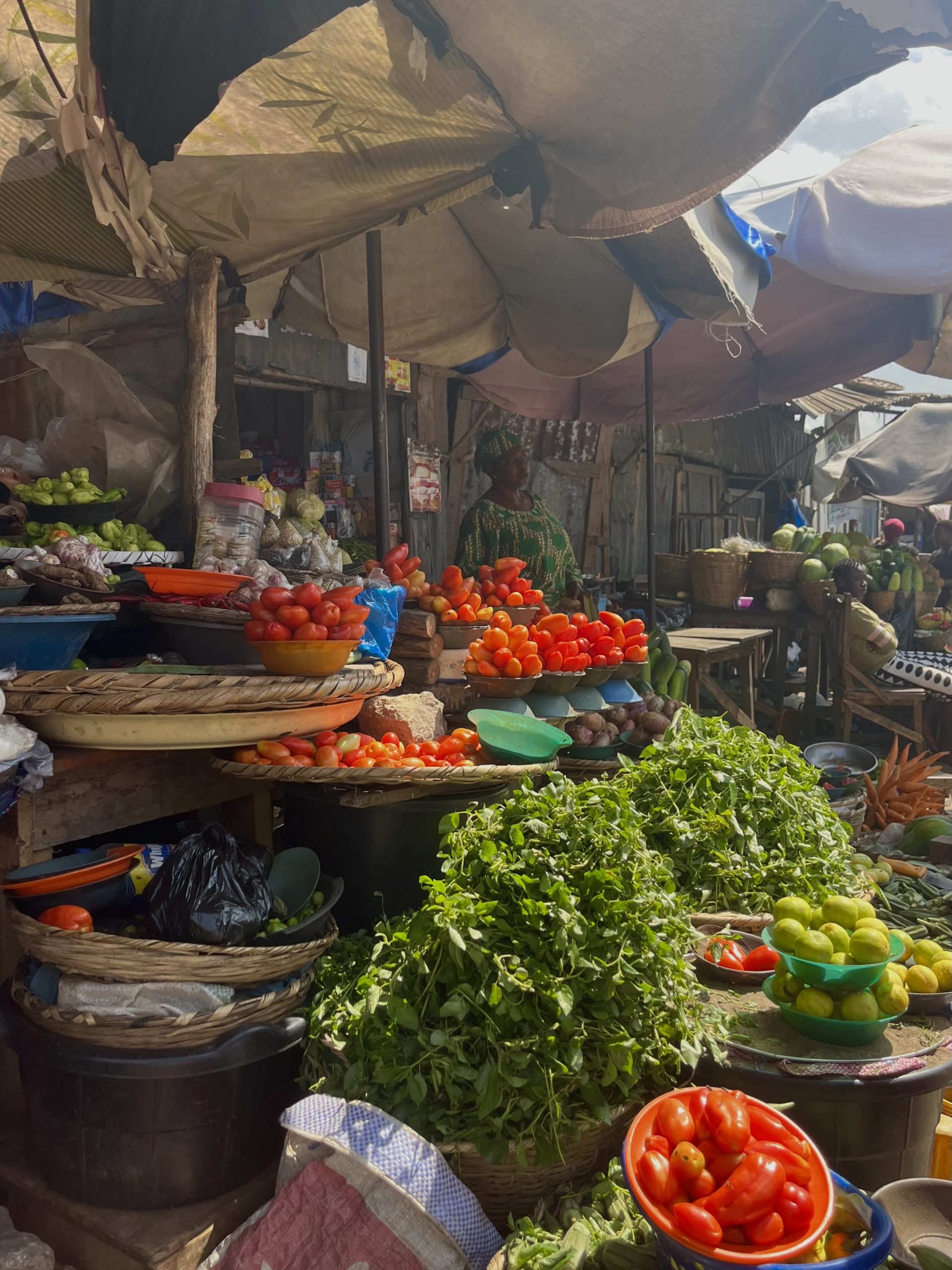
And yet, despite these barriers and complexities, the country opens its arms and shows me its multiplicity. Communities are woven together by families and neighbours to form a vibrant social fabric. I admire the women, with babies wrapped in the pagne* on their backs, who carry baskets on their heads and walk with a grace that eludes me. Here, it’s impossible not to notice the chaos, the constant movement, the noise.
The ground underfoot, rich with the rusted metals of Earth, holds a history that feels more significant than those I’ve encountered before. It was once walked upon by sovereigns, by Amazons, by enslaved people, by their captors. In tracing their paths, their presence remains, their memory holds strong. By immersing myself in the history of another country, of another continent, I can feel the pull towards the lands where my own familial roots lie growing stronger. Hopefully this experience will finally prompt me to go.
Now, my family and friends no longer ask me what it’s like. I’ve sent them more than enough photos and messages sharing my experience of being here, dissipating their anxieties and turning them into jealousy. But maybe upon my return, I’ll bring back these questions I’ve asked myself for others, packing them into the space in my suitcase which has now been freed up. Benin has been a mirror into my own being. When I eventually leave, I hope this country’s effect on me remains. When I get home, my feet may no longer be dusted red with soil— but I really do hope that when I wash it off for the last time, the memory of walking here won’t follow it down the drain.
*Outre-mere: the 5 French regions or ‘departments’, located outside of Europe, that were acquired as a result of colonial activities. They are considered fully-fledged French territories, and have the same status and powers that mainland departments do.
*Metissée: a term used to denote people of mixed-race origin in francophone Africa. At some points in history, and in some places today, the term has been considered offensive. Others, however, consider it a badge of pride and use it freely.
*Chinoise: Chinese.
*Pagne: a colourful cloth garment worn widely by people in West Africa.
Words by Ruby-Angel Clement. Images courtesy of Ruby-Angel Clement.
You may also like
Weekly Round Up: Coronation Street, The Bezos Divorce and the Sultan of Brunei Petition
Petition to revoke Sultan of Brunei’s honorary Oxford degree A petition calling on the Universit